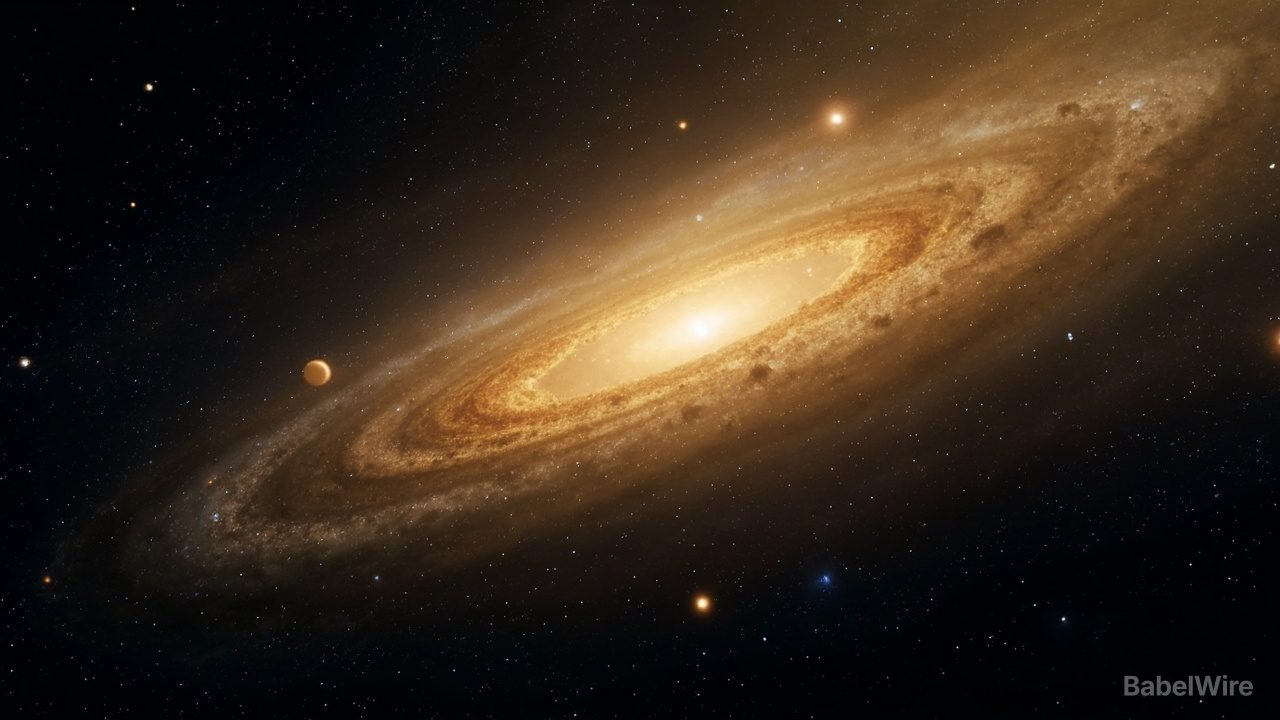
Astronomers have measured the full extent of IC 1101, the dominant galaxy at the center of the Abell 2029 galaxy cluster, confirming it as the largest known galaxy in the universe.
A team led by Carlos Marrero-de la Rosa of the Astrophysical Institute of the Canary Islands used the deepest images ever taken of the galaxy, captured with the Isaac Newton Telescope's Wide Field Camera, to resolve its diffuse outer boundary in unprecedented detail. Because the galaxy's faint outskirts blend into the gas and stars that fill the surrounding cluster, earlier studies could not determine where IC 1101 actually ends.
To overcome scattered light from more than 250 foreground stars, the researchers built a detailed model of how the telescope spreads light and subtracted it from the images. The result: IC 1101 spans roughly 520 kiloparsecs — about 1.7 million light-years, or 17 times the width of the Milky Way. Its stars alone contain an estimated 3.4 trillion solar masses, compared with 1 to 1.5 trillion solar masses for the entire Milky Way including dark matter.
IC 1101 belongs to a class of "brightest cluster galaxies" that grow over billions of years by absorbing smaller neighbors. The new observations also reveal eight structures beyond its main edge — two aligned with previously seen X-ray disturbances — suggesting the galaxy collided with another galaxy group two to three billion years ago and is still growing today.
The paper, "How Large Can Galaxies Be? Ultra-Deep Imaging of IC 1101, the Most Extended Known Galaxy," is available on arXiv ahead of publication in Astronomy and Astrophysics.