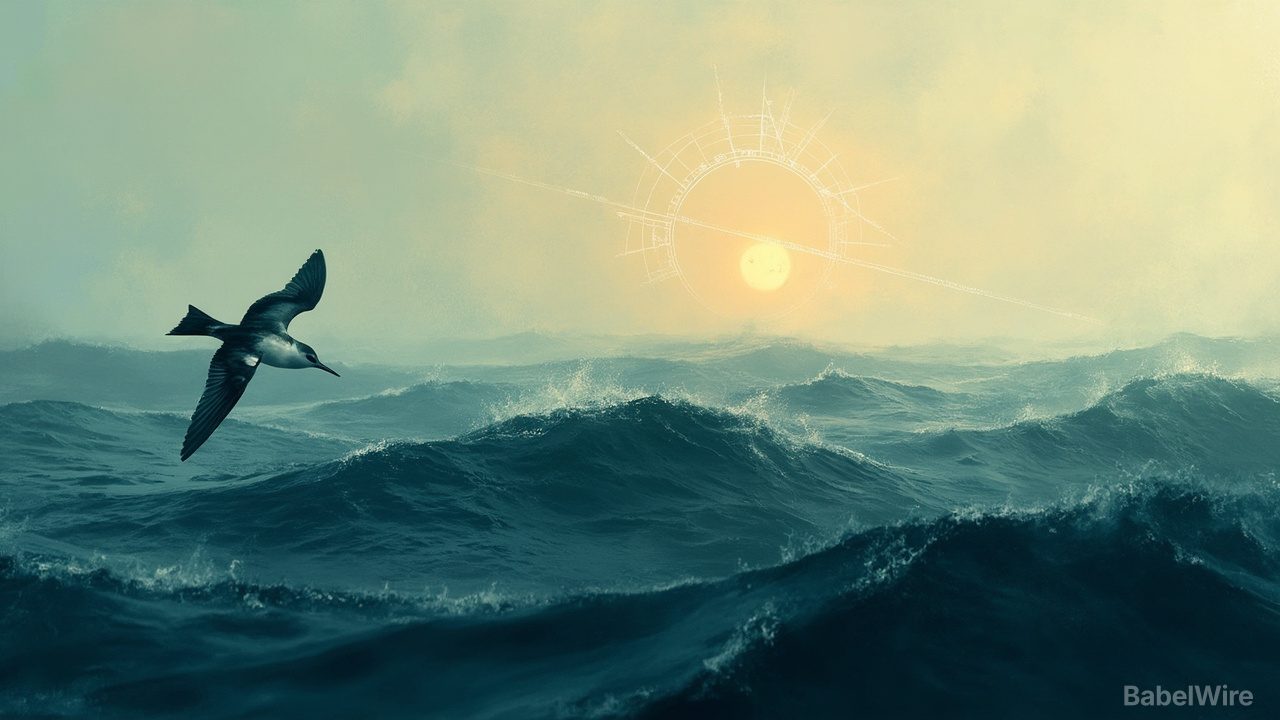
Every dusk and dawn, a Manx shearwater resets its internal clock. That is the whole problem.
The pigeon-sized seabird nests in burrows on islands around the North Atlantic — roughly half the world population breeds in Wales — and flies as far as 1,000 kilometres out into the Atlantic to feed. To get home it is thought to combine a map sense, possibly built on smell, with a compass read from the Sun. But a Sun compass is only as good as the clock behind it: at sunrise a bird heading south must fly 90 degrees clockwise of the Sun, at noon straight at it, at sunset 90 degrees anticlockwise. Get the time wrong by 20 minutes and you steer wrong all day.
Shearwaters recalibrate at dawn and dusk, which means that for every degree of longitude crossed between sunrise and sunset, the clock drifts four minutes out of step with local time. A bird that has flown a long way east thinks it is earlier than it is; one that has flown west thinks it is later. Either way the Sun is not where the bird's clock says it should be, and the bird turns.
Nobody had shown this in a wild animal moving under its own steam, because the effect is small and needs an unreasonable amount of data. Patrick Lewin, a behavioural and sensory ecologist at Oxford, had the data. Tim Guilford and Chris Perrins began fitting shearwaters with GPS tags in 2004, when the devices first became light enough. Two decades later the team held 3,688 foraging trips by 1,045 birds.
The analysis isolates homing flights, which are easy to spot: foraging birds make short, wiggly hops between dives, while a bird heading home flies fast and straight for hours. For each homing flight the researchers located the point where the bird last saw sunrise, then used every GPS fix to calculate how far east or west it had travelled since, and how far that should bend its compass. Because each bird was heading for its own burrow, its actual deviation was measurable.
Across 335 homing flights made out of sight of land, the birds veered the way the arithmetic predicted. The clock shifts were modest — most 10 to 15 minutes, about an hour at the extreme — and the resulting errors reached roughly 15 degrees. For a shearwater covering 1,000 kilometres east in a day, the average error comes to about seven degrees, which costs some five extra kilometres if the bird keeps checking its position against its map sense.
Crosswinds, the Coriolis effect and a magnetic compass were all modelled as alternative explanations, and none fitted as well. The birds also drifted slightly toward or away from the coast on coastal flights, in the direction their expected error predicted — an echo of Oxford work from two decades ago in which clock-shifted pigeons did the same along a familiar road. That has led to a hypothesis that birds run two navigation systems in parallel, compass and landmarks, without ever fully handing over to either.
What the study cannot say is whether shearwaters feel jet-lagged the way humans do. Lewin's next questions are whether the shifts change when the birds forage, how much food they bring back, and whether they breed as successfully. He suspects the phenomenon is common: any animal with a circadian clock that travels far enough east or west in a single day will accumulate it, which mostly means fliers and animals near the poles, where lines of longitude crowd together.
There is a practical thread too. Long-term jet lag damages human health, and birds that live with it constantly may have evolved ways of coping. Lewin also notes that anyone building bio-inspired navigation — a drone with a Sun compass and a cheap clock — has now been handed a quantified error budget.
The study is published in Science (DOI: 10.1126/science.adz2542).