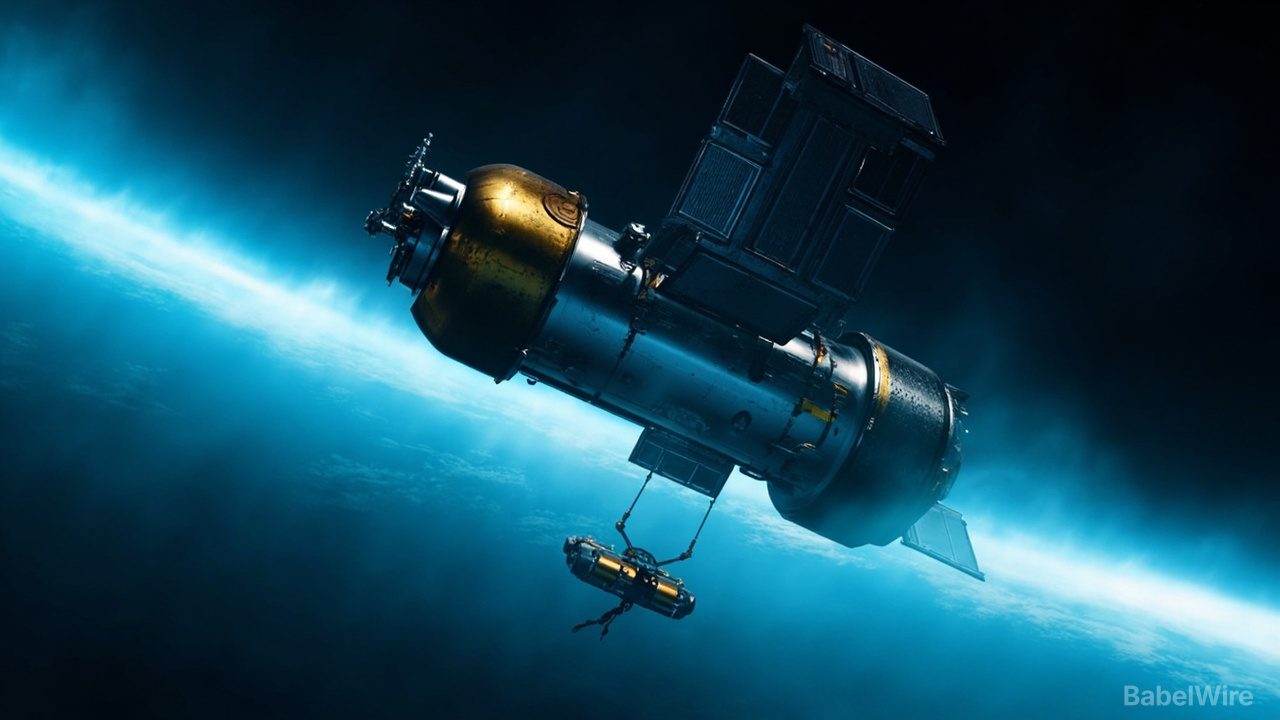
Hubble has no engine, and it has been falling for 24 years.
NASA last raised the telescope's orbit in 2002, during the Space Shuttle Columbia's servicing mission. The final shuttle visit in 2009 did not reboost it, the fleet retired two years later, and ever since the observatory has been gliding down through the thin upper atmosphere. It has fallen from 583 km (362 miles) to roughly 470 km (292 miles). Orbital dynamicists expect reentry in 2033 or 2034, earlier if solar activity swells the atmosphere.
On Thursday NASA published a Request for Information asking commercial companies what they could do about it. Responses are due November 30. The agency wants to hear about capturing Hubble and boosting it to at least 600 km (373 miles), about servicing it, or about guiding it to a controlled reentry. The mission, per the RFI, "must not harm the HST" and is expected to occur by 2032. A contractor would supply the launch vehicle, the servicing spacecraft, mission operations and "crew if applicable."
A reboost to 600 km would likely keep Hubble alive for at least 25 more years. No money has been appropriated to buy any of this.
The reason to think it is possible is a failure. NASA paid Katalyst Space Technologies $30 million last year and gave the startup nine months to build a satellite that could catch the Swift gamma-ray observatory and lift it. Katalyst did build it and launched on deadline, closing to within about 10 km (6 miles) of Swift. Ground teams stopped the approach after problems with the spacecraft's power and reaction control systems. NASA has since ended the Swift mission; the telescope is expected to reenter.
That attempt demonstrated something useful even in defeat: a servicing mission does not have to cost billions. It also demonstrated the limit — nine months and $30 million is not what Hubble requires.
There is a symmetry here. In 2022 Jared Isaacman, then a private astronaut, proposed a Dragon servicing mission to Hubble, offering to fund most of it, with new gyroscopes to fix the telescope's degraded pointing. NASA solicited other ideas, got eight responses including an Astroscale–Momentus robotic reboost concept, said in 2024 it would pursue a reboost — and shelved the plans as "notional concepts." Isaacman is now NASA's administrator. A crewed mission, however, is unlikely this time: SpaceX aims to retire Crew Dragon by 2030, and Isaacman has said he expects the new RFI to draw robotics companies.
The industry it would draw has changed. Northrop Grumman flew a sophisticated robotic servicing satellite this year with DARPA; Astroscale and Starfish Space hold servicing and refuelling contracts with the Space Force and NASA.
Why not just let it go? Because nothing replaces it. Hubble sees in visible and ultraviolet light; Webb and Roman are infrared machines. The next observatory that would actually improve on Hubble's ultraviolet vision is the Habitable Worlds Observatory, in the 2040s. Between reentry and that launch sits a gap in a kind of astronomy that produced most of the images the public knows by name.
"If there are innovative and cost-effective ways to extend the life of an asset already on orbit, we owe it to the American taxpayer and the scientific community to explore them," Isaacman said.
What to watch: who answers by November 30 with a credible architecture rather than a concept render, and whether the 2032 date survives contact with a budget cycle that currently contains nothing for it.