Quanta Magazine asked the question in its headline this week: is there more to cold fusion than failure and fraud? The answer is yes, and it has been sitting in the same drawer for seventy years.
The "cold fusion" that collapsed in 1989 — Martin Fleischmann and Stanley Pons, palladium electrodes, a press conference before a paper — is not what this is about. Muon-catalysed fusion (μCF) is a different animal, predicted by Andrei Sakharov in 1948 and first seen in Luis Alvarez's bubble-chamber experiments at Berkeley in the late 1950s. It works.
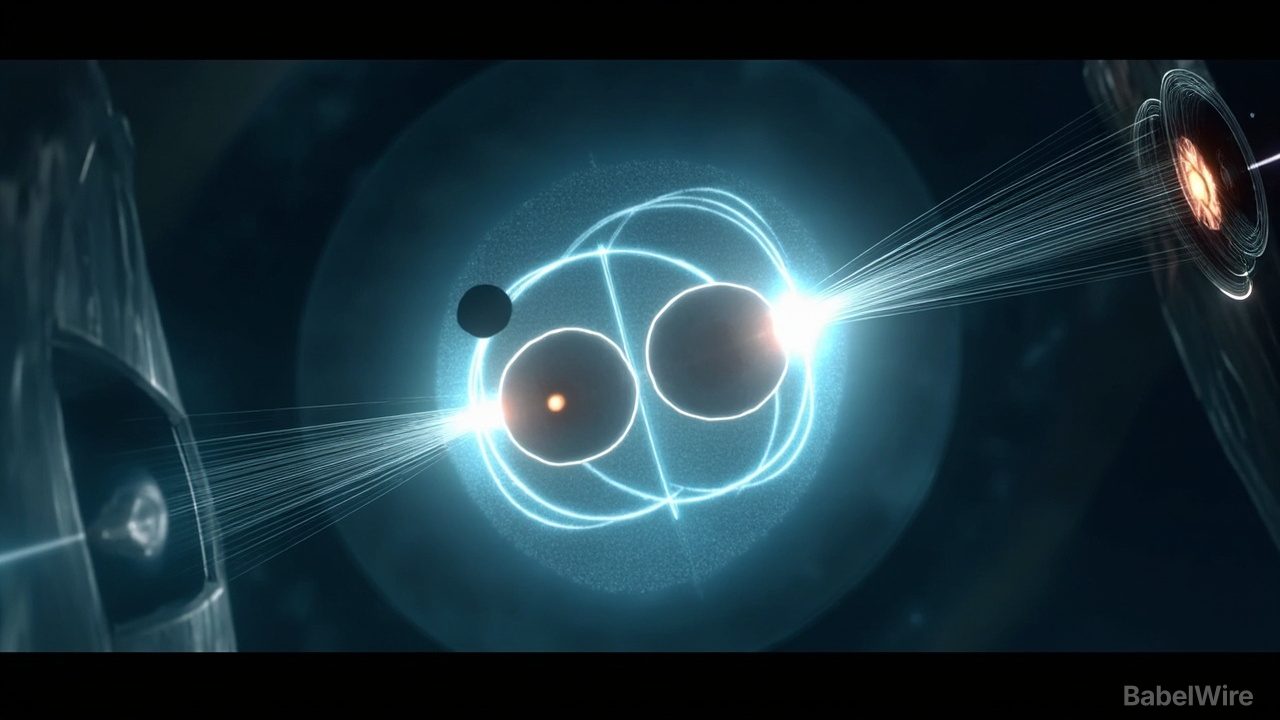
The mechanism is almost offensively simple. A muon is a heavy electron: same charge, about 207 times the mass. Swap the electron in a hydrogen molecule for a muon and the orbit collapses — the nuclei sit roughly 200 times closer than they do in ordinary hydrogen. At that distance, deuterium and tritium nuclei tunnel into each other and fuse at room temperature, with no plasma, no lasers, no hundred-million-degree vacuum vessel.
The muon is a catalyst, not fuel: after the fusion it is usually thrown free and can start again. Two things stop it. The muon decays in about 2.2 microseconds, and every so often it sticks to the helium nucleus the reaction produces — "alpha sticking", roughly 0.7% of cycles — taking it out of circulation permanently. The energy accounting is brutal: a D–T fusion releases 17.6 MeV, while making a muon costs on the order of 5 GeV, so you need something like 300 fusions per muon to break even. The best experiments have reached about half that.
Which makes the formation rate everything. And the formation rate runs through a reaction step nobody had watched: the muonic molecule passing through a resonance state. Theories predicted these states matter; experiment could not separate their X-ray signature from the much brighter glow of ordinary muonic atoms, and the gap between theory and measurement sat there for decades.
This April, a team led by Yuichi Toyama and Shinji Okada at Chubu University, with Takuma Yamashita and Yasushi Kino at Tohoku and Tadayuki Takahashi at Kavli IPMU, published the fix in Science Advances. They used a superconducting transition-edge sensor microcalorimeter — a NIST-developed detector with enough resolution to split overlapping X-ray lines — to separate photons coming from muonic molecules from those coming from muonic atoms. The resonance states of the deuterium-deuterium muonic molecule showed up at the level of individual vibrational quantum states, with population ratios measured rather than assumed, and the spectrum matched the high-precision calculation.
That is not a power plant. It is the measurement a power plant would have to be designed on: the reaction-rate models are now calibrated against data instead of fitted to it. The work sits under Japan's Moonshot Goal 10, which funds μCF for practical use.
The Quanta essay's framing is the right one. The field will not solve the energy crisis on any schedule worth planning around, and it is still capped by the price of muons and the sticking problem. But a research programme that was buried by association with a different, failed claim has been quietly producing quantum-state-resolved measurements of a nuclear reaction that runs in a bottle. That is a strange and useful thing to have.
Numbers worth keeping straight: 207 times the electron mass; about 1/200 the internuclear distance; 2.2 microseconds; roughly 0.7% sticking; 17.6 MeV out; about 5 GeV in. The gap between the last two is the whole field.
Sources
- quantamagazine.orgQuanta Magazine — Is There More to Cold Fusion Than Failure and Fraud?
- science.orgScience Advances — Direct observation of muonic molecules in resonance states
- asiaresearchnews.comAsia Research News — Researchers directly observe muonic molecules critical to muon catalyzed fusion
- arxiv.orgarXiv — Muon-Catalyzed Nuclear Fusion: Physical Mechanism and Prospects