For ninety years, materials without an external field came in two magnetic flavours. Ferromagnets — fridge magnets — have spins pointing the same way, which produces an observable field and makes them easy to read but easy to disturb. Antiferromagnets alternate up-down-up-down, producing no net field: stable, but nearly invisible, so hard to read and hard to drive currents through.
In 2022 a group of theorists proposed a third class that does both: altermagnets. Same alternating spins as an antiferromagnet, but with the crystal lattice around the "up" spins rotated relative to the lattice around the "down" spins. That symmetry break, the argument went, should give the material a handedness — chirality — and with it spin-polarised currents without net magnetisation.
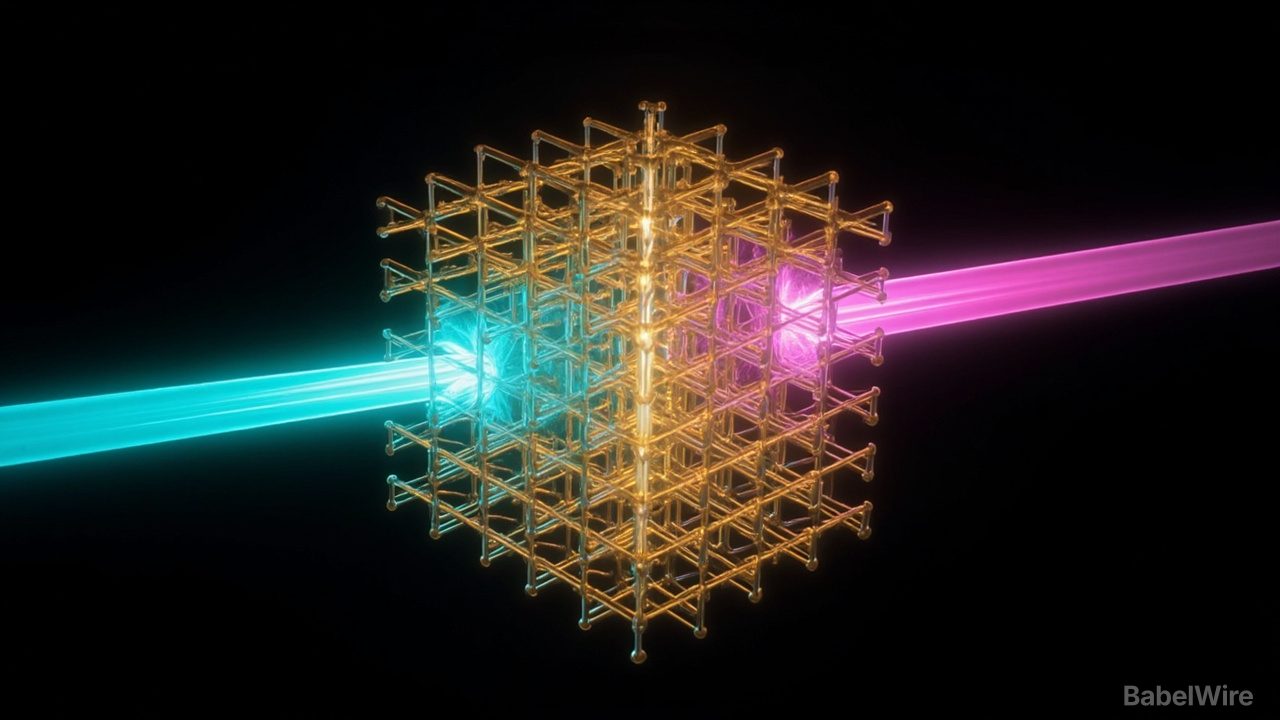
Evidence has been piling up since, but indirect. Now a SLAC-led team reports in Science that manganese telluride (MnTe), treated for decades as an ordinary antiferromagnet, carries the signature that a conventional antiferromagnet cannot produce. They took the sample to the ID32 beamline at the European Synchrotron Radiation Facility in Grenoble and scattered circularly polarised X-rays off it. Chiral materials scatter left-handed and right-handed light differently; non-chiral ones do not care. MnTe cared. The first experiment ran in 2024, was repeated in early 2025, and the chiral signal held.
"This chiral signature gave us the solid experimental ground to say altermagnetism stands in a class of its own," lead author Daniel Jost of SLAC and SIMES said.
Why it matters is not the magnet on the fridge but what comes after it. Spintronics uses an electron's spin as well as its charge, and has been stuck between the two old options: ferromagnets whose bits a passing magnet can flip — Jost's example is a permanent magnet in your pocket scrambling a device — and antiferromagnets whose state is too quiet to read out. An altermagnet has zero net magnetisation and still produces spin-polarised currents, which is exactly the combination a memory or logic device wants. SLAC points to quantum technologies, memory and data centres, where the pitch is speed and much lower power draw.
Caveats are in order. This is materials physics, not a product: the next questions are whether altermagnetic states can be switched with light and electricity, and how they behave at device scale and room temperature. A second paper published the same day reports altermagnetism in manganese difluoride (MnF2), seen with polarised neutron scattering, which suggests MnTe is not a one-off.
Still, after four years of "candidate materials", the third kind of magnetism now has an experiment that the other two cannot explain. That is what a textbook changing looks like.