In 1912 a 24-year-old clerk at the Madras Port Trust began mailing pages of formulas he could not prove to mathematicians in England. One of those pages reached G. H. Hardy at Cambridge, who recognised Srinivasa Ramanujan as a mathematician of exceptional originality. Two of the equations in that correspondence — now known as the Rogers-Ramanujan identities — spent most of the following century as what the number theorist George Andrews calls "an isolated gem": a beautiful special case with no visible family around it.
A team led by Yifeng Huang, now a postdoctoral researcher at Emory University, has shown that the gem is the first case of an infinite family. With Ruofan Jiang of UC Berkeley, Alexei Oblomkov of UMass Amherst and Ken Ono of the University of Virginia, Huang proved what they call the HJO conjecture: the old identities are one instance of a geometric theory in which every "pinched" curve hides a new family of equations.
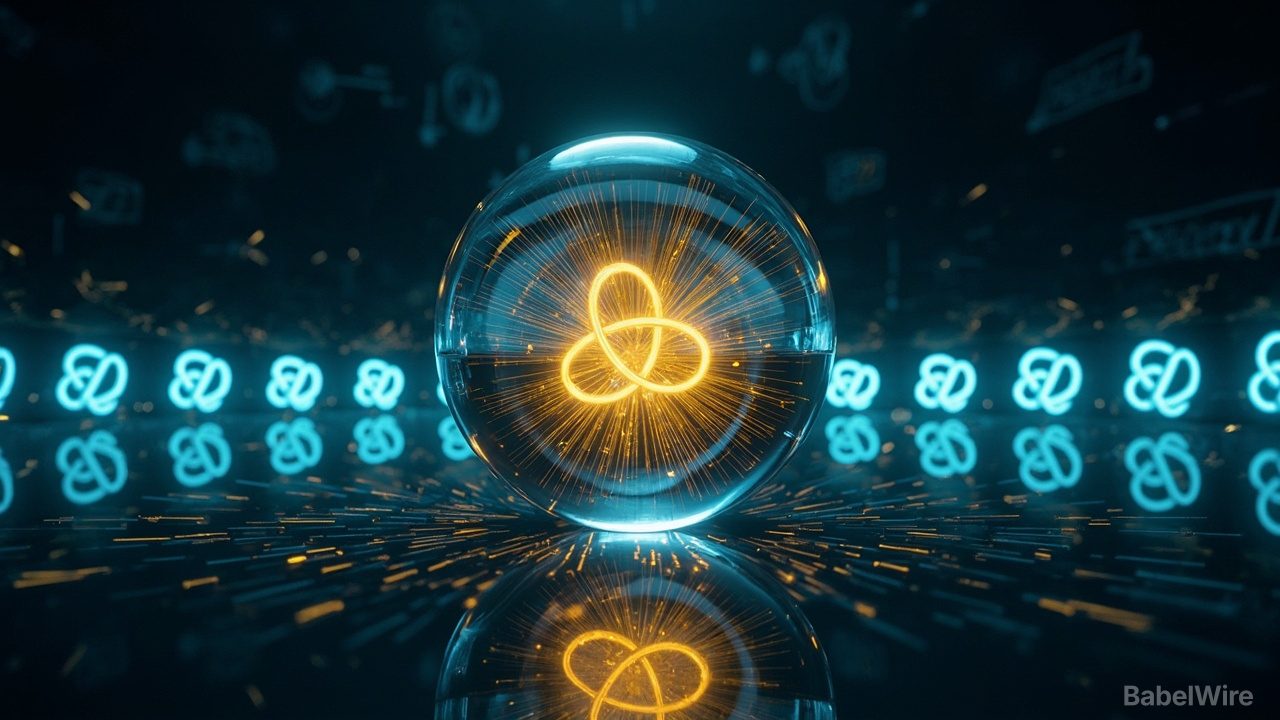
The mechanism is surprisingly visual. Take a curve of the form x^a = y^b that comes to a sharp point, and count how many pairs of matrices satisfy it. Zoom in on that singularity and wrap a small sphere around it in four dimensions: the curve pierces the sphere along a knot. For a = 2, b = 3 the knot is a trefoil — the familiar Celtic knot — and the count collapses onto the Rogers-Ramanujan identities. Larger values of a give more intricately wound torus knots and, with them, new identities. The family for a = 2 was found by Andrews and Basil Gordon in the 1970s; everything above it was uncharted.
The making of the proof is its own story. Ono is founding mathematician at the AI company Axiom Math, and with Huang and Axiom mathematician Kenny Lau he spent seven months working alongside AxiomProver, the firm's maths-focused system. Because the ideas were so new, the model could not simply be pointed at the problem — there was no literature for it to learn from. Instead it explored a far wider space of ideas than a human could, and translated the finished argument into Lean, a machine-checkable language. Four mathematicians and a machine stitched together results from five different areas of mathematics.
"Everything about this subject, even the original discovery, is a surprise," Andrews said. Ono pushes back on the field's anxiety about AI: "Everyone talks about the end of math. But someone had to invent this structure." The conjecture was posted to arXiv in August 2026, the proof in September. Next comes the case of a Hopf link, and Fields medallist Peter Scholze has already published papers extending Huang's ideas further.
Why it matters: a curious formula from a 1912 letter turns out to be the first slice of an infinite family, found where algebraic geometry, knot theory and matrix counting meet. The more consequential precedent, though, is the division of labour — a human spots the pattern, a machine searches the idea space and formally verifies the result. That combination is likely to become more common than any single spectacular theorem it produces.