Metals get cold. Cold means brittle. That is not a footnote in materials science but one of its more reliable rules: the lower the temperature, the harder it is for the dislocations that let a metal absorb stress to move — and the likelier a crack is to spread instead of the part yielding. Body-centred cubic metals such as iron, tungsten and chromium are especially prone to it.
Two experimental niobium-titanium alloys disobey. At 20 kelvin — minus 253°C, minus 424°F — they showed no measurable shift toward brittle behaviour, according to an international team from the University of California, Berkeley, Lawrence Berkeley National Laboratory and the University of Oxford, publishing in Nature on October 14.
A different route for releasing stress
The finding is not that these alloys are simply "better." It is that they switch on a different mechanism when the usual one is blocked.
Normally a metal deforms by the movement of dislocations — defects in the crystal lattice that let layers of atoms slide past one another. As it cools, that motion becomes progressively harder. Stress piles up around a crack tip, and the material fractures.
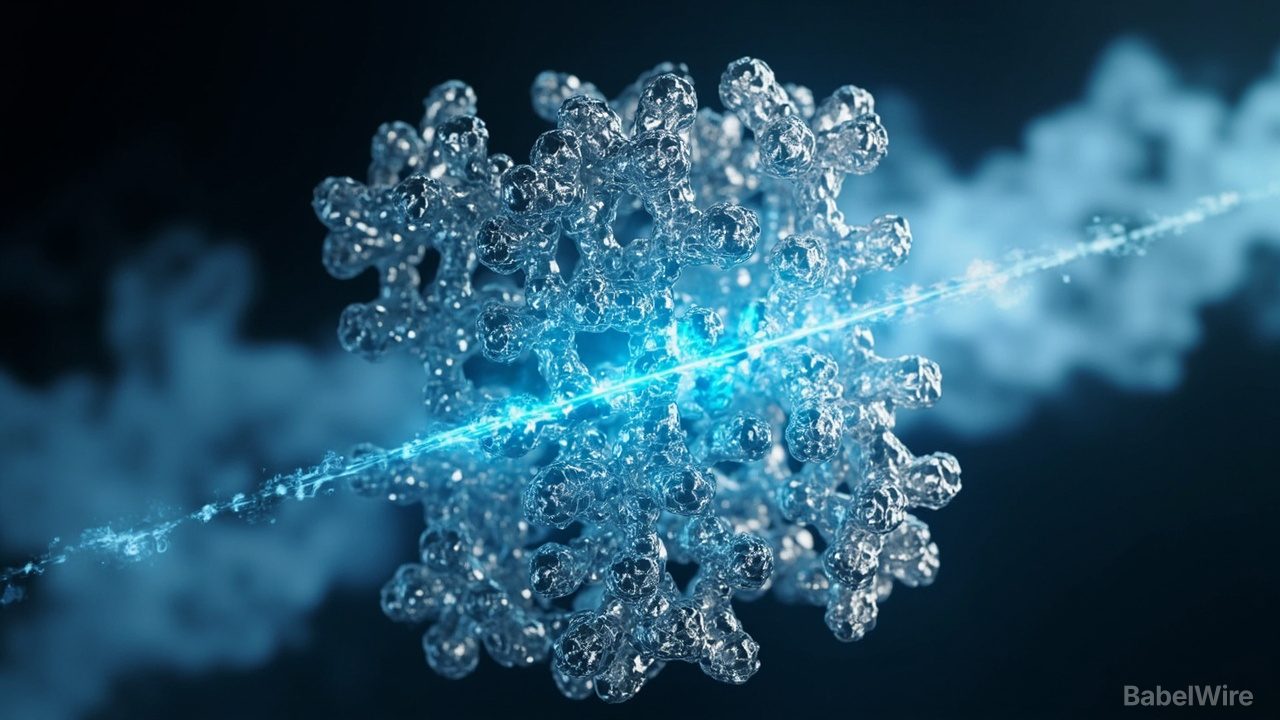
In these alloys, the researchers instead observed nanoscale twinning: tiny regions of the lattice rearranging into mirror-image patterns, alongside a local phase transformation. When those new regions meet grain boundaries, they produce concentrated stress — and those concentrations generate fresh dislocations. The material creates new routes to deform rather than failing on the blocked one.
The team compares it to a road network finding alternative routes when the usual ones are iced over.
How you measure at minus 253 degrees
You do not prove this at a desk. The researchers cooled samples with gaseous helium to roughly minus 253°C while pulling them apart, with a neutron beam passing through the sample, on the Engin-X instrument at the ISIS Neutron and Muon Source in Oxfordshire. Neutron diffraction shows what is happening inside the material under load. Electron microscopes then revealed the tiny structural changes, and atom-probe analysis mapped how the elements were distributed.
Why the theory moves
The old picture was that brittleness depends mainly on how easily existing dislocations can travel. The new results suggest that the ability to create new dislocations at interfaces matters just as much.
"For decades, the ductile-to-brittle transition has been viewed as a fundamental limitation of body-centred cubic metals," said Professor Dong Liu of Oxford. "What surprised us is that these alloys remain remarkably damage tolerant even at 20 kelvin." Lead author David Cook, at Berkeley during the study and now at Cambridge, drew the design consequence: if you understand the microstructure that lets a metal create its own routes to stay ductile, you can engineer for it.
Where this leads
Materials that stay tough in the cold are not an academic want. Liquid hydrogen and liquid oxygen have to be stored. Superconducting magnets in accelerators and fusion machines run at a few kelvin. Space structures see deep cold in shadow and heat in sunlight within the same component.
The real contribution is therefore less a new alloy than a new design principle: stop asking only how mobile a metal's existing defects are, and start asking how good it is at making new ones. That is tunable through grain size, phase stability and composition — which means designing the behaviour instead of selecting for it.
Sources
- nature.comCompeting mechanisms toughen bcc binary and medium-entropy alloys at 20 K (Nature)
- ox.ac.ukNew study reveals metal alloys that unexpectedly resist extreme cold, staying tough at -253°C (University of Oxford)
- sciencedaily.comScientists discover metals that defy the deep freeze at -424°F (ScienceDaily)