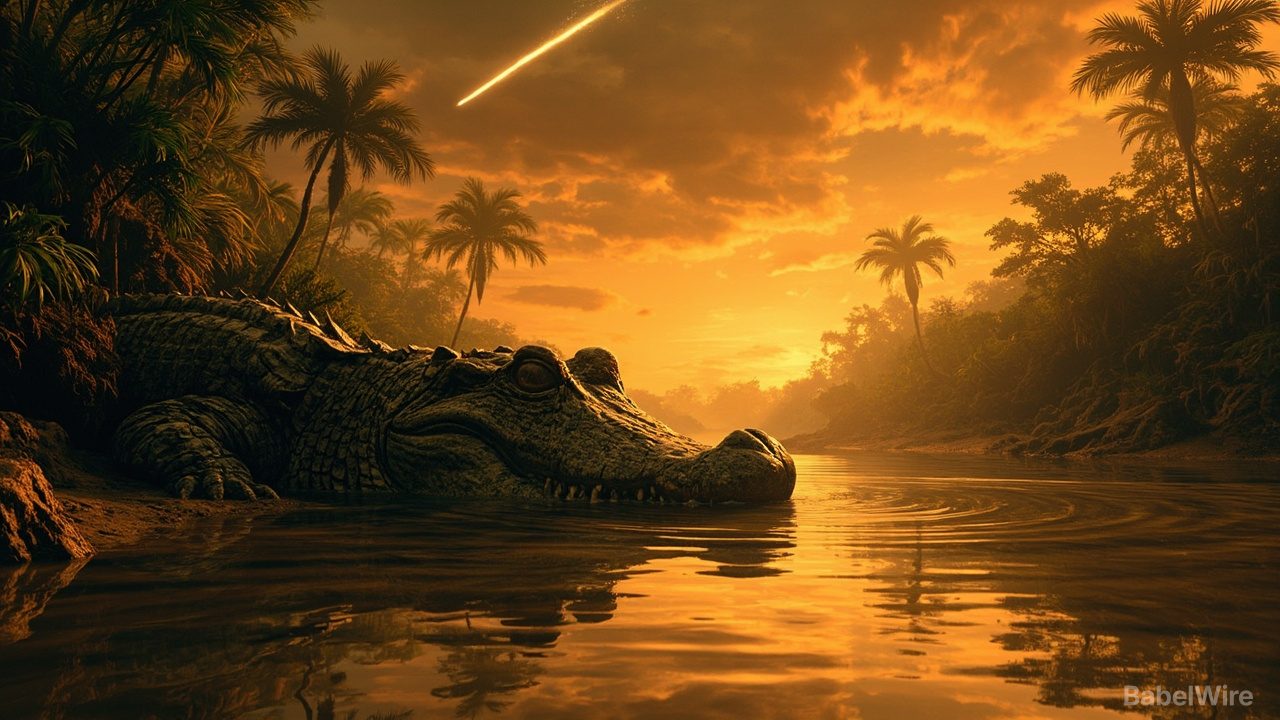
For 66 million years, the question has been why the asteroid took the dinosaurs and left the crocodiles. A new study suggests the answer has less to do with toughness than with address.
Published in Science Advances and led by Dr Alfio Alessandro Chiarenza at UCL Earth Sciences, the work assembled more than 7,000 fossil records covering over 400 living and extinct species, then combined them with computer models reconstructing Earth's climate and geography across 245 million years.
The pattern is unusually consistent. Crocodilians and their relatives — the pseudosuchians — did not evolve to tolerate dramatically different temperature regimes. They followed the warm ones. When the planet heated, they expanded: during the early Eocene, roughly 50 million years ago, with global temperatures about 10°C above today's and no permanent polar ice, their relatives lived at high latitudes across North America, Europe and even Antarctica. As the planet cooled over the following millions of years, their range contracted back toward the tropics.
Then came Chicxulub
The researchers modelled the decades and centuries after the impact, including sunlight blocked by dust and ash, and rising carbon dioxide from volcanism. With sunlight reduced by 5% or 10%, tropical and subtropical regions remained suitable for crocodile relatives. A 15% reduction would have eliminated those refuges as well — a scenario the authors note is now considered unlikely. Earlier modelling by members of the same team found that habitat for non-avian dinosaurs contracted far more severely.
"The asteroid did not make the whole planet equally hostile to every group," Chiarenza said. "Crocodiles' long-standing preference for warm environments may have placed survivors exactly where suitable climates held up best, like around the equator. These refuges could have sheltered populations that later recovered and radiated out."
Temperature was not the whole story. Small body size, a partly aquatic life, flexible diets and the modest energy needs of an ectotherm all improved their odds. But the geographic argument explains why a lineage that appeared alongside the dinosaurs endured not one but two of the five great mass extinctions.
Two exceptions that prove the rule
Stubbornness was not absolute. During the Cretaceous Thermal Maximum about 94 million years ago, when temperatures climbed as much as 14°C above modern levels, one branch of the family tree evolved tolerance for hotter conditions than the wider lineage could handle. And around 34 million years ago in Australia, an extinct group adapted to increasingly arid, desert-like conditions as the continent dried. Some could adapt — most simply never needed to.
"Living fossils" is the wrong phrase
The broader lineage was once far more varied than today's crocodiles, alligators, caimans and gharials. Pseudosuchians included heavily armoured plant eaters, predators that hunted entirely on land, and animals weighing more than a tonne. Among them was Sarcosuchus, a 12-metre "super croc", and Postosuchus, a land hunter that could move on two legs or four.
"Crocodiles are often called living fossils, but their ancestors and relatives changed enormously throughout their history," Chiarenza said, "ranging from giants the size of a bus that could have devoured a T. rex, to small, cute animals with the face of a pug. Our study shows that, despite all this diversity, what stayed surprisingly consistent was their relationship with climate."
The strategy that is now a liability
Following the warmth worked because there was somewhere to follow it to. That is no longer guaranteed. "If crocodiles mostly coped with past climate change by moving towards suitable habitats, today's species will need room to move as the planet warms, and the loss of suitable areas to roads, farms and cities is making that harder," said Professor Philip Mannion of UCL Earth Sciences.
The study was funded by the Royal Society, the Leverhulme Trust and the Natural Environment Research Council. Its honest limit is the one the authors state themselves: favourable temperature was probably one advantage among several, and the extreme scenarios are modelled, not observed. But the central finding is clean — the survivors of the worst day in Earth's history were the ones already standing where the weather held.