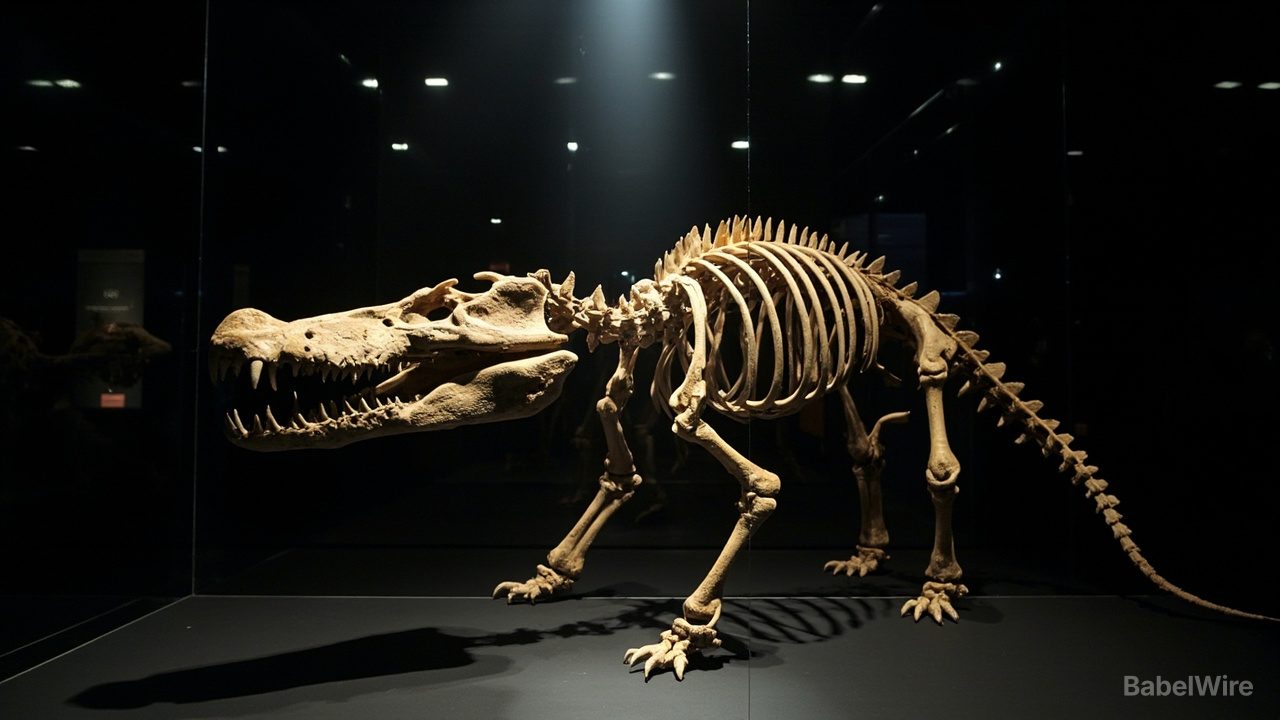
A fossil that sat largely untouched in Yale's Peabody Museum of Natural History for nearly 80 years has yielded a new species of ancient predator — one that sheds new light on how the ancestors of modern crocodiles diversified during the late Triassic period, about 210 million years ago.
The new species, named Eosphorosuchus lacrimosa, was identified by Yale paleontologists led by associate professor Bhart-Anjan Bhullar. It was excavated at Ghost Ranch in northern New Mexico in 1948, alongside fossils of the closely related Hesperosuchus agilis — a fast-running land predator with a long snout and powerful hind legs.
For decades, both specimens were assumed to be Hesperosuchus. But Bhullar noticed that the second animal had a noticeably different head: a shorter snout, a more strongly reinforced skull, and enlarged jaw muscles built for snapping down on larger prey.
"I had been staring at this fossil for a while," Bhullar said. "For years, both Ghost Ranch crocs were thought to be examples of Hesperosuchus, but it looked like the Yale animal had a different facial structure."
To investigate, PhD student Miranda Margulis-Ohnuma studied a CT scan of the fossil, digitally "disassembling" it one bone at a time. The imaging revealed anatomical features — including a more robust skull architecture and different muscle attachment points — that confirmed Eosphorosuchus as a separate genus and species.
The discovery is significant because the two animals appear to have lived side by side in the same ecosystem. Their contrasting skulls suggest that closely related predators were already dividing up food resources by developing different feeding strategies — a hallmark of ecological diversification.
During the late Triassic, the ancestors of crocodiles and the lineage that produced dinosaurs were both beginning to expand into new ecological roles. Unlike today's mostly aquatic crocodilians, many early crocodile relatives were agile, four-legged predators that ran across land.
"It's a time-slice of a single moment 210 million years ago," Bhullar said. "These two individuals had to compete and interact with each other. They were quite possibly looking at each other when they died."
The study, published in Proceedings of the Royal Society B, highlights the potential of existing museum collections to continue revealing novel insights into the history of life — sometimes from fossils that have been hiding in plain sight for decades.