For most of the satellite era, the water beneath the Southern Ocean's surface was getting fresher. That trend has now reversed — abruptly.
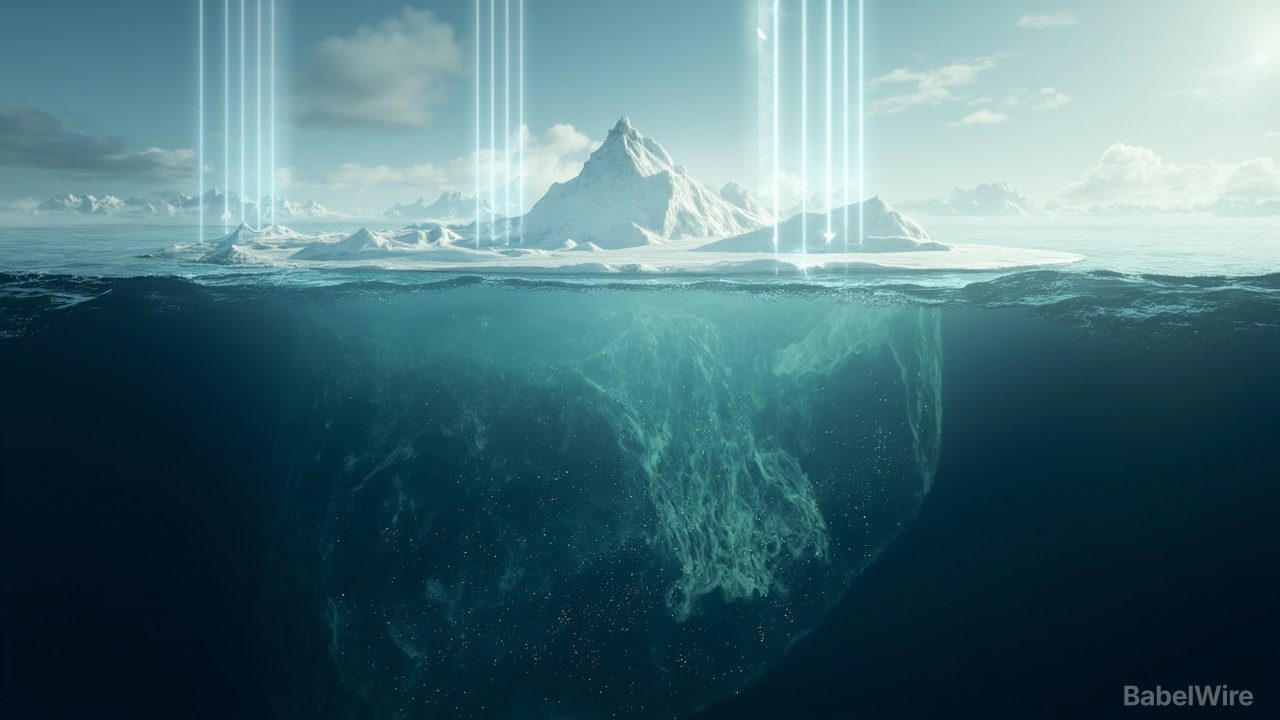
In a paper published on Wednesday, researchers report a sharp increase in the salinity of Antarctic Intermediate Water, the layer that sits roughly 700 to 1,200 metres down (2,300 to 4,000 feet), encircles Antarctica and spreads north into the Indian, Pacific and Atlantic oceans. The freshening it replaces had accumulated over decades. The salty turn took years.
The mechanism runs through sea ice. Antarctic sea ice hit its highest extent in the satellite record in 2014, then collapsed to a record low just two years later, and reached another low in 2023 — about 1 million square miles below the 1981–2010 average, an area roughly four times the size of Texas. Less ice means less freshwater released during the melt season, and the saltier surface signal mixes down into the intermediate layer.
The finding rests on six independent datasets covering 2004 to 2024, most of them from Argo floats: autonomous instruments that drift with currents, periodically sink to measure temperature, salinity and density, then resurface to transmit.
That layer is not a local curiosity. Co-author Bishakhdatta Gayen, of the University of Melbourne and the Centre for Atmospheric and Oceanic Sciences in Bengaluru, notes that it carries heat, carbon, oxygen and nutrients north toward the tropics and across the equator. Changes to its density and thickness alter how heat moves between the surface ocean and the deep, and therefore how the ocean stores and redistributes it.
Michael Meredith of the British Antarctic Survey, who spent years leading its polar oceans work, put the stakes plainly: "The Southern Ocean is the key juncture for all the world's oceans. It's the major site where old waters are reprocessed into new, so this could have global consequences." It is also, he noted, a major sink for human carbon dioxide — the process that moderates how fast climate change is felt where people live.
Gayen suggests the consequences could arrive sooner than climate timescales usually imply — "knocking on your door" within five years — including increased storm frequency and ocean heat loss identified by a 2024 study. Meredith draws the distinction that matters for planning: earlier work showed the deep circulation slowing, but the upper circulation "can affect our climate within years to decades, not centuries."
Two caveats travel with the result. The observational record is short, so it is not yet established that the low-ice state — and the saltier water beneath it — is permanent. And the global climate models used to guide policy still do not reproduce the recent sea-ice losses well. "Our climate models need to catch up," Meredith said. If the low-ice state holds, he added, "these changes will keep spreading through the world's oceans, and the effects will ripple out across our climate and ecosystems."