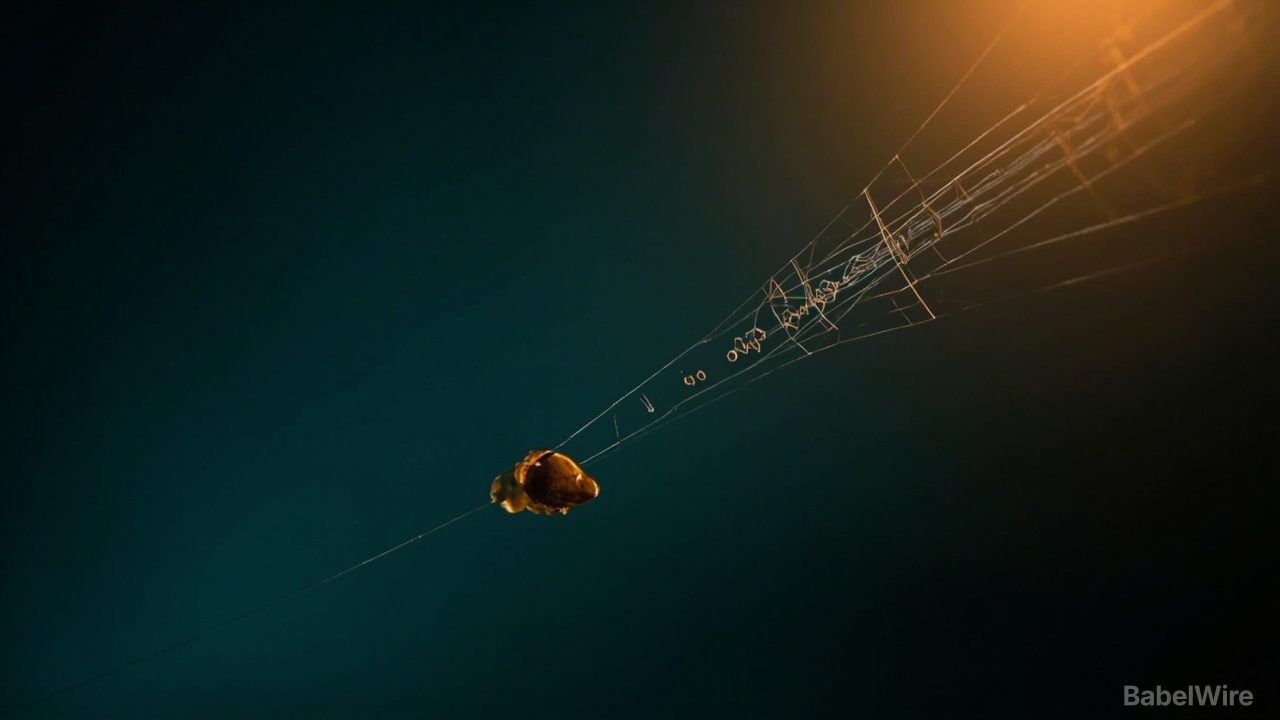
A spider knocked off a wall does not fall far. Within milliseconds it has extruded a strand and is hauling itself back up on a fibre that is tougher than Kevlar and, weight for weight, stronger than steel — spun at room temperature out of nothing but protein, water and salt.
That contrast is the whole problem. Kevlar, the synthetic benchmark, is made at high temperature under acidic conditions. The spider does it in open air. And every attempt to copy the trick in a lab has produced silk measurably weaker than the real thing, because nobody could see the step in the middle: how a disordered soup of protein becomes an ordered solid.
A team led by Gregory Holland, a chemist and spectroscopist at San Diego State University, has now described that step at atomic resolution. The work, reported by Quanta Magazine on 28 October, shows the liquid dope passing through a condensate — a gel-like droplet of concentrated protein — before it becomes fibre, with two amino acids doing the mechanical work of holding the transition together.
Six spiders, an hour each, and an isotope label
Holland's group worked with black widow dragline silk, whose spidroin proteins are among the best characterised in any spider. Every few months through 2023 and 2024, shipments of female black widows arrived at the chemistry department. Hannah Johnson, then a graduate student, put on two pairs of gloves, knocked the spiders out with carbon dioxide, and over the course of an hour teased silk from their spinnerets, winding it onto a vial driven by a motor. The spiders were fed a cocktail of amino acids enriched with isotopes the lab could detect later.
Johnson then ran nuclear magnetic resonance on the liquid dope and on condensates collected from the spiders' ampullae — the middle section of the silk gland. Kevin Chalek, then a postdoc in the same lab, mapped the structure of the finished fibre. "We were trying to bridge the gap between what is happening when the protein is inside the spider and when it's outside the spider," Chalek said.
The answer was a handshake between two side chains. When phosphate was added to the dope — a trigger proposed in 2020 by Keiji Numata's group at Kyoto University — arginine and tyrosine side groups in the proteins' intrinsically disordered regions began to interact weakly. That interaction pushed water out, packing the floppy proteins into a denser, gel-like condensate. Crucially, the same contacts were still present in the solid fibre. The two amino acids behave, in Holland's framing, as molecular stickers: they hold the disordered regions together long enough to be organised, then stay put as the beta-sheet crystals that give silk its strength form around them.
AlphaFold models and molecular dynamics simulations, run by other members of the team, predicted the same picture and added a detail the wet lab could not see: the stickers line up at the bends in the beta sheets, in a position to guide the proteins into their final geometry.
Not a replacement theory, but an added stage
Spider silk formation has had several competing explanations. One held that proteins align like a liquid crystal; another, borrowed from silkworms, proposed micelles — small spheres that compress into fibre. Holland himself previously showed micelles in native silk. He now suggests micelles, condensates and liquid crystals may all be stages of one phase transition, occurring not in tidy sequence but simultaneously and unevenly inside the gland.
Outside researchers quoted by Quanta largely accepted the addition. Matthew Harrington, a biological materials scientist at McGill, called condensates a strategy used "across a range of different organisms", and Chris Holland at Sheffield — no relation — said the use of real spiders rather than synthetic silk was "brilliant". Yang Daiwen of the National University of Singapore called the result "direct evidence" that condensates can form from native silk.
Why it matters beyond spiders
The practical payoff is in the manufacturing problem. Spiders cannot be farmed: they are cannibalistic, need individual containers, and it would take on the order of a million of them to produce what a textile process needs. Recombinant silk made from the correct amino acid sequence is the obvious route, and it has consistently underperformed the natural fibre. Chalek's suspicion is that the difference lies in structural features the synthetic versions leave out — the disordered regions and their interactions, precisely the part this study maps.
There is a broader biology story too. Condensates, first noticed in fertilised worm eggs in 2009, turned out to be a general tool cells use to organise DNA, regulate genes and build materials: squid beaks, mussel adhesives, the cement sandcastle worms use to build tubes. Spider silk is now one of the clearest cases where the atomic rules behind that tool can be read directly.
What remains unknown is how much of the process this covers. Other amino acid interactions almost certainly matter, and phosphate is unlikely to be the only trigger. "We don't know all of the switches yet," Chris Holland said. The chemical industry has been trying to match a spider's ambient-temperature factory for decades; it now has the blueprint for one of the steps, and a clearer idea of how many are left.