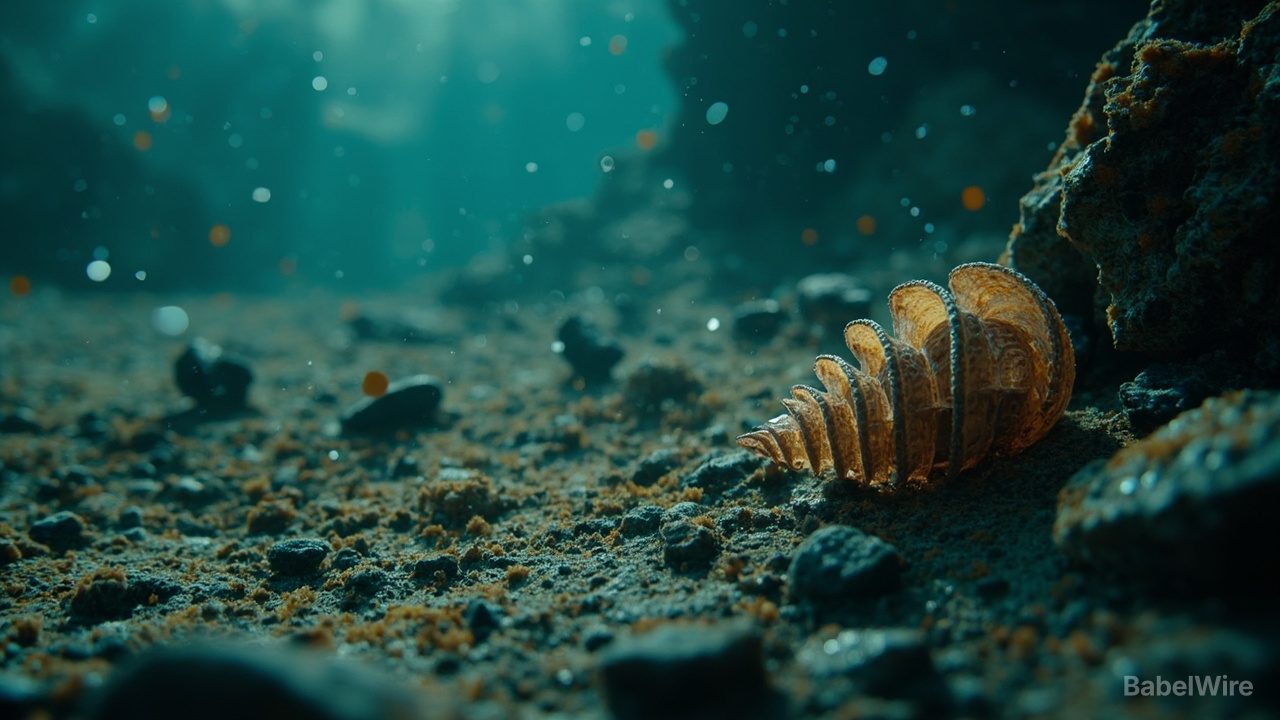
The animal that would one day give rise to squid, octopuses and cuttlefish started out about the size of a grain of rice. In a study published in Nature, researchers led by Chang'an University paleontologist Zuchen Song describe Eoceras shaanxiense, a millimeter-sized cephalopod from the Shuijingtuo Formation in China that lived roughly 520 million years ago.
What makes the fossil extraordinary is a single anatomical detail: a segmented tube running along the underside of its straight, cone-shaped shell. That tube, connected to the shell's internal chambers through tiny canals, is the earliest known siphuncle — the buoyancy-regulating structure that separates cephalopods from all other mollusks.
"Combined with jet propulsion, the siphuncle enables cephalopods to engage in a nektonic and mostly predatory lifestyle through long-term regulation of their buoyancy," the researchers wrote. "The origin of this key innovation remains unknown, as major gaps exist between the earliest accepted cephalopod, Plectronoceras cambria from the Late Cambrian, and molecular clock estimates placing the divergence in the Early Cambrian."
The new specimens help bridge that gap. At 520 million years old, Eoceras predates Plectronoceras by roughly 30 million years and extends the known range of stem cephalopods into the Early Cambrian, matching predictions from molecular clocks. Because its buoyancy system was still primitive, the animal likely spent most of its life on the seafloor rather than swimming freely.
Scientists caution that the soft-tissue anatomy remains unknown, but the discovery reveals the early stages of how a chambered shell evolved into a precision buoyancy device — the innovation that eventually let cephalopods hunt, hover and flee in open water, and that still defines the group today.