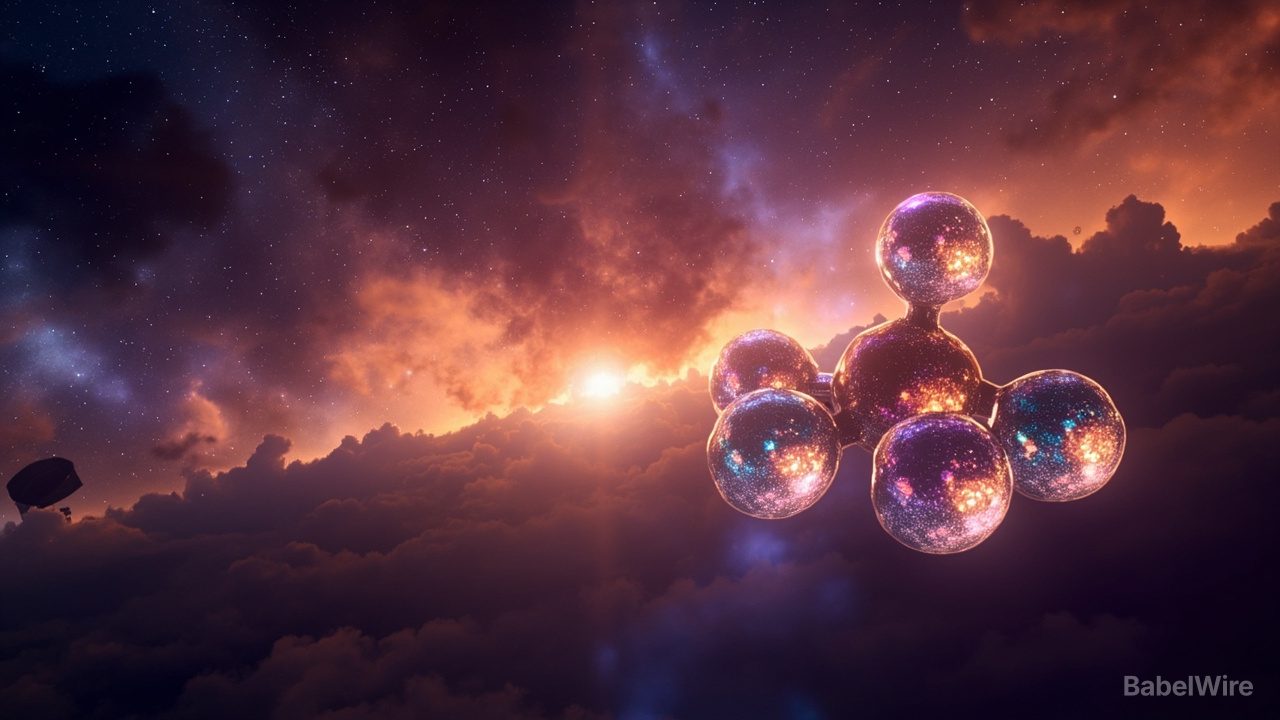
**Call it an extra-sweet discovery. Astronomers have detected a true sugar molecule swirling inside a cloud of gas and dust near the center of our galaxy — the first time such a complex organic compound has been confirmed in interstellar space.**
The molecule, called erythrulose, has four carbon atoms and is the most complex sugar ever spotted beyond our Solar System. The findings, published July 13 in the journal Nature Astronomy, could help clarify how life on Earth began.
A surprising signature
The discovery was made by a team led by Izaskun Jiménez-Serra, an astronomer at the Spanish National Research Council in Madrid. For years, the team had been scanning the night sky for complex sugars without success. Then in 2022, physical chemist Emilio Cocinero from the University of the Basque Country shared spectroscopic data for erythrulose — the specific fingerprint of wavelengths the molecule emits.
"I said, 'Okay, why don't you send me the information, and then I'll check whether we see it in our data'," Jiménez-Serra recalled. She was skeptical at first. But to her surprise, the erythrulose fingerprint showed up in the team's observations of a molecular cloud near the center of the Milky Way. Using Spain's Yebes 40-meter and IRAM 30-meter radio telescopes for deeper observations, the team saw the signal even more clearly.
"This is an incredibly exciting result," said Brett McGuire, an astrochemist at MIT. "Astronomers have, for a very long time, been pushing to detect sugars in space."
What makes it a 'true sugar'
Previous detections had found glycolaldehyde — a two-carbon molecule sometimes considered the simplest sugar — in interstellar space back in 2000. But although glycolaldehyde acts similarly to a sugar, it is "not formally a sugar," McGuire explained. True sugars, he added, must have a backbone of at least three carbon atoms.
Erythrulose, with four, clears that bar easily.
Cosmic delivery service
The discovery adds weight to the theory that life's essential ingredients arrived on Earth via space rocks. Sugars are fundamental to life — ribose, a five-carbon sugar, is a core component of RNA — and traces of ribose had previously been found in multi-billion-year-old meteorite samples.
If sugars can form in interstellar clouds and hitch a ride on asteroids and comets, then the raw materials for life could be delivered to planets throughout the galaxy, not just Earth.
"Astronomers have seen hints that sugars on Earth that are essential to life originated in outer space," the researchers noted. The new detection of a larger, true sugar in the same kind of environment where stars and planets are born strengthens that picture considerably.
The finding also opens the door to searching for even more complex sugar molecules in space. With erythrulose confirmed, astronomers now know that interstellar chemistry can build carbon chains of at least four atoms — and likely longer ones waiting to be discovered.