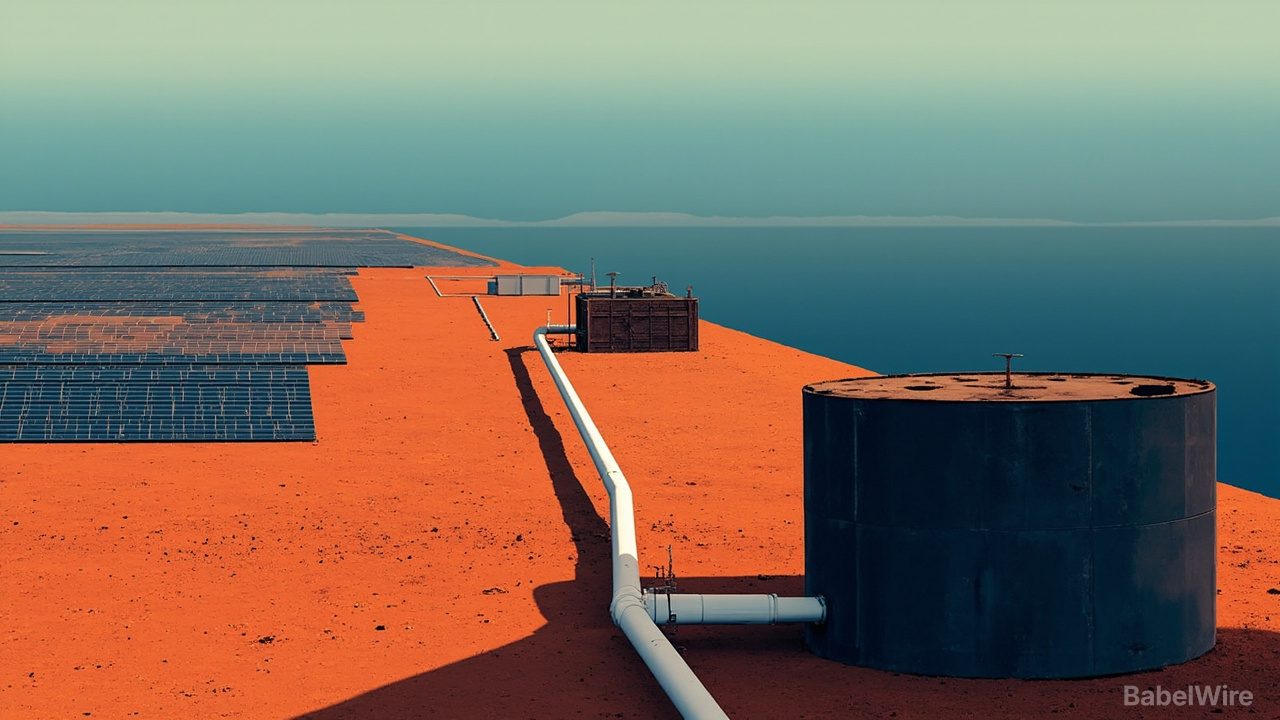
Physics World poses a question that more and more water-stressed regions are asking in earnest: when does solar-powered desalination actually pay off? The short answer is that it depends less on the sun than on everything attached to it.
Desalination is at bottom an energy problem. Reverse osmosis, the dominant technology, needs only a few kilowatt-hours to produce a cubic metre of fresh water from seawater — a number that sounds manageable right up until it is multiplied by a city. Electricity is the largest running cost in most plants, so cheap solar generation looks at first glance like a perfect match: free fuel, no emissions, and a plant that produces when the sun shines.
The catch is that the sun shines on a schedule the water system does not share. Demand peaks in the morning and in the evening; solar output peaks in the middle of the day, and disappears entirely at night. Bridging that gap means storage — batteries, thermal mass, or a reservoir of already-treated water — and storage is where the economics of standalone solar desalination usually lives or dies. A plant built around a large treated-water tank and modest PV capacity is a very different investment from one that buys batteries to run through the night.
Location does the rest. High and stable irradiance, a genuinely scarce and therefore expensive alternative water source, cheap land, manageable brine disposal and a stable grid for backup is the combination that works. Remove the expensive alternative — a coastal city with a cheap, reliable surface supply — and the same solar array becomes hard to justify, however cheap its panels have become.
None of this makes solar desalination a bad idea. It makes it a local calculation rather than a universal one. The interesting question is not whether the sun can desalinate water — plainly it can — but whether, in this place, at this price, with this much storage, it beats the alternatives. That question has a different answer every time.