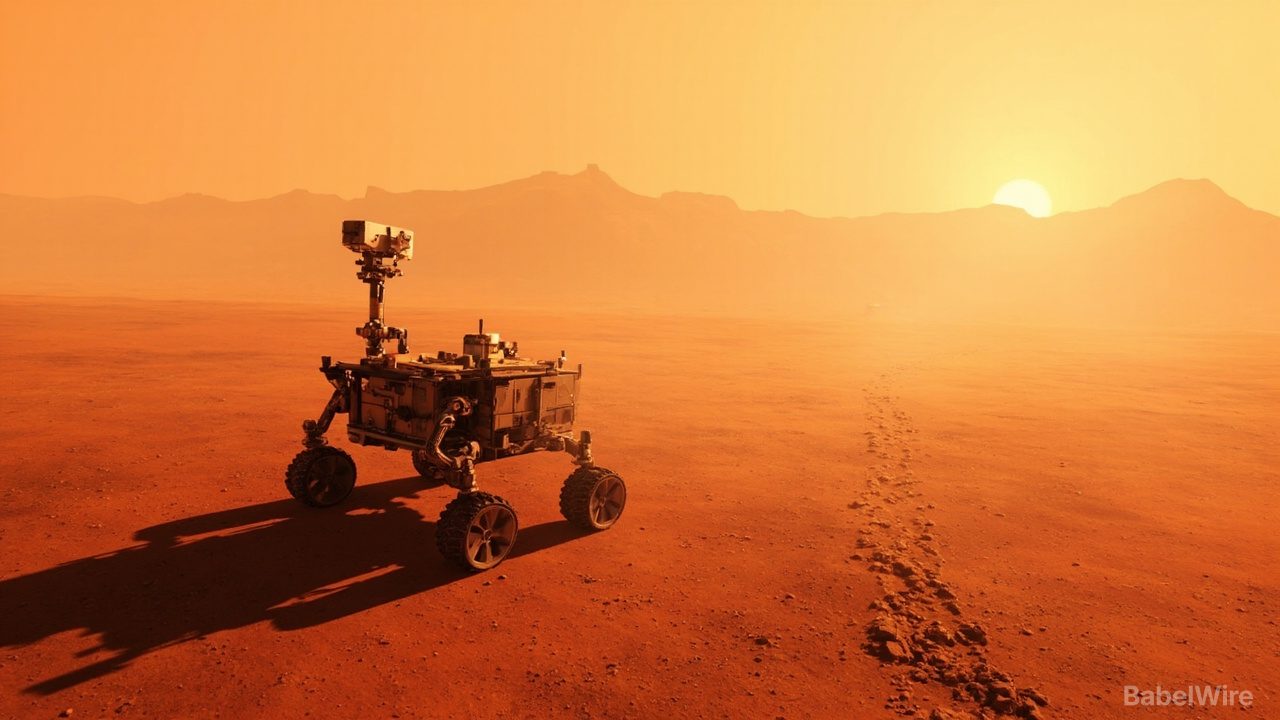
NASA's Perseverance rover has driven farther across the surface of another world than any vehicle before it, taking over a distance record that had stood for more than a decade.
According to reporting by heise online, the Mars rover has now passed the cumulative distance covered by its predecessor Opportunity, which drove roughly 45 kilometres (about 28 miles) across Meridiani Planum between 2004 and 2018. That mark, itself a record set in 2014 when Opportunity overtook the Soviet Lunokhod 2 rover, had survived every mission launched since, Curiosity included.
Perseverance reached the milestone through more than five and a half years of patient driving. The rover landed in Jezero Crater on 18 February 2021 with a mandate to hunt for signs of ancient microbial life, cache rock and soil samples for a possible return to Earth, and test new technology. Along the way it carried the Ingenuity helicopter — the first aircraft to fly on another planet — and ran the MOXIE experiment, which produced oxygen from the Martian atmosphere.
Distance was never the headline objective, but it is the means by which everything else gets done. A rover that cannot move cannot reach the rocks worth sampling, and the science return of a mission is ultimately bounded by how much ground it can cover safely.
Much of Perseverance's mileage comes down to software. Its AutoNav system lets the rover plan routes and steer around hazards on its own, rather than waiting for engineers on Earth to upload a path and confirm each segment. That autonomy allows longer drives per sol than earlier rovers managed, and NASA's Jet Propulsion Laboratory has progressively loosened the leash, letting the vehicle handle longer stretches of terrain by itself.
Every kilometre is paid for in wear: wheel damage, motor cycles, dust, and nights that fall far below minus 60 degrees Celsius. The record is therefore as much an engineering result as a navigational one. It is also a reminder that Perseverance is a nuclear-powered machine still operating far beyond the two-year prime mission for which it was designed.
Since 2024 the rover has been working the western rim of Jezero Crater, where the terrain is steeper and rockier and progress is measured in hundreds of metres a day rather than kilometres. The record was crossed on that kind of ground, not on the smooth plains of earlier campaigns.
Why the odometer matters beyond bragging rights: it is direct field evidence that autonomous long-distance navigation works at planetary scale, which is exactly the capability that future sample-retrieval missions and eventual crewed expeditions to Mars will depend on. NASA publishes the rover's odometry as the mission progresses, so the number will keep climbing.
For now, the next kilometres belong to the sample-caching campaign — the materials Perseverance has already set aside still await a ride home. Note: exact odometer figures are updated continuously by the mission team; the distance tied to the record is reported by heise online and should be read as approximate.