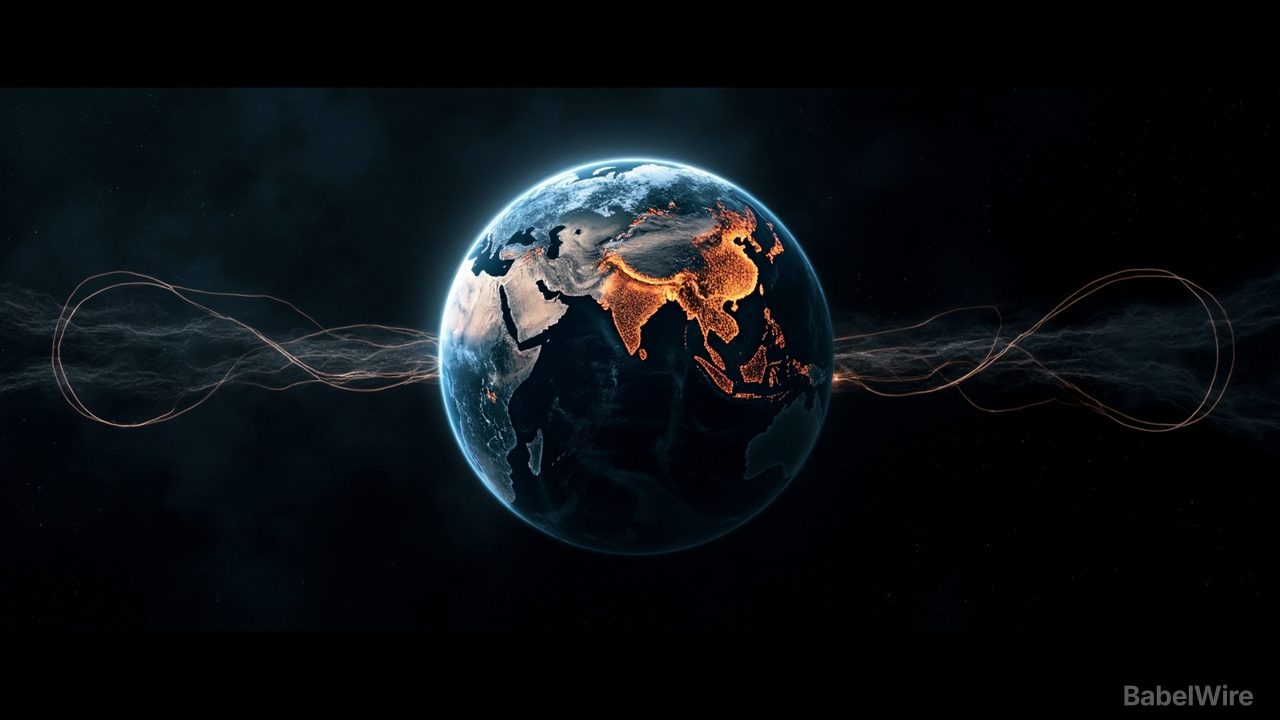
The tropical Pacific and the Indian Ocean have held a long-distance climate conversation for centuries, relayed through the atmosphere. A new study in Nature Communications suggests that conversation is now breaking down in a way it has not for 400 years.
Researchers at the Woods Hole Oceanographic Institution (WHOI) combined instrumental records and climate models with natural climate archives — 35 coral records, three tree-ring records and one stalagmite — to reconstruct Indo-Pacific patterns back to 1631. For most of those four centuries the Pacific and Indian sides of the system moved together: when circulation over the Pacific changed, the Indian Ocean's basin-wide temperature pattern followed.
One period stood out. Between roughly 1810 and 1850 the coupling weakened considerably, during a stretch of major tropical volcanic eruptions including Indonesia's Mount Tambora in 1815. Sulfur gases thrown into the stratosphere form aerosols that reflect sunlight and temporarily cool the surface; because that cooling is uneven, it shifts temperatures and winds. Simulations spanning the past millennium supported the interpretation, with the size of the disruption depending on the scale of the eruptions and the climate state at the time.
The real finding, though, is the present. The tropical Indian Ocean has warmed by about 0.1 degrees Celsius per decade since the 1950s, while the Pacific Walker circulation has strengthened since the 1980s. The sign of the relationship has reversed: the Indian Ocean no longer follows the Pacific's lead the way it did.
The researchers compared the modern correlation (1945–2025) with equivalent 80-year windows from simulations and reconstructions covering the past millennium. The modern value fell outside the 95 percent ranges of both — even compared with periods of intense volcanism. "A key finding is that global warming and human emissions are now overwhelming the Pacific's natural influence on the Indian Ocean," said co-author Caroline Ummenhofer. Not every link broke: a separate relationship involving the Indian Ocean Walker circulation did not show the same shift.
This matters beyond oceanography. Stable coupling between tropical basins is one source of seasonal-to-multiyear climate predictability. If those relationships change, forecasts built on historical behaviour can become less reliable — and the rainfall patterns that large parts of Africa, Asia and Australia depend on move with them. The authors point to implications for climate-risk and regional water-resource management.
Uncertainties remain: the simulations did not reproduce every detail of the 19th-century volcanic disruption, and how the Pacific Walker circulation evolves under continued warming is still unclear. The broader message is that climate change does not simply warm individual oceans. It alters the relationships between them.
Sources
- sciencedaily.comGlobal warming is breaking a 400-year climate link between two oceans — ScienceDaily / Woods Hole Oceanographic Institution
- sciencealert.comGlobal Warming Is Breaking The Link Between Two Major Oceans — ScienceAlert
- deeperblue.comGreenhouse Gases Disrupt Climate Link Between Indian and Pacific Oceans — DeeperBlue