The Royal Swedish Academy of Sciences awarded the 2026 Nobel Prize in Physics on Tuesday to Francis Halzen, the Belgian-American particle physicist who turned a cubic kilometre of pristine Antarctic ice into the world's largest neutrino detector.
The citation honours Halzen "for decisive contributions to the IceCube Neutrino Observatory and the discovery of high-energy neutrinos of astrophysical origin." He takes the prize alone; the award is worth 12 million Swedish crowns, about $1.2 million, and will be presented in Stockholm on December 10.
Neutrinos are electrically neutral and almost massless. They pass through the Earth — and through our bodies — without a trace, rarely interacting with matter at all, which is why they are nicknamed "ghost particles." But that same indifference is what makes them valuable: unlike light, a neutrino is not deflected by magnetic fields or absorbed along the way, so the direction it arrives from points directly back at whatever produced it.
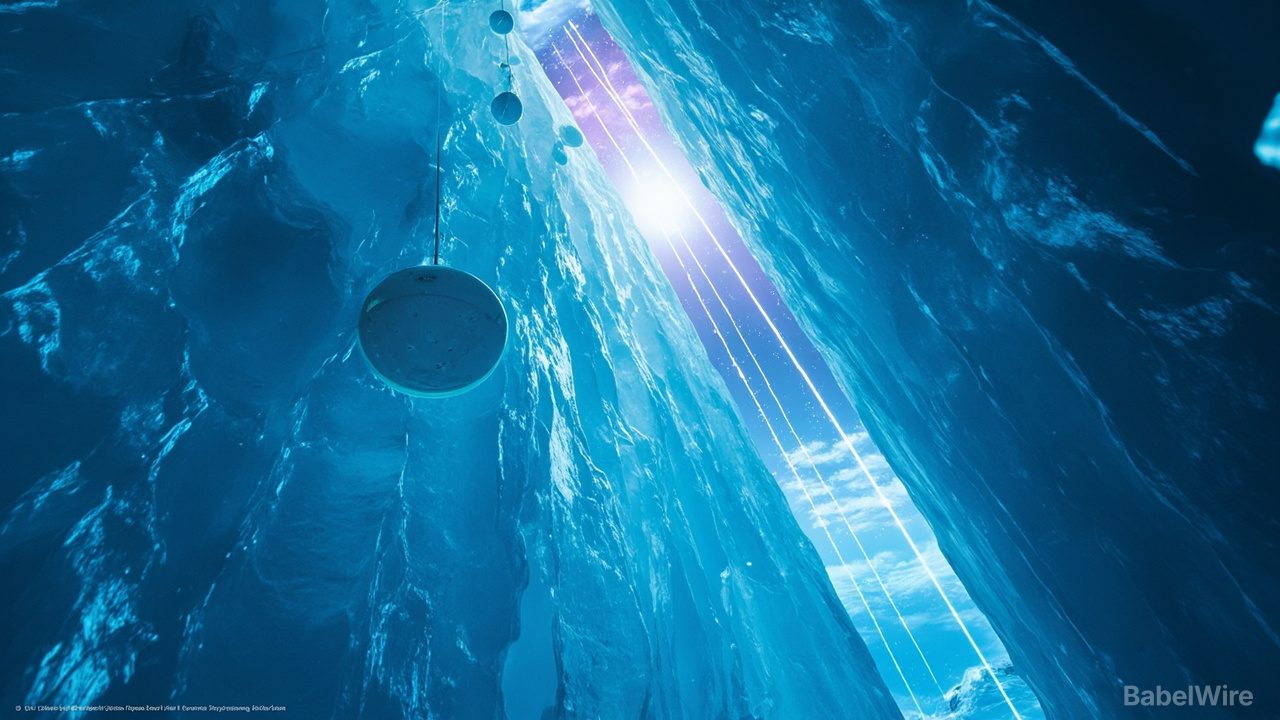
Halzen's idea was to use the ice itself. The IceCube detector is set in a cubic kilometre of clear ice extending 2,500 metres below the surface near the Amundsen–Scott South Pole Station, instrumented with sensors that catch the faint blue flashes produced when a neutrino does interact. He first pitched the concept at the South Pole in 1988; the observatory was completed in 2011 and registers roughly one high-energy neutrino a day.
"The messengers bring information from the cosmos," Eva Olsson of the Royal Swedish Academy of Sciences told a press conference. "They open the door to distant galaxies and tell us about the processes of exploding stars."
Working from those signals, IceCube researchers established that high-energy neutrinos originate both inside and far beyond our own galaxy — launching an interstellar hunt for the objects and processes that create them, from exploding stars and gamma-ray bursts to violent events involving black holes and neutron stars.
Halzen, 82, is a professor at the University of Wisconsin–Madison. Speaking by telephone from the announcement, he was careful not to oversell the result. "I have to emphasise how lucky I was because, when we started this project, everybody realised this was maybe a good idea, but very few thought it would work, including myself," he said. Asked what the method might ultimately reveal about the universe, he answered: "The real excitement is that I cannot answer that question yet. This is just an introduction to the science, the astronomy is still to come."
Physics is the second of this year's Nobel Prizes. On Monday the medicine prize went to Karl Deisseroth, Peter Hegemann and Georg Nagel for optogenetics, the light-switch technique for controlling nerve cells. Last year's physics prize honoured John Clarke, Michel Devoret and John Martinis for experiments that demonstrated quantum principles in action.