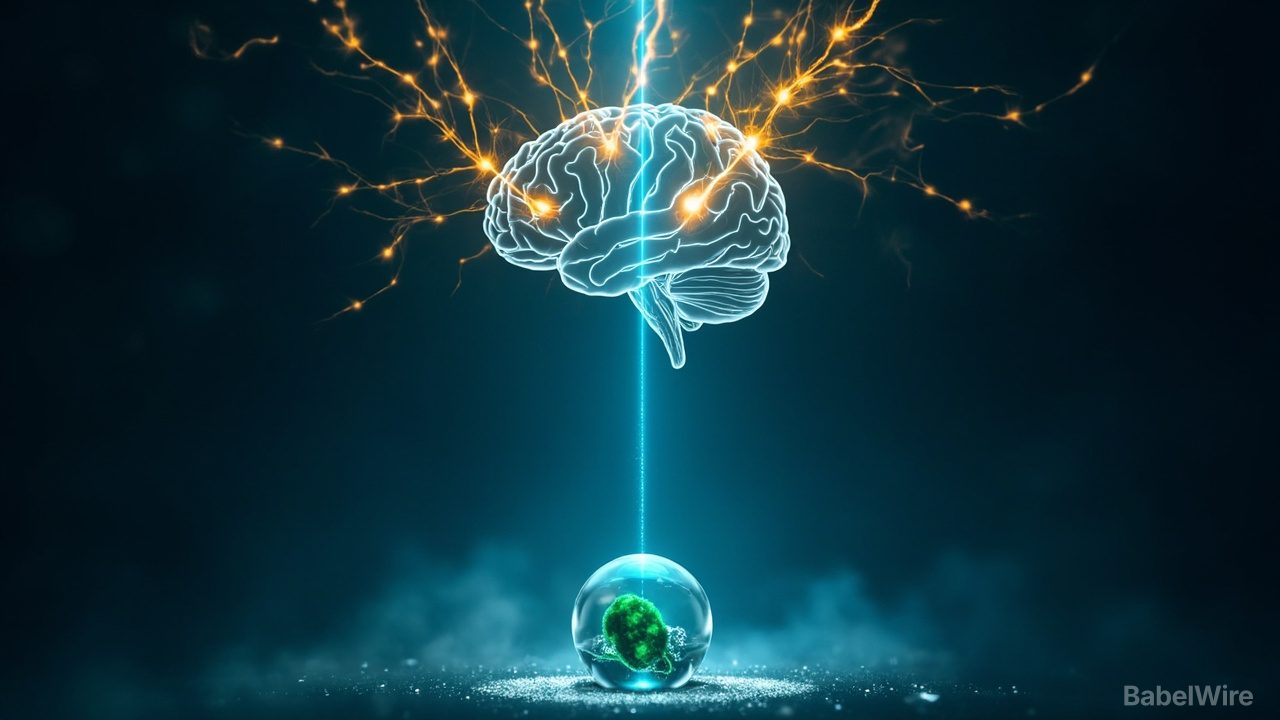
Three scientists who turned a light-sensitive algal protein into a switch for nerve cells have won the 2026 Nobel Prize in Physiology or Medicine. Karl Deisseroth of the Howard Hughes Medical Institute and Stanford University, Peter Hegemann of Humboldt University of Berlin and Georg Nagel of the University of Würzburg share the prize equally "for their discoveries concerning light-gated ion channels and optogenetics." The award is worth 12 million Swedish kronor.
The story begins with Hegemann's curiosity about how Chlamydomonas, a single-celled alga, swims toward light. In the early 2000s, he and Nagel discovered channelrhodopsin, a protein on the cell surface that opens a channel when struck by blue light, letting charged ions flow in and creating an electrical impulse. Cells of many kinds became light-sensitive once the protein was inserted.
Deisseroth then introduced the gene for channelrhodopsin into rat nerve cells and, in 2005, showed that blue light could trigger a nerve signal. Two years later he made the light-controlled switch work in the brains of living mice. The technique, now called optogenetics, lets researchers turn specific neurons on and off with millisecond precision.
The Nobel Assembly credits optogenetics with transforming neuroscience: researchers have used it to reveal the circuits behind specific memories, feelings and behaviours relevant to neurological and psychiatric disorders, and clinicians are testing it in attempts to restore sight in people with visual impairment. "Optogenetics provides opportunities for mapping the brain in a way that we could once only dream of," said Per Svenningsson, chair of the Nobel Committee for Physiology or Medicine.
Bios: Deisseroth, born 1971, earned his PhD in 1998 and his MD in 2000 at Stanford. Hegemann, born 1954, earned his PhD in 1984 at the Max Planck Institute for Biochemistry in Martinsried, where the prize-winning discoveries were made. Nagel, born 1953, earned his PhD in 1988 at the University of Frankfurt; the awarded work was done at the Max Planck Institute for Biophysics in Frankfurt.