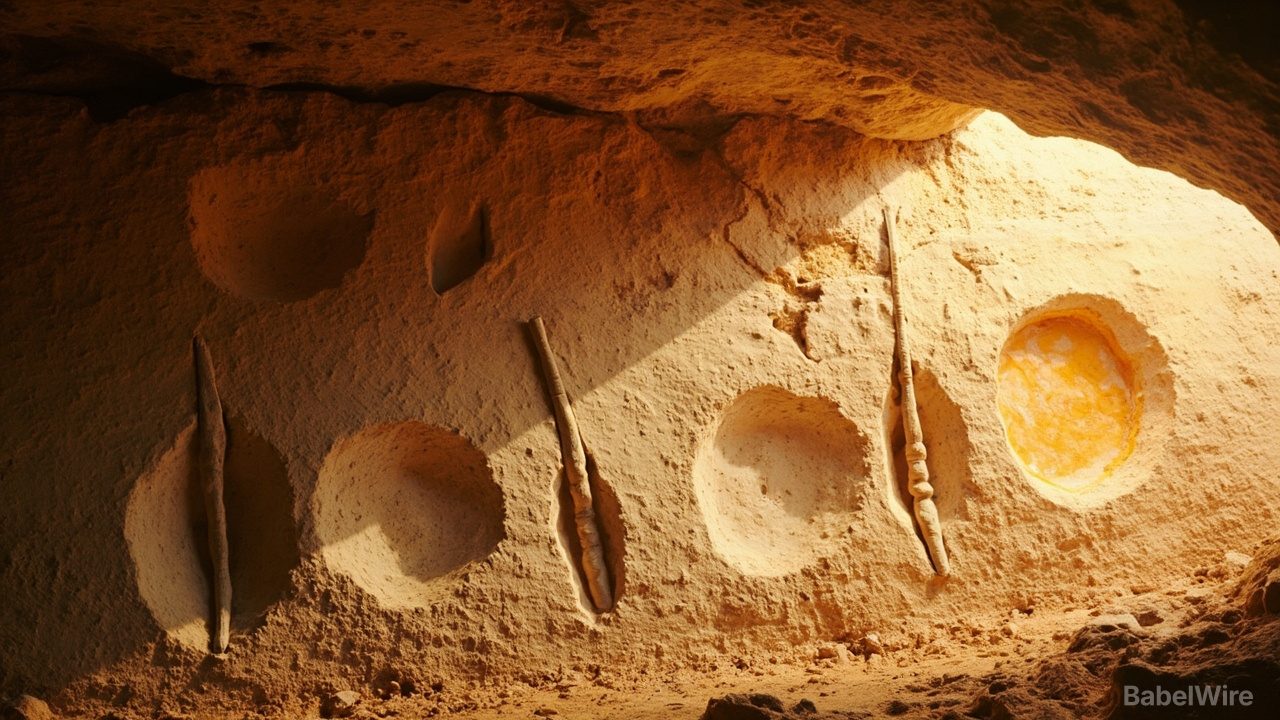
A rock shelter west of Barcelona has yielded the richest known collection of Neanderthal woodwork — not as preserved wood, but as stone. At Abric Romaní, near Capellades, calcium-rich spring water dripped across the shelter floor and precipitated a limestone-like crust around whatever lay there. The wood inside slowly decayed, leaving hollow moulds that reproduce its shape in negative, sometimes so finely that the outlines of wood cells are visible under a microscope.
In a study in Science Advances, a team from the Catalan Institute of Human Paleoecology and Social Evolution (IPHES-CERCA) catalogues 597 wooden remains from Neanderthal living areas dated between 62,000 and 40,000 years ago. Most are natural trunks, fallen branches and firewood, largely Scots pine. Thirteen objects were made or modified by Neanderthals — and their variety is the point.
The finds include a 2.45-metre spear whose point, cast in resin, carries an impact fracture matching the damage seen on spears used by Aboriginal Australians; four shallow juniper-bark trays, the largest 55 by 20 centimetres, found near hearths and possibly used to carry food or scoop embers; crossed poles over a thick hearth that may be the remains of a tripod; and a branchless pole more than five metres long, tucked against the back wall, consistent with a windbreak or simple hut — experiments suggest such a structure needs about that length of timber.
The most unusual object is a club carved from a single piece of wood, with a 16-centimetre handle and a pointed, roughly triangular head about 14 centimetres tall. Where handle meets head there is an abrupt right-angle step that may have kept the hand from slipping. The only earlier object hypothesised to be a club comes from Kalambo Falls in Zambia and is roughly 400,000 years old. Nothing quite like this one has turned up anywhere, according to co-author M. Gema Chacón.
Site structure matters too. Along the back wall the excavators found a row of small hearths, about 50 centimetres across and spaced roughly a metre apart, with almost no debris around them — Chacón suspects these were sleeping hearths, placed for light and to deter predators. The busy end of the shelter had large overlapping hearths surrounded by animal bones, knapping debris and firewood, the signature of food preparation and toolmaking.
Material selection suggests deliberate knowledge of wood properties: easy-to-work Scots pine for tools, fibrous juniper bark for the trays, dry wood for burning and fresh wood for shaping. "When they went to look for wood, it was like when they went to look for stone; they knew exactly what they wanted to make," Chacón said.
Abric Romaní has been excavated continuously since 1983, and the team has refined a method for working with finds that are essentially empty space: outline, map and photograph each one, consolidate the fragile crust, then open it carefully. Where the team once filled the hollows with resin or plaster for a positive cast, most wood remains are now scanned and 3D-printed. Chacón worries that time and budget constraints elsewhere mean similar finds may already have been lost — colleagues, she said, have told her of wood they excavated, photographed and discarded. DOI: 10.1126/sciadv.aeh2287