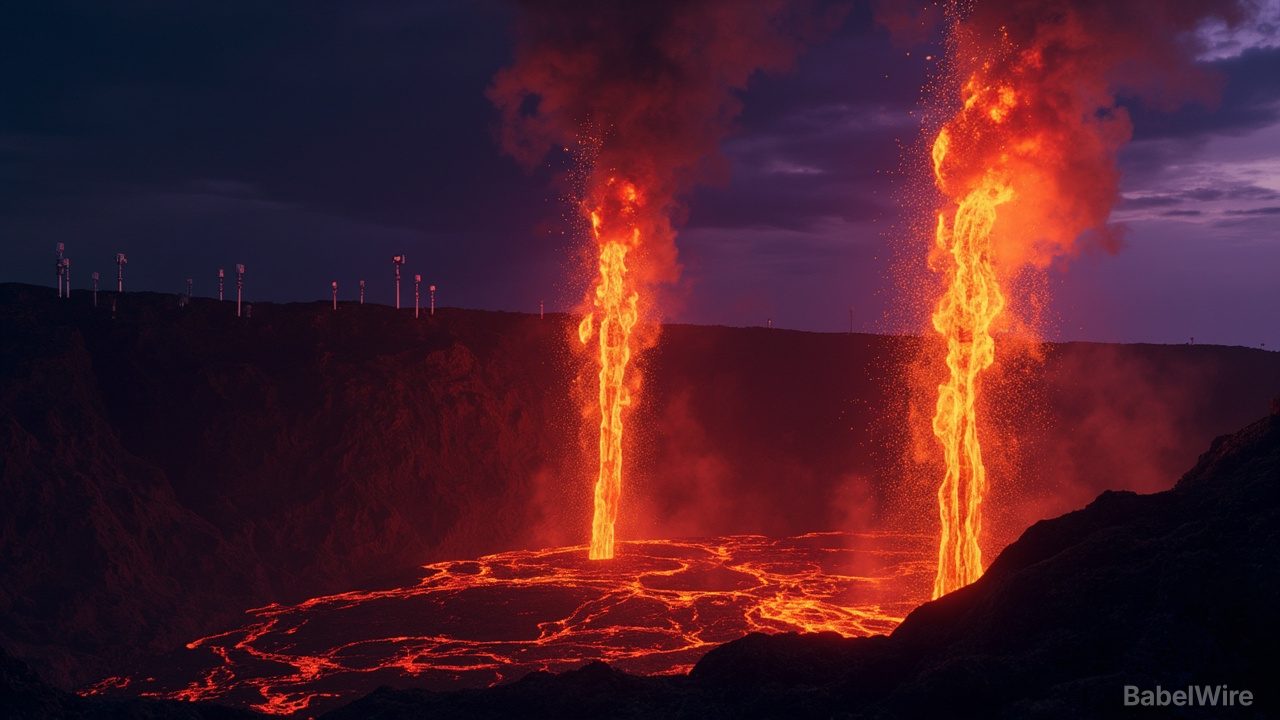
Most volcanic eruptions are patient affairs. At a few places — Etna, Iceland, Hawaii's Kilauea — molten rock leaves the ground as fountains that can reach hundreds of metres into the air. What powers them has never been settled. A new analysis in Science, from US Geological Survey researchers, uses an unusually well-instrumented eruption sequence to narrow the options.
Kilauea has had a dense monitoring network for years: 35 stations combining seismic, infrasound, geodetic and gas sensors with visual and thermal cameras. The current episode began building after a major 2018 eruption partly drained an underground reservoir. Refilling accelerated from 2019, with the summit inflating at more than 22 centimetres a year; in 2023 that rate doubled to 57 centimetres a year and the deformation spread to a nearby caldera. In 2024, a swarm of earthquakes accompanied the opening of a vent and a 900-metre fissure, which threw lava 160 metres high for 13 hours. A second eruption followed less than a day later. By last month, the researchers count 52 further fountain eruptions, the most violent reaching over 400 metres.
Two mechanisms compete in the literature. One holds that pressure keeps water mixed into the magma until it reaches shallow enough depths to flash to steam; the steam fragments the magma, which rises faster, which releases more steam — a runaway that produces a jet. The other proposes that carbon dioxide exsolved from the magma forms a foam at the roof of the chamber, which bursts and drives magma out until the supply is spent.
The new data does not clearly favour the foam model. Carbon dioxide levels stayed low through the whole eruption cycle. Sulphur dioxide rose during eruptions and fell afterwards but remained elevated throughout, indicating continuous gas loss from magma rather than a one-off threshold event. The evidence leans toward a steam-driven mechanism — but it does not explain why a process running continuously suddenly triggers fountains when conditions shift slightly.
Chemistry adds a second thread. Magnesium oxide, a proxy for magma temperature, fluctuated across the cycle in a way consistent with eruptions draining a reservoir that is then refilled by hotter material. Other oxides rose over time, hinting that the incoming magma has a distinct composition.
One practical finding stands out: the eruptions became predictable from summit tilt. Consecutive fountains occurred when the tilt reached similar levels, and although the threshold drifted downward over time, the gap between eruptions stayed small. That pattern let the USGS issue alerts ahead of unrest — valuable, because there were no clear seismic precursors immediately before fountains restarted.
The researchers acknowledge they would still like more data. Gas sampling is typically done at infrared wavelengths, and during a fountaining eruption there is a great deal happening in the infrared; some locations were too dangerous to install more instruments, and one camera was destroyed capturing images of falling lava. DOI: 10.1126/science.aef2931