NASA's Nancy Grace Roman Space Telescope — the agency's next great observatory poised to lead humanity's next generation of astronomical discoveries — has been formally cleared for its final launch preparations following a successful Flight Readiness Review on August 21.
The telescope is scheduled to launch no earlier than 7:26 a.m. EDT (1126 GMT) on Sunday, August 30, aboard a SpaceX Falcon Heavy rocket from Launch Complex 39A at NASA's Kennedy Space Center in Florida.
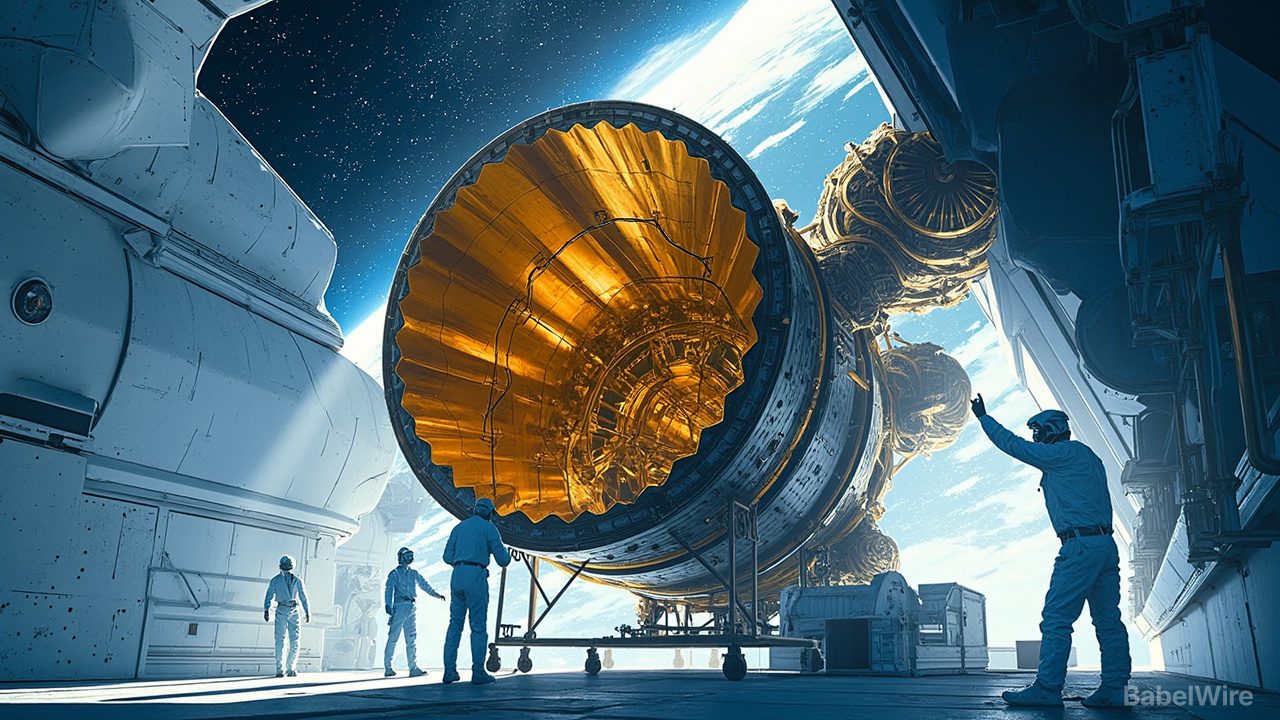
Roman has spent the past several weeks undergoing final preparations at Kennedy Space Center. Technicians loaded the observatory with 290 gallons (1,100 liters) of hydrazine fuel on July 25, then attached it to its payload adapter in early August. The telescope was recently encapsulated inside Falcon Heavy's payload fairing, and underwent a full launch-day dress rehearsal on August 20.
The Flight Readiness Review, completed on August 21 by NASA, SpaceX, and Roman mission managers, formally cleared the observatory to begin its final launch preparations. The telescope, encapsulated in its payload fairing, will next be transported to SpaceX's hangar at LC-39A, where it will be attached to the Falcon Heavy rocket before rolling out to the pad for launch later this week.
Roman carries a mirror the size of Hubble's 2.4-meter primary mirror, but sees a patch of sky about 100 times wider. This combination of sensitivity and field of view will allow it to survey vast areas of the sky efficiently, creating a cosmic inventory of galaxies, stars, and planets across billions of light-years.
The telescope's primary science goals include probing the nature of dark energy — the mysterious force driving the accelerating expansion of the universe — and searching for exoplanets, particularly Earth-sized worlds in the habitable zones of their host stars. Roman's wide-field infrared imaging capabilities will also enable studies of distant galaxies, dark matter distribution, and the physics of stars.
The launch represents the culmination of more than two decades of development, originally conceived as the Wide Field Infrared Survey Telescope (WFIRST) before being renamed in honor of Nancy Grace Roman, NASA's first chief of astronomy and a pioneer of space-based observatories.
Roman will operate from the Sun-Earth Lagrange Point 2 (L2), approximately 1 million miles from Earth, joining the James Webb Space Telescope at this stable gravitational point. From L2, the telescope will have an unobstructed view of the cosmos, with its sunshield keeping it cold enough for sensitive infrared observations.
The mission is expected to operate for at least five years, with the potential to revolutionize our understanding of the universe's structure, composition, and evolution. Scientists anticipate Roman will discover thousands of new exoplanets, map the distribution of dark matter and dark energy across cosmic time, and provide unprecedented views of the most distant reaches of the observable universe.