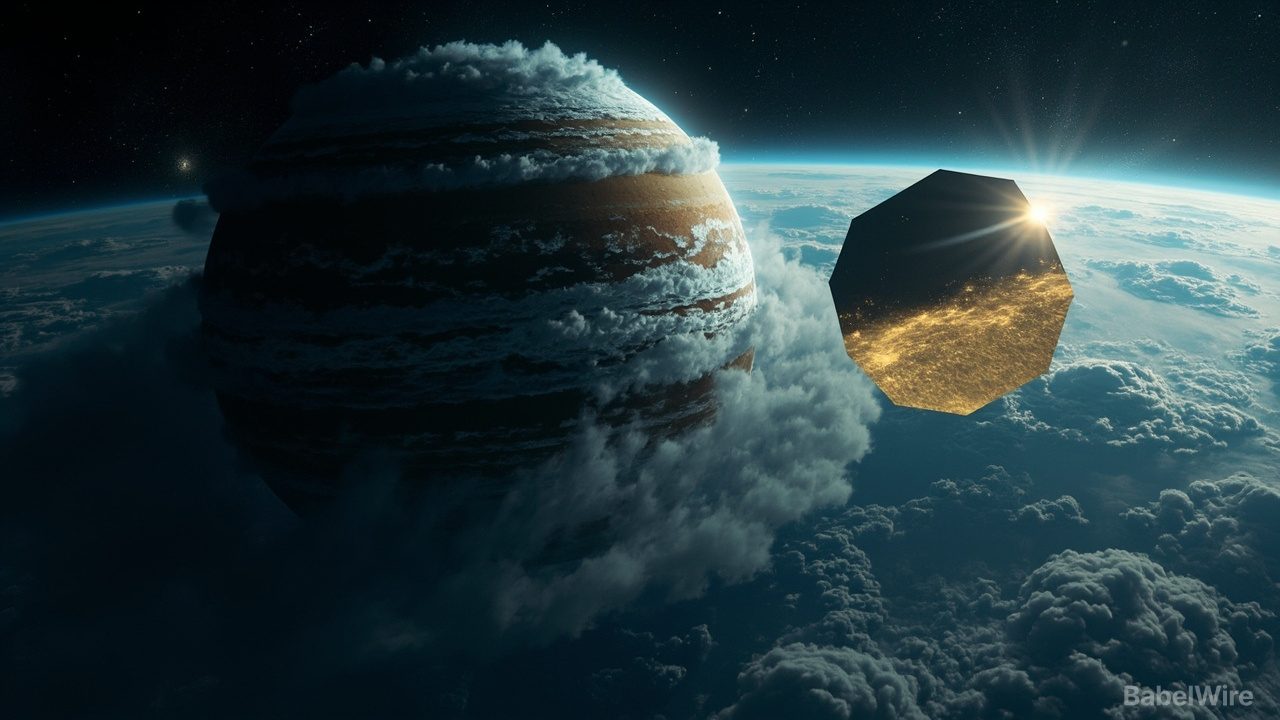
WISE 0855 is the coldest known brown dwarf: roughly twice Jupiter's mass, about 7.5 light-years away, and around 265 Kelvin — colder than the surface of the Earth. Now it has something no other object outside the solar system has: a confirmed weather report.
Brittany Miles of the University of Arizona's Steward Observatory led a team that pointed the James Webb Space Telescope at the object for 11 hours, capturing a spectrum every 15 minutes. The result, published in The Astrophysical Journal, is the most detailed time series yet taken of such a cold world — and the first direct confirmation that water clouds beyond the solar system change thickness over time.
Two processes are visible at once. High-altitude water clouds grow thicker and thinner as WISE 0855 rotates, exposing warmer and cooler patches. Deeper down, convection dredges carbon monoxide and phosphine upward from the interior — the disequilibrium chemistry also seen on Jupiter — and that signal varies rhythmically with time.
Co-author Mark Marley compares the atmosphere to a screen door filtering light: to read the world behind it you must understand the screen. Here the screen keeps changing. The team argues that if the physics of clouds, convection and chemistry is universal, it also governs the gas-giant exoplanets JWST is now probing in earnest.