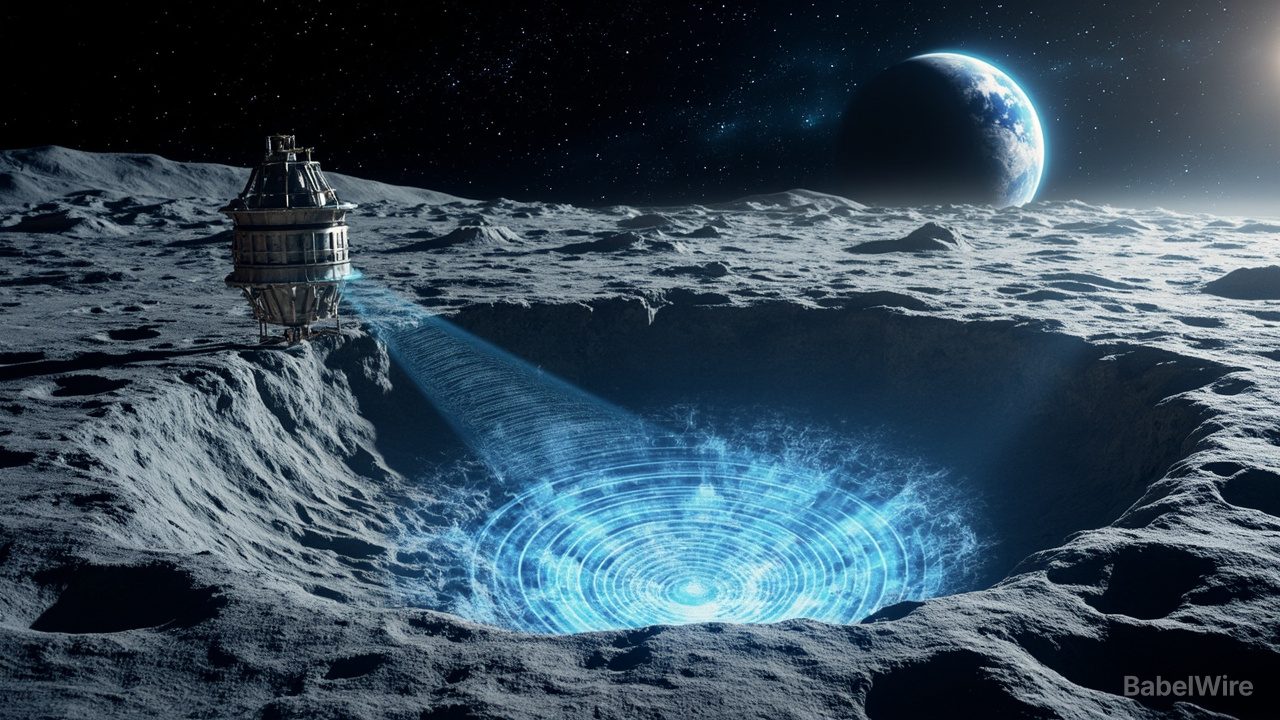
Finding water on the Moon may be a matter of detecting the right vibrations. A study published in Science Advances on July 31 shows that seismic waves — the same vibrations measured during earthquakes — could locate and map ice buried beneath the lunar surface.
The idea is straightforward: ice stiffens whatever it is mixed into. Frozen lunar soil transmits seismic waves two to three times faster than dry regolith, and ice-rich zones can make seismic energy bounce back like sound echoing off a wall. 'We can use seismic waves to not just see whether ice is present but also roughly how much of it there is,' said Nicholas Schmerr of the University of Maryland, a co-author.
To test the theory, the team combined three approaches: freezing a volcanic rock that closely mimics moon dust and imaging it with X-rays in a custom cryogenic vacuum chamber at Berkeley Lab; modeling temperature maps of the Moon's south polar region to find craters cold enough to preserve ice for billions of years; and running computer simulations of moonquakes rippling through underground ice. In every case, the ice left clear, measurable marks on the seismic data, with the models describing structure down to about 800 meters.
The stakes are practical and scientific. Melted and purified, lunar ice becomes drinking water; split apart, it yields oxygen to breathe and hydrogen for rocket fuel — resources that could let future missions live off the land. The tests may not wait long: China's Chang'e-7 mission, carrying a seismometer, is expected to land near Shackleton Crater in late 2026, and NASA's Artemis astronauts could deploy a seismic monitoring station in 2028. As Schmerr said, 'No one has physically measured the ice on the moon yet, but we now have a prediction for what to look out for.'