On August 12, astronomers reported in Nature what may be the most elegant explanation yet for one of the James Webb Space Telescope's deepest mysteries: the hundreds of compact, puzzling "Little Red Dots" scattered across the early universe.
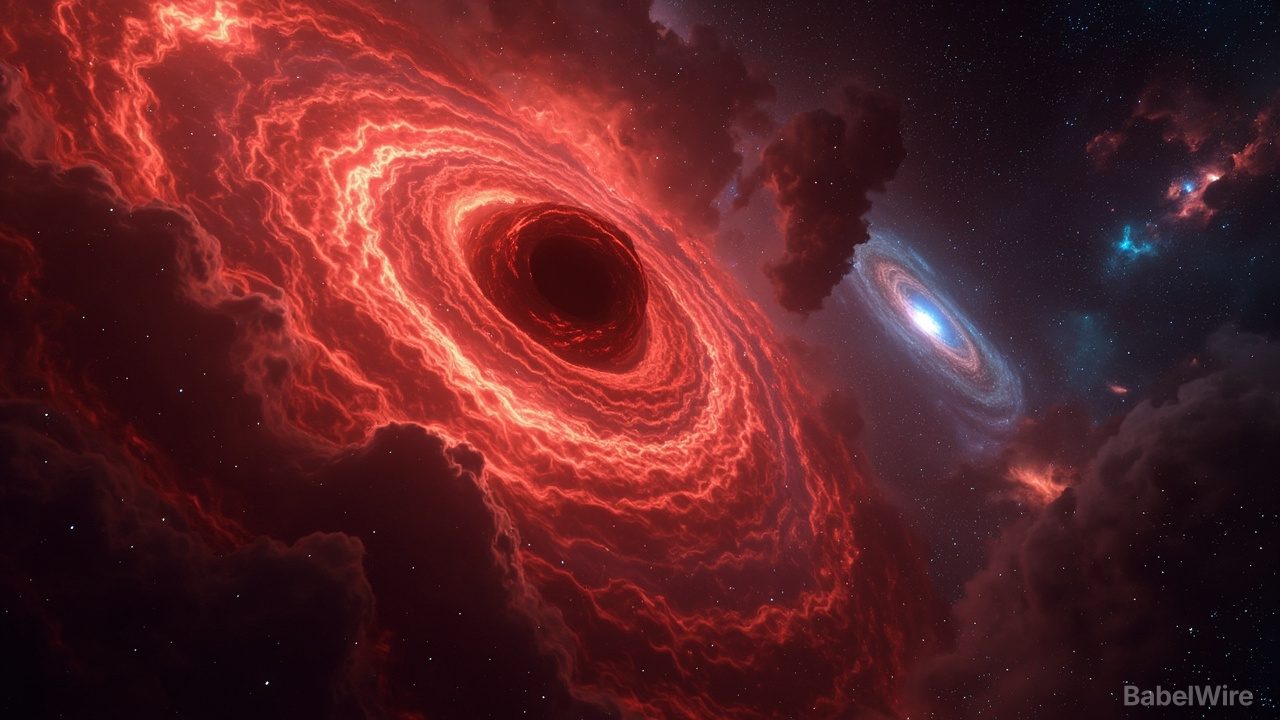
The object is called MoM-BH*-1. It appears to be a massive black hole — roughly one to ten million solar masses — wrapped in such a dense, extended envelope of hydrogen that the entire system looks like a gigantic star. Its light began traveling when the universe was just 660 million years old, at a redshift of 7.7569.
The crucial fingerprint is an extraordinary Balmer break — an abrupt change in brightness around hydrogen wavelengths — with a measured break strength of 7.7. Normal stellar populations produce breaks of around 3; even artificial populations made entirely of bright stars stay below 5. This extreme break, combined with broad hydrogen emission and the source's apparent variability, points to something far stranger than a conventional star or galaxy.
In their preferred interpretation, radiation from a feeding black hole travels through enormous quantities of dense hydrogen gas. The gas absorbs, scatters, and re-emits the light until the escaping spectrum begins to resemble radiation from a stellar atmosphere. The envelope sits roughly 10 to 100 astronomical units from the black hole — about the scale of our solar system — and is Compton-thick, meaning even energetic X-rays have difficulty escaping.
The real breakthrough came when the researchers performed a simple exercise: they took the spectrum of MoM-BH*-1 and added the spectrum of a nearby bright galaxy. The combined result produced exactly the familiar V-shaped spectrum of a Little Red Dot — bright ultraviolet light, a trough, then a strong rise into the rest-frame optical with broad hydrogen emission.
This explains why the same object can look different through different Webb filters. At ultraviolet wavelengths, the host galaxy's stars supply most of the light, making the source appear extended. At longer wavelengths, the compact gas-wrapped black hole takes over and the dot tightens around the center.
The discovery has implications far beyond a single peculiar object. A separate 2026 search has already identified 241 candidate black-hole-star-dominated sources in Webb data. If many Little Red Dots turn out to be composites of young galaxies and black hole stars, it would reshape our understanding of how the early universe built massive black holes so quickly — potentially allowing black holes to grow faster than previously thought possible by consuming matter at several times the formal Eddington limit.
"It wouldn't have been possible without JWST," said Sean McGee of the University of Birmingham, who was not involved in the research. The upcoming Square Kilometer Array radio telescope will offer a crucial test: if the findings are correct, neutral hydrogen — which emits a distinctive 21-centimeter radio signal — should be absent near these objects, because the black hole stars would have already ionized it.