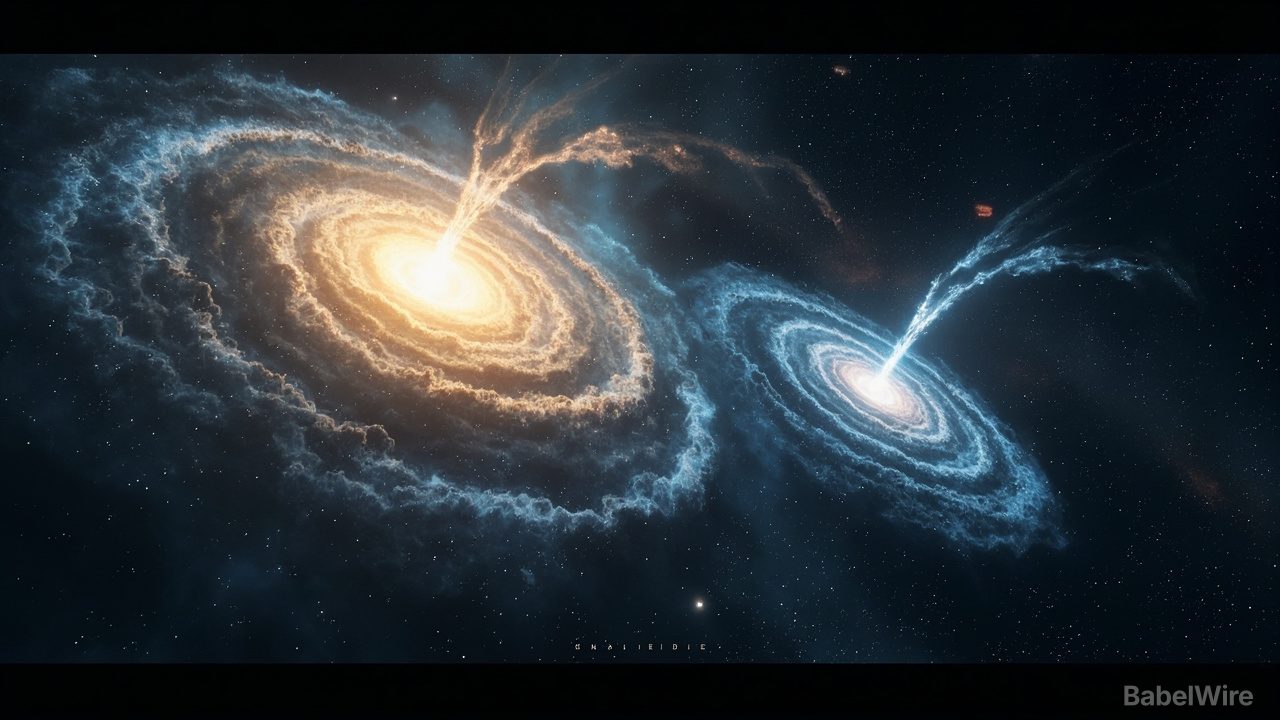
Our home galaxy, the Milky Way, wasn't always the massive spiral we see today. It grew to its current size partly by consuming smaller galaxies — and now Hubble has found evidence of its earliest known feast.
Published August 17 in Nature Astronomy, the study reveals definitive evidence that a dwarf galaxy known as LKH (Low-energy-Kraken-Heracles) collided with and was absorbed by the young Milky Way approximately 11.8 billion years ago, just 2 billion years after the Big Bang. This extends our knowledge of the galaxy's merger history by 1.8 billion years beyond the previous oldest known event — the Gaia-Sausage-Enceladus merger, dated to about 10 billion years ago.
"Our home is the Milky Way galaxy, but we do not know how our house was built," said Davide Massari of the Astrophysics and Space Science Observatory of Bologna, Italy, lead author of the study. "In this paper we discover where the first significant batch of bricks came from: a dwarf galaxy that we call LKH."
The team used Hubble's high-resolution imaging to study 39 globular clusters — dense, ancient collections of tens of thousands to millions of stars — in the inner 20,000 light-years of the Milky Way. By precisely measuring the age and metallicity (chemical composition) of these clusters, they identified a third distinct population that couldn't have come from the Milky Way itself or from the later Gaia-Sausage-Enceladus merger.
These clusters are older than the Gaia-Sausage-Enceladus population but younger than those born natively in the Milky Way, regardless of their metal content — pointing to an entirely separate and earlier merger. The LKH dwarf galaxy is estimated to have contained roughly 500 million solar masses in stars, a substantial fraction of the Milky Way's mass at that epoch.
The finding has profound implications: the earliest phases of our galaxy's evolution were not defined solely by stars born within the Milky Way. "Stars born in external galaxies also need to be considered," Massari said.
The team plans to continue studying the Milky Way's globular clusters to characterize all massive mergers our galaxy has experienced across its 13.6-billion-year history.