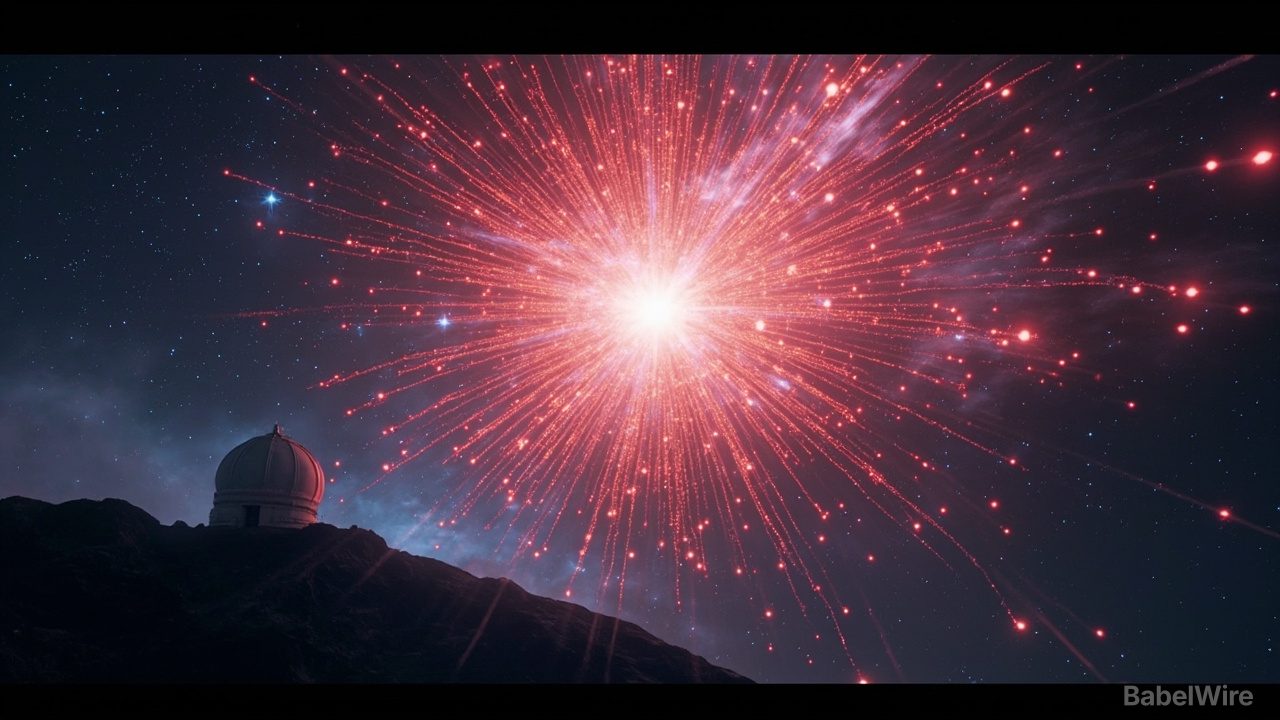
Nearly 845 years after astronomers in China, Japan and the Arab world recorded a "guest star" blazing in the constellation Cassiopeia, the telescope image they could never have imagined has arrived — and it has changed what researchers thought they were looking at.
The new view of Pa 30, the nebula widely identified as the remnant of supernova SN 1181, comes from the Gemini North telescope on Maunakea in Hawai'i, using the Gemini Multi-Object Spectrograph. It resolves about ten times more filamentary structure than any previous image of the object.
What the team, led by Timothy Cunningham (Center for Astrophysics | Harvard & Smithsonian) and Ilaria Caiazzo (Institute of Science and Technology Austria), found is that Pa 30's famously firework-like radial filaments are not smooth streaks at all. They are chains of small knots of gas, fairly uniform in size — "cosmic pearls" strung along the filaments. According to the study, published in The Astrophysical Journal, each knot measures roughly four light-days across; as Caiazzo put it in a press release, the planetary region of our Solar System could fit inside one about ten times over.
The regularity is the surprise. Supernova ejecta are usually a mess of uneven clumps; here the knots are similar in size and appear aligned along the filaments, hinting at thermal or density variations in the circumstellar medium that shaped the debris as it expanded.
Pa 30 is already unique among known supernova remnants, and that is why it matters. Its central star, IRAS 00500+6713, is extremely hot — about 200,000°C — and drives stellar winds at roughly 16,000 km/s. More telling, the surviving star sits almost exactly at the centre of the remnant. Because supernovae normally "kick" their leftover star away, that symmetry points to an unusually symmetrical explosion: a rare Type Iax supernova, a lower-energy, incomplete detonation that fails to destroy its star entirely. Pa 30 is the only known Type Iax remnant in the Milky Way.
That makes it a natural laboratory for how "zombie stars" survive their own destruction — and, incidentally, for one of astronomy's more poetic threads: a structure humans first noticed with the naked eye in 1181, now being measured knot by knot with an 8-metre mirror.
Sources
- noirlab.eduGemini North Reveals Pearl-Like Knots in the Remnant of a Supernova Witnessed in the Year 1181 — NSF NOIRLab
- wired.comHumans Watched This Supernova Explode Nearly a Millennium Ago. Now You Can See It in High Definition — WIRED
- ista.ac.atLike Pearls in the Sky — ISTA
- gemini.eduGemini Observatory — NSF NOIRLab