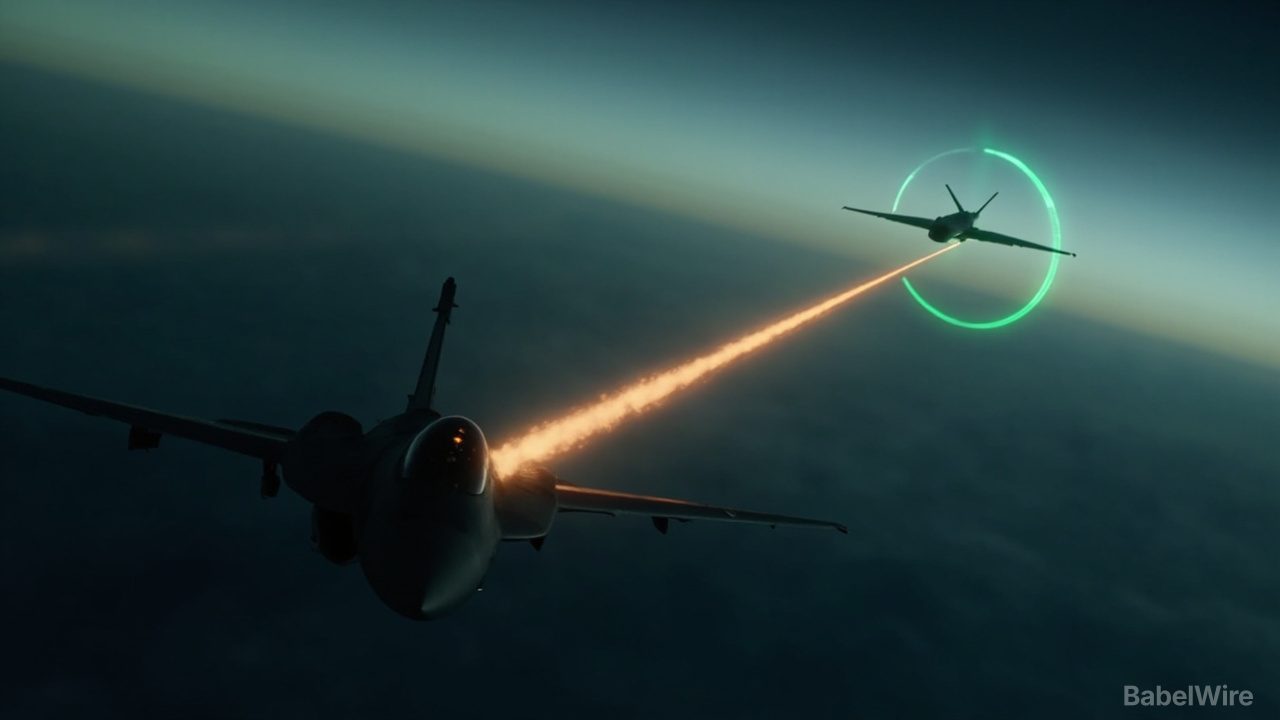
An F-22 Raptor pilot has taken control of Anduril's Fury combat drone in flight, Golem reports — the first time a pilot in a crewed fighter has directly flown one of the US Air Force's Collaborative Combat Aircraft.
The detail is small; the implication is not. CCAs are not the remotely piloted drones of the past two decades, flown by a ground crew sitting in a container in Nevada. They are built to fly themselves: to accept a task — screen ahead, jam that radar, carry these missiles, be at this point at this time — and execute it while the human in the cockpit commands intent rather than stick and rudder. Autonomy is the product. The human is supposed to be a supervisor.
A pilot seizing the controls tests the one seam that concept cannot avoid: the handover. For those minutes the aircraft stops being a teammate and becomes a vehicle flown by someone in another aircraft, through a datalink, at combat speed, with a human's reaction time at one end and aerodynamics at the other. Everything that makes a fighter pleasant to fly — the tight loop between hand and control surface — now runs through a radio link that an adversary would very much like to jam.
That is why the milestone is worth more than a press release. The Air Force's CCA programme, Increment 1, has two competitors flying: Anduril's Fury and General Atomics' YFQ-42A. Both have flown. What has been missing is evidence that a crewed fighter's pilot can reach into a drone's control loop without the whole thing degenerating into a slow, fragile remote-control session — and that the drone hands control back without drama.
The engineering problems are unglamorous and hard. Latency budgets shrink to nothing at merge speeds. Bandwidth is contested: the spectrum the drone needs for command is the same spectrum an electronic-attack aircraft will fill with noise. Lost-link behaviour has to be defined in advance and has to be safe, because a drone that goes stupid when the link drops is a hazard to its own side. And the human's attention is the scarcest resource in the cockpit — a pilot already managing sensors, weapons and a wingman has very little left over to fly someone else's aircraft.
There is a doctrinal question underneath the technical one. The point of a loyal wingman is that it absorbs risk so the expensive, irreplaceable human does not have to. The moment a pilot starts hand-flying the cheap aircraft, he is doing the thing the cheap aircraft was meant to spare him — and doing it while distracted from his own jet. Air forces will have to decide deliberately when handover is worth its cost, rather than treating it as a capability that exists because it can.
What the test does not prove is combat employment. A successful handover on a range shows the pipe works under benign conditions. It says nothing yet about a contested electromagnetic environment, with a pilot simultaneously defending himself and a drone that has to decide, on its own, whether the silence on the link means jamming or a dead radio.
Accountability is the unresolved layer. A drone flying itself under a pilot's tasking is already a legal grey zone when something goes wrong; a drone being actively flown by a pilot in another aircraft collapses the distance between decision and effect in a way rules of engagement were not written for.
What to watch: whether handover becomes a trained procedure in the syllabus or stays a demonstration; the Increment 1 production decision between the two vendors; and whether the next increment pushes toward more autonomy or more teleoperation. The second would be a quiet admission that the autonomy is not yet trusted.