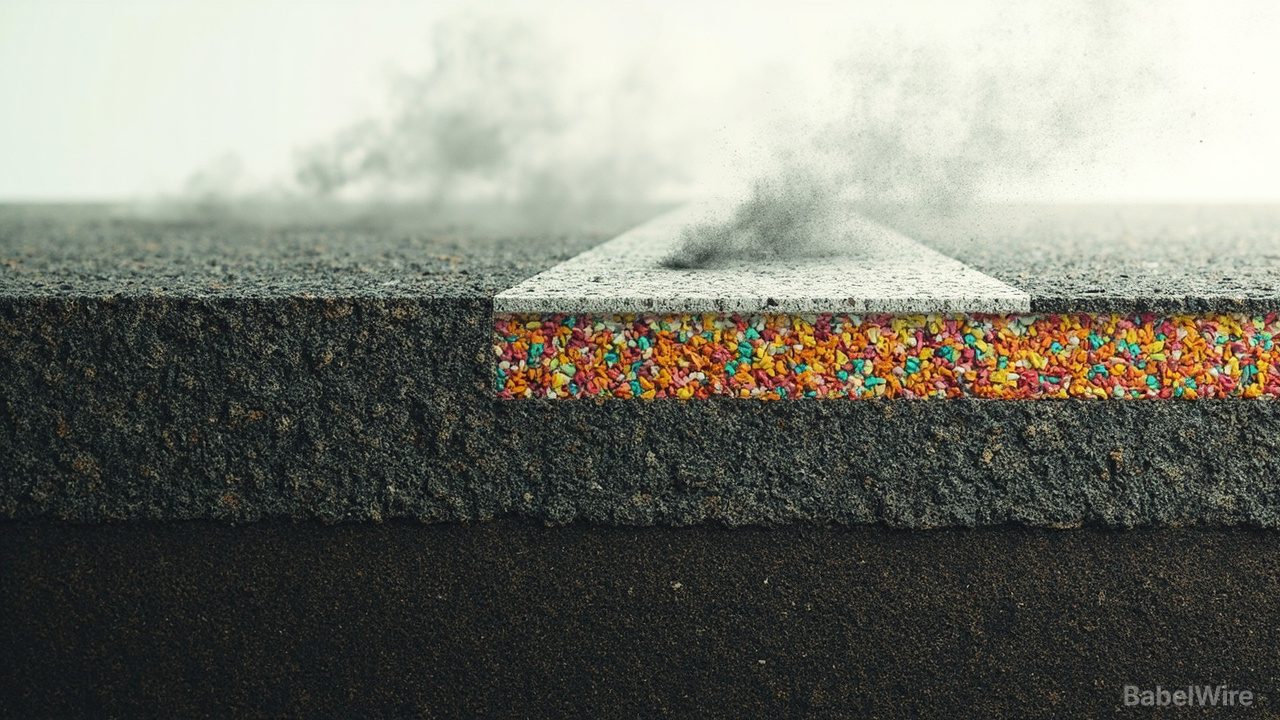
Adding plastic waste to road asphalt is one of those ideas that sounds like it solves two problems at once and has spent a decade failing to prove it. Golem reports a road-building test in which plastic-modified asphalt released fewer particles than the comparison mix. Taken at face value, that is the first kind of evidence the concept actually needs: not a laboratory argument about binding, but a measurement of what comes off a real surface under real traffic.
The premise is simple enough. A fraction of the bitumen binder is replaced with processed plastic waste, which is abundant, cheap, and otherwise destined for landfill or incineration. Field trials have run for years — in India, the Netherlands, the UK — and the results have been mixed in the way that infrastructure results usually are: promising short-term mechanical performance, unclear behaviour over a service life, and very little data on what the material does as it ages.
The particle measurement is the interesting part, and also the part that needs the most care. 'Fewer particles' is not one number. Road surfaces shed in several distinct ways: tyre and road wear particles generated by abrasion, fine mineral dust from the aggregate, and — in a plastic-modified mix — potentially polymer fragments from the binder itself. A test that reports a lower total can be good news about wear resistance while saying nothing about the composition of what remains. If the mix sheds less mass overall but a larger share of it is polymer, the environmental ledger is not obviously better.
There is a second accounting problem, and it is the one critics keep returning to. A road is not a closed system. Plastic in a binder is exposed to UV, water, salt, freeze-thaw cycling and mechanical stress for decades, and the end-of-life question is unresolved: asphalt is one of the most successfully recycled materials in construction, and a polymer-modified binder complicates the milling and remixing loop that makes that recycling work. A material that performs well in year three and contaminates the recyclate in year twenty has moved the problem, not solved it.
That is why the framing of any positive result matters. A test showing reduced particle release is evidence for durability — plastic-modified binder may indeed be tougher, and tougher surfaces abrade less. It is not evidence that the plastic stays put, and the two claims get conflated constantly in coverage of plastic roads. The first is a materials-science finding. The second is the one that determines whether this belongs on a road or in a landfill.
What would make the case properly: leaching studies on aged samples rather than fresh ones, a full lifecycle accounting that includes the recyclate, and wear-particle composition analysis rather than total mass. Those are unglamorous, expensive, and slow — which is precisely why a decade of trials has produced so few of them.
None of this makes the German result worthless. Particle release from road surfaces is a genuine air-quality and water-quality problem, and anything that reduces it deserves testing rather than dismissal. But the correct conclusion from a single favourable test is narrow: this mix, in this configuration, shed less. The question of what it shed is still open, and it is the question that decides the idea's fate.