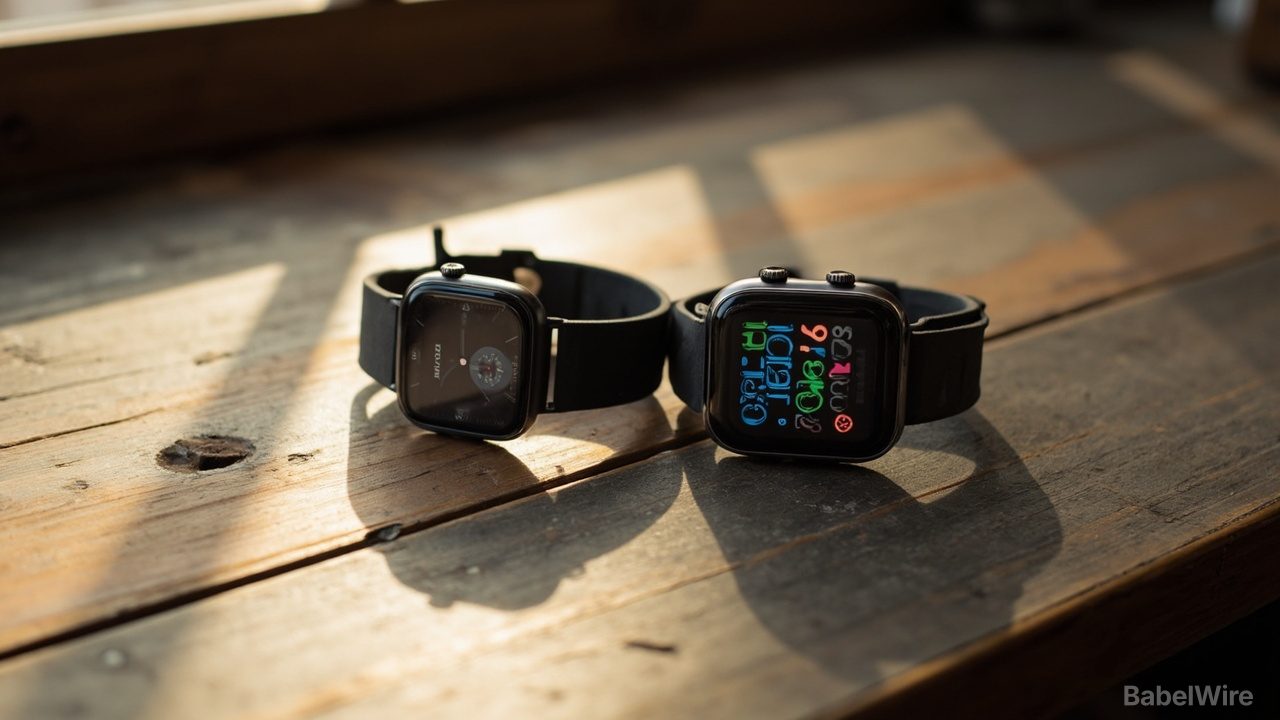
c't uplink's smartwatch test this week does something more useful than ranking fitness sensors: it puts the revived Pebble next to Google's Pixel Watch 5 and lets two philosophies of the wrist computer argue it out.
The Pixel Watch line is the industry's consensus answer. Wear OS, an always-on colour display, an assistant on the wrist, LTE options and Fitbit's health stack — a small phone that happens to be strapped on, with the battery life that implies. Google has iterated on that formula for five generations.
The Pebble that came back is the opposite bet. When Google open-sourced PebbleOS in January 2025, Eric Migicovsky — the founder who sold the original company to Fitbit in 2016 — used it to bring the hardware back through his new outfit, Core Devices: e-paper displays, physical buttons, an app catalogue inherited from the original ecosystem, and battery life measured in weeks rather than a day. No assistant worth the name, no app-store gravity, none of the sensor arms race.
That the revival exists at all is the story. Pebble died in 2018 as a casualty of a market that had decided smartwatches should be feature phones, and for seven years the "dumbwatch" idea survived only as a niche of Garmin and Casio buyers. The new Pebbles were funded by people who wanted the old thing back, not a better version of the new thing.
The c't comparison is the first time that demand has been tested against a current flagship rather than against nostalgia. The trade-off it exposes is genuinely binary: weeks of battery and a screen you can read in sunlight, or a watch that answers, tracks and nags. Both are legitimate; for a decade the industry pretended only one was.
Two caveats keep the comeback from being a sure thing. First, an open-source watch OS outlives its vendor, but the hardware does not: parts, repair and a tiny company's attention span are all single points of failure. Second, "weeks of battery" is only an advantage if the watch does the thing you actually need — and for many buyers that thing is now the health sensor.
What the test really shows is that the smartwatch market has stopped converging. The wrist is wide enough for a tool and a trinket at the same time, and the revived Pebble is the first product in years to make that choice explicit instead of pretending it was already settled.