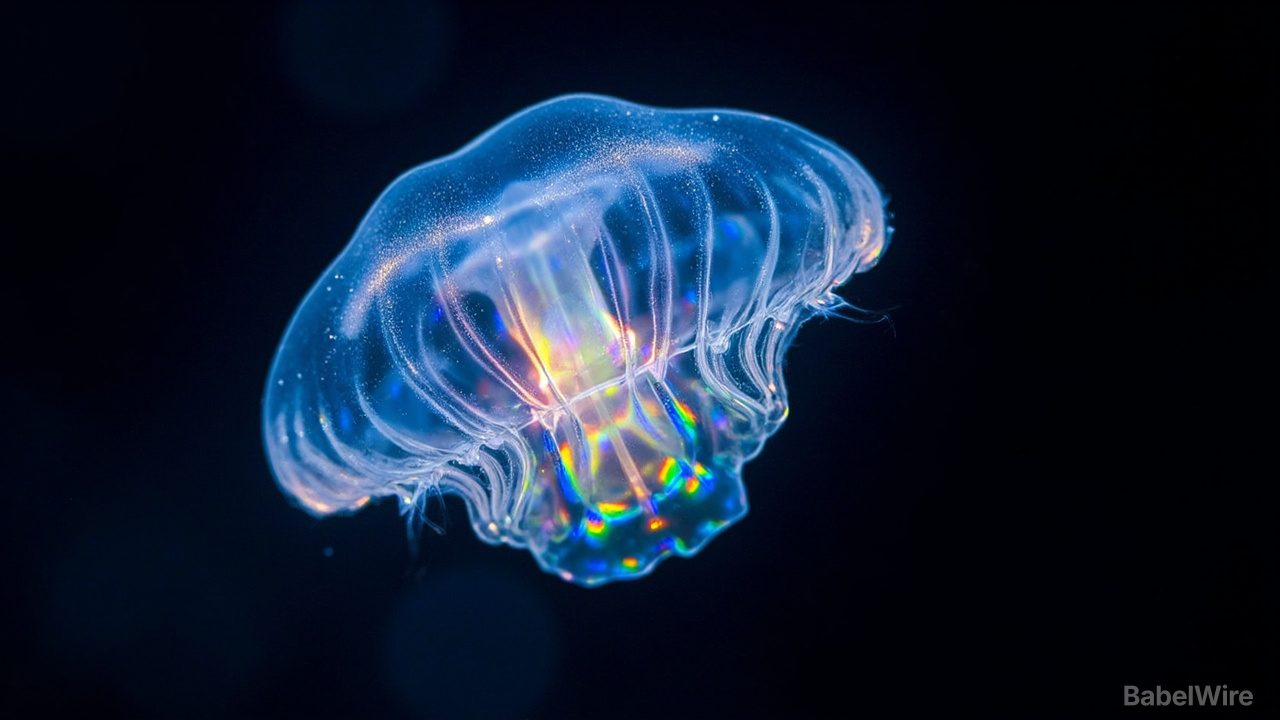
Around 700 million years ago, a group of organisms resembling little more than glowing, gelatinous blobs split off from the rest of the animals, forming possibly the earliest branching animal lineage. Nearly 200 species of ctenophores, commonly known as comb jellies, live today in environments ranging from the cold depths of the sea to warm coastal surface waters.
Over the past decade, ctenophores have helped answer long-standing questions about fundamental biology, from how early nervous systems evolved to the origins of bioluminescence. A landmark 2023 paper analyzing chromosome organization found that ctenophores, not sponges, are the sister group to all other animals — overturning more than a century of scientific consensus.
What makes this all the more surprising is that sponges lack muscles and neurons, while ctenophores have muscles and exhibit evidence of a simple nervous system. "If you think about the earliest branching animal lineage, you would expect less complexity," said Pawel Burkhardt, an evolutionary biologist at the University of Bergen. "That changes a lot of the assumptions about how the very first animal may have looked."
Using volume electron microscopy, Burkhardt's lab identified 17 unique cell types in Mnemiopsis leidyi — 11 previously unknown — in the aboral organ, a structure that helps ctenophores sense light, pressure, and gravity. The research also revealed a nerve net whose neurons are connected by continuous cytoplasm but with no synapses between them, suggesting evolution may have crafted nervous systems twice independently.
Further discoveries include evidence that looped DNA may have evolved 150 million years earlier than thought, and insights into how the most abundant light-emitting molecule in the ocean — coelenterazine — evolved across distant branches of the animal tree. Deep-sea comb jellies also harbor special plasmalogen lipids that help them withstand extreme hydrostatic pressure, a biomolecule also important in human brain health and linked to neurodegenerative diseases like dementia.