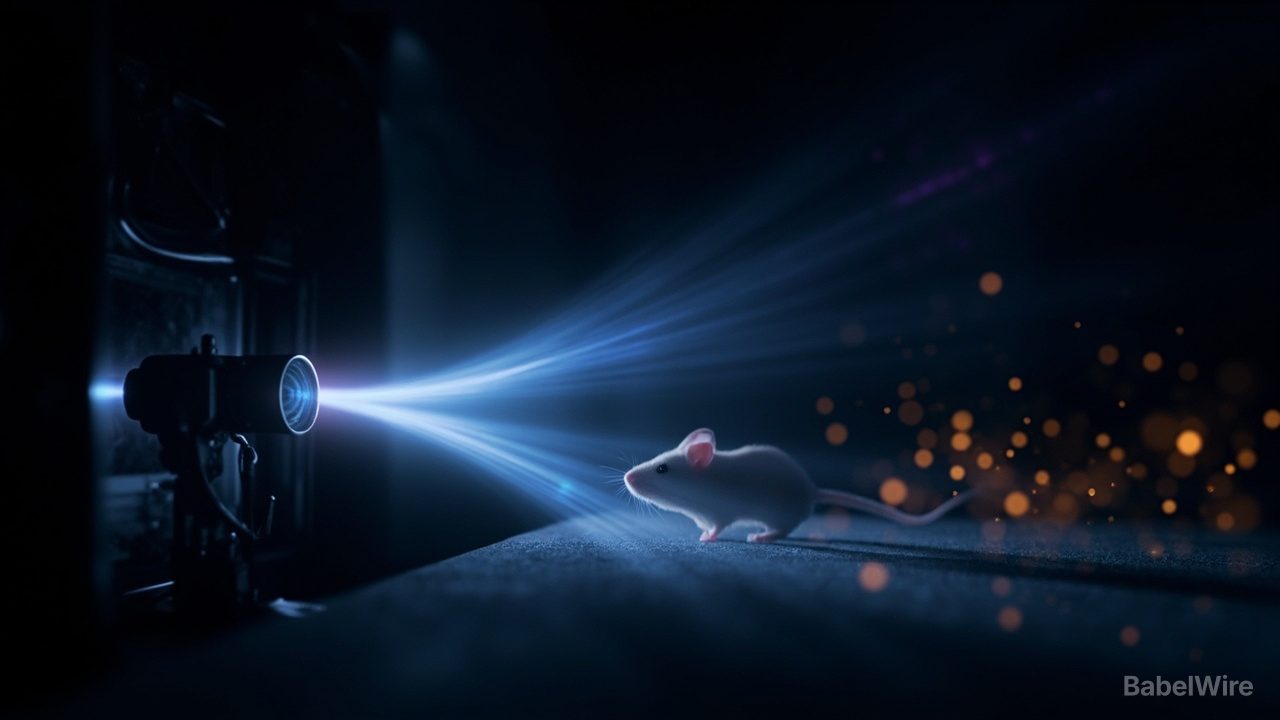
In 2025, quantum physicist Daniel Oblak and his colleagues published images that made headlines: four anaesthetized mice placed in a dark chamber emitted a ghostly glow, picked up by a sensitive camera. When the mice were killed and imaged again, the glow was gone. 'It was as if the researchers had photographed life itself,' writes Nature in a feature examining the field of 'biophotons' — the ultra-weak light emitted by living cells.
The emissions stem from metabolic processes inside cells, mostly in their mitochondria. As oxygen-based metabolism produces short-lived reactive oxygen species, excited molecules relax and release energy as photons — a few tens to hundreds of photons per square centimetre per second, just below the limit of human vision, and distinct from both heat radiation and the bright light of fireflies.
The idea that cells might communicate with light dates to the 1920s, when Russian biologist Alexander Gurwitsch reported that onion root tips could trigger cell division in neighbours through quartz (UV-transparent) but not glass barriers. Later work was hard to replicate, and the field was long tainted by pseudoscience associations. But more sensitive detectors and rigorous methods have revived it.
Researchers are now testing whether biophoton patterns can reveal disease. Earlier this year, a team led by Maurizio Benfatto reported differing emission patterns in healthy brain cells versus glioblastoma cells, and Nirosha Murugan's group found the same for healthy skin cells versus melanoma cells — she is recruiting participants to test whether photon counts can distinguish benign moles from melanomas without a biopsy. The University of Calgary team has also reported differences between healthy rat hippocampus tissue and tissue from rats with a chemically induced Alzheimer's-like condition, suggesting a future photonic chip inside the skull could monitor the disease. Other applications being explored include scanning plant seeds for viability and checking donated organs before transplant.
Far more controversial is the idea that cells actually react to each other's light. Experiments by Rhys Mould's team at the University of Westminster found that a toxin added to one container of isolated mitochondria decreased respiration in adjacent sealed containers — an effect blocked by aluminium foil. Michal Cifra of the Czech Academy of Sciences, a frequent critic, says the effects are often hard to reproduce but 'I'm not discarding the possibility for this phenomenon to be real.'
'It's a whole new signal you can look at. I think we have really only scratched the surface,' says Christoph Simon of the University of Calgary. Skeptics like Brian Wilson of the University of Toronto caution that for diagnostics, 'the signal is just far too weak.'