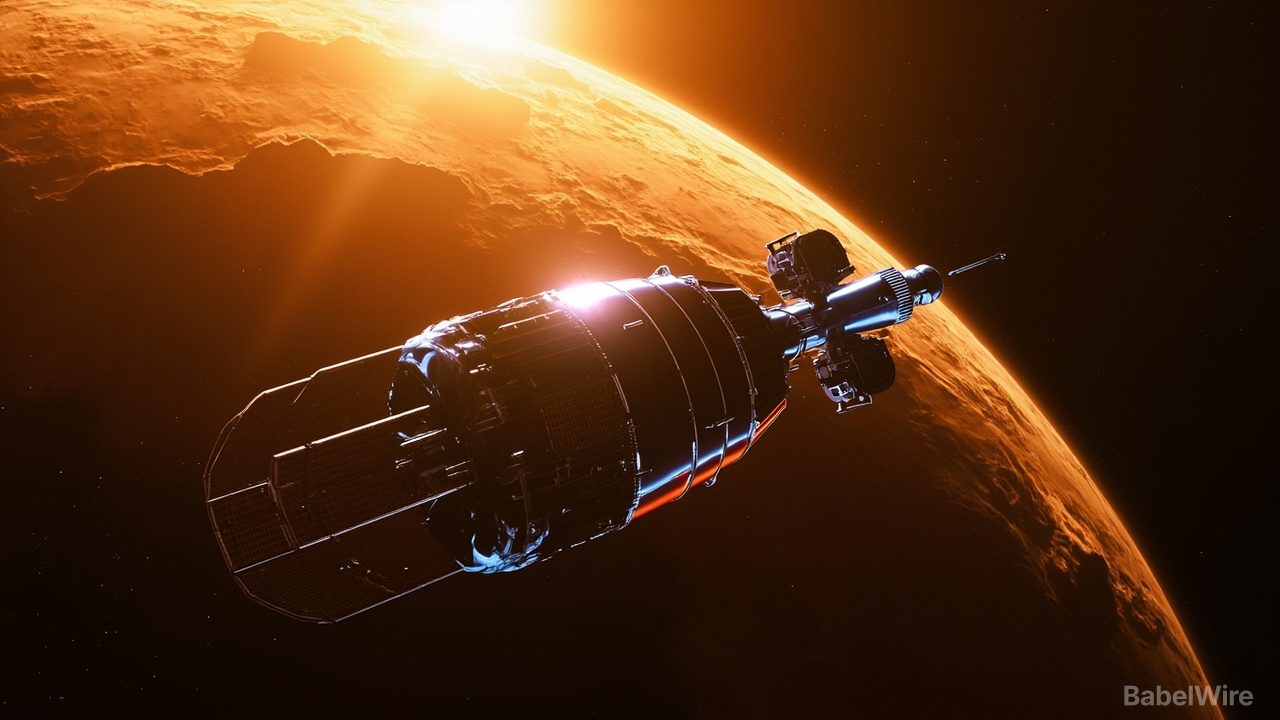
Europe's BepiColombo mission cleared a major milestone this week in the final stretch of an eight-year voyage to Mercury, jettisoning the propulsion module that has powered it since launch as it prepares to enter orbit around the Solar System's innermost planet in November.
BepiColombo is a roughly $2 billion mission led by the European Space Agency with contributions from Japan and the United States. Since its launch in 2018, the spacecraft has spiraled toward the Sun using the most powerful electric propulsion system ever flown in deep space — four gridded ion thrusters — combined with an unprecedented nine planetary flybys of Earth, Venus and Mercury. Reaching orbit around Mercury requires more energy than flying past Pluto, which is why the mission needed so many gravity assists.
On Thursday 3 September, at a distance of about 39 million miles (63 million km) from the Sun, the spacecraft released the Mercury Transfer Module, the section carrying the ion thrusters and solar arrays. Four springs pushed the sections apart, and telemetry downlinked to Earth confirmed that the European-built Mercury Planetary Orbiter's solar arrays were generating power and recharging its batteries.
ESA managers described the separation as risky — "equivalent to launching a new spacecraft," in the words of Ignacio Tanco, ESA's head of inner Solar System operations — because the remaining stack had to take over power, pointing, propulsion and thermal control on its own, using new sensors and mechanisms never tried so close to the Sun. Several science instruments, including the mission's best cameras, had been blocked by the transfer module during the cruise and are only now seeing first light.
BepiColombo is in fact a stack of three spacecraft: the transfer module, ESA's Mercury Planetary Orbiter and Japan's Mercury Magnetospheric Orbiter, nicknamed Mio. The two orbiters will separate from each other in December, soon after arriving in their initial orbits around Mercury, with routine science observations beginning next April. ESA's orbiter will study the surface from a lower orbit; Mio will map magnetic fields, plasma and dust from higher up. Together they will deliver the first dual-spacecraft view of how the solar wind shapes the planet — and help answer questions raised by NASA's MESSENGER mission about Mercury's composition, the water ice suspected in polar craters, and the planet's origins.
The road has not been smooth: the ion thrusters lost partial power in 2024, extending the cruise by a year. The spacecraft has now covered more than 6 billion miles (10 billion km) and is on track for Mercury orbit insertion on 21 November. "Mercury is a challenging destination," said Santa Martinez, ESA's mission manager for BepiColombo. "For the first time in space exploration, we are bringing two spacecraft to the vicinity of the planet, and we are going to put them in orbit around this mysterious body."