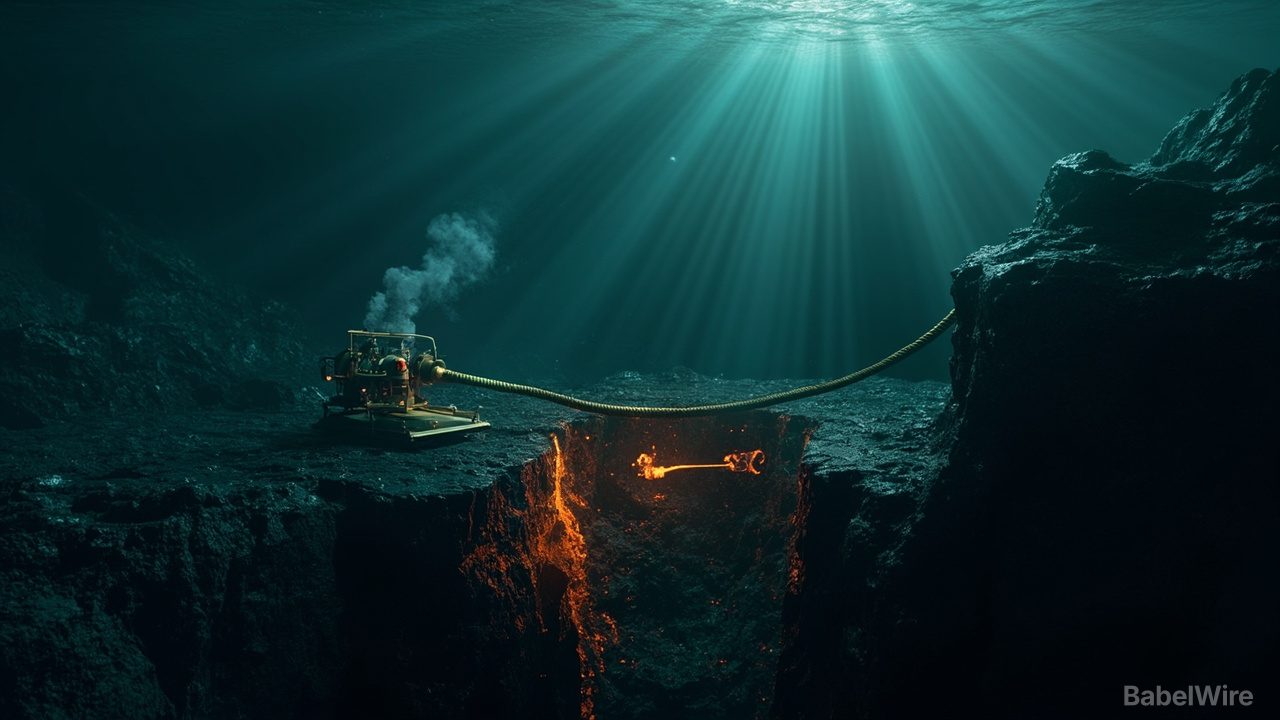
Ars Technica reports that a startup has tapped an underwater volcano as an energy source, in what the company calls a "proof point" test. The phrase is doing a lot of work, and it deserves to be read carefully: a proof point is not a power plant. It is an argument that the physics and the plumbing can be made to cooperate long enough to be measured.
The idea itself is old and sound. Wherever magma rises close to the seafloor, seawater percolates down, heats to hundreds of degrees and returns through vents. That is a heat engine already running, free of fuel, in a place with no land, no grid and no neighbours to object. Offshore geothermal tries to intercept that heat deliberately: drill into a hot formation or a vent field, bring high-temperature fluid to a power-conversion unit on the seabed or on a platform, generate electricity, and send it ashore or to an offshore user. Unlike wind and solar, the resource does not care whether the sun is up or the wind is blowing, which is why every serious grid-modelling exercise eventually asks whether there is a cheaper baseload answer than storage.
What makes it hard is everything else. Seawater at depth is corrosive and full of dissolved minerals that precipitate out as the fluid cools, scaling up pipes and heat exchangers. Subsea hardware must survive years without a technician walking to it. Cables, connectors and pressure housings fail in ways that require ships and remotely operated vehicles to fix. Permitting spans maritime law, environmental review and, in volcanic settings, genuine geological uncertainty about whether the reservoir behaves the way the model says it will. And a thermal resource is only worth what you can convert it into: the efficiency of a low-to-medium temperature cycle is modest, so small demonstration numbers can look disappointing even when the underlying resource is large.
That is the correct frame for this test. Ars describes a demonstration rather than commercial operation; the startup's own language, "proof point", signals the same. The valuable output of such a test is not megawatt-hours but data: flow rates sustained over time, the chemistry of what comes up, how much the equipment fouled, how the reservoir pressure responded. Those numbers decide whether the next step is a pilot plant or a write-off.
Details not independently confirmed here include the company's identity, the site and its depth, the generating capacity demonstrated, the duration of the test, the temperature of the produced fluid and the intended route to market. Readers should treat specific performance figures as pending until the company publishes them or an independent party inspects the installation.
Why it is worth watching anyway: the world's demand for firm, clean power is rising faster than the list of technologies that can supply it, and undersea volcanism is one of the few resources that is enormous, geographically distributed along plate boundaries, and largely untouched. Iceland has proven that geothermal works at scale on land. The open question is whether the economics survive the transition to salt water, and that question is answered one expensive, unglamorous, instrumented test at a time.