Almost every serious plan to cut emissions runs through a battery. That is what makes Ars Technica's question the right one to be asking now, before the manufacturing base is locked in: if batteries are meant to reduce emissions, how do we reduce the emissions of the batteries themselves?
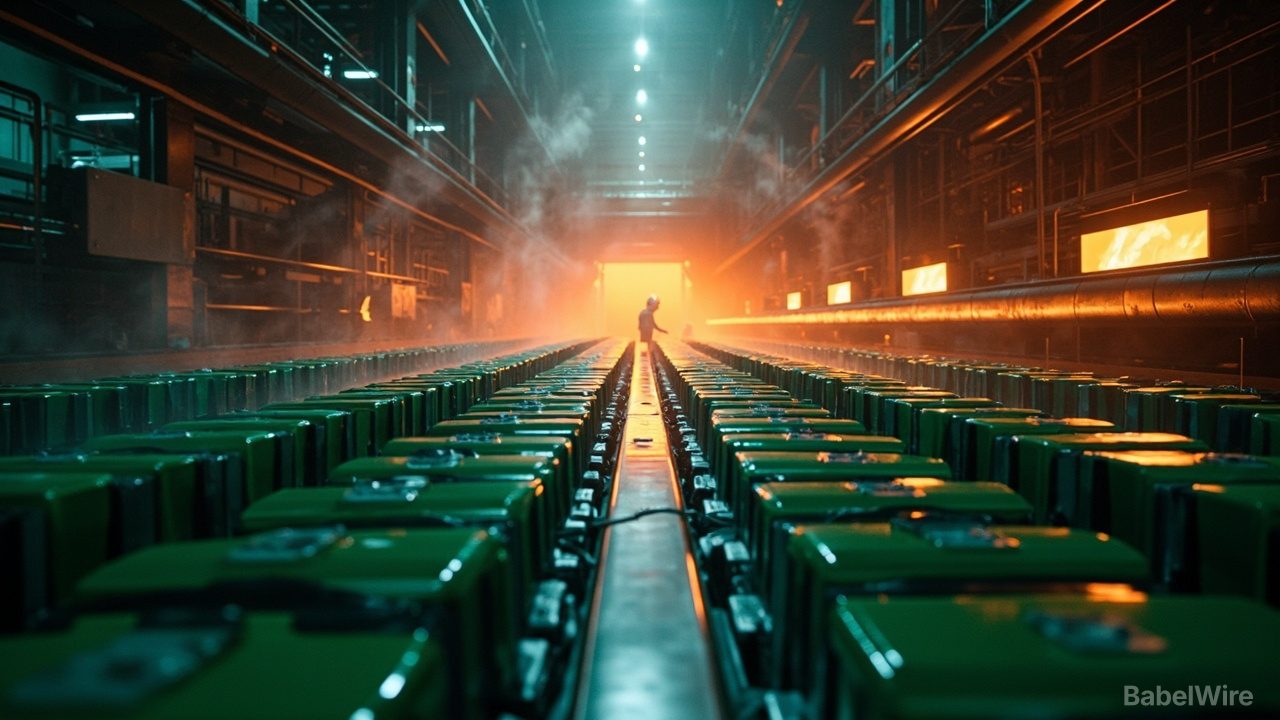
The footprint is not where most people guess. A battery's climate impact is dominated by production rather than by the years it spends cycling on a wall or in a car — mining and refining lithium, nickel, cobalt and graphite; sintering cathode powder in furnaces that run for hours at several hundred degrees; coating and drying electrodes in humidity-controlled rooms; assembling cells. Do all of that with coal-fired power and the pack arrives carrying a debt that a decade of clean driving only slowly repays.
The levers are well understood, which is the encouraging part.
Chemistry is the biggest. LFP cells — no nickel, no cobalt — have gone from a niche, low-range choice to the default for stationary storage and a large share of new electric vehicles, and their production footprint per kilowatt-hour is materially smaller. Sodium-ion, further behind, removes lithium from the equation entirely.
Process is the second. Conventional electrode manufacturing uses a solvent that has to be evaporated in long ovens; dry-electrode processes skip the solvent and the ovens with it. Every kilowatt-hour of gas burned in a drying line is a kilowatt-hour that eventually shows up in the carbon account.
Location is the third, and the most underrated. A cathode plant drawing on a grid with a high share of renewables or nuclear produces the same cathode with a fraction of the emissions of one drawing on coal. As grids decarbonise, existing factories get cleaner without changing a single process step — but only if the plant was built somewhere the grid is heading.
Then there is circularity. Recycled nickel and cobalt carry a fraction of the footprint of primary metal, and the first wave of packs sold in the 2010s is now reaching end of life. Recycling is not a moral bonus; it is a supply-chain strategy that happens to be a climate strategy too.
Policy is catching up. The EU's batteries regulation requires, in stages, a carbon-footprint declaration for EV batteries, which turns the footprint into a trade question and not only an environmental one.
The honest summary: batteries remain an overwhelmingly good trade for the climate. But 'electric' is not a synonym for 'clean', and the build-out of manufacturing over the next decade will decide how much of the benefit survives contact with reality.