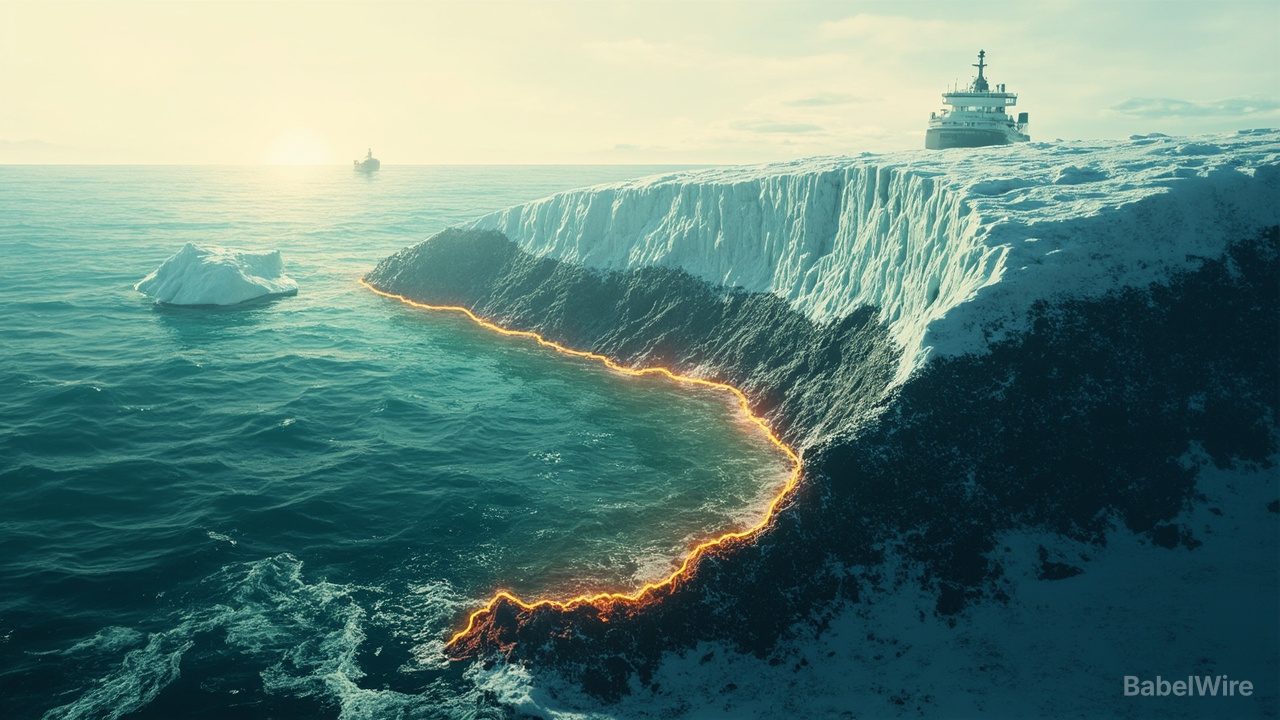
New research offers a more reassuring twist in the story of thawing permafrost: although ancient carbon is pouring into the Arctic Ocean as frozen ground erodes, most of it is being buried in the seafloor rather than released into the atmosphere as greenhouse gas.
Published in Nature Geoscience, the study by the Alfred Wegener Institute and MARUM – Center for Marine Environmental Sciences at the University of Bremen examined sediment cores collected near Qikiqtaruk (Herschel Island) off Canada's Yukon coast. The cores, spanning roughly 50 years of deposition, show that only about 10% of the organic carbon swept into the sea is converted into gases by microorganisms; the rest stays trapped in the seabed.
The stakes are enormous. Arctic permafrost holds around 1,300 gigatonnes of organic carbon — much of it from ancient plant remains — with another 400 gigatonnes stored in ocean sediments and river deltas. As the Arctic warms faster than any other region, coasts are crumbling: up to 0.02 gigatonnes of carbon now enter the sea each year, an outflow forecast to rise 70–150% by 2100.
"Surprisingly little of it ends up in the ocean's active carbon cycle," said lead author Manuel Ruben of the Alfred Wegener Institute. "Microorganisms convert around ten percent of the organic carbon from the sediments into gases."
Using carbon isotopes in pore water — 13C to identify whether microbes ate land or sea carbon, 14C to distinguish old permafrost carbon from fresh algal remains — the team found that sediment microbes are "gourmet" eaters that prefer fresh marine carbon. Because of that preference, ancient permafrost carbon may contribute less to atmospheric greenhouse gas levels than once feared.
The researchers caution that the full picture is still open: some permafrost carbon may already be broken down before it reaches the seabed, and the influx of eroded sediment is darkening coastal waters, dimming the sunlight that algae need and potentially reshaping the food web that supports fish, crustaceans and seals. The team plans to investigate further during the international "Arctic Pulse" campaign in 2027, using the research icebreaker Polarstern. "This provides an important foundation for climate models that can predict the consequences of permafrost thawing for the global climate," said Ruben.