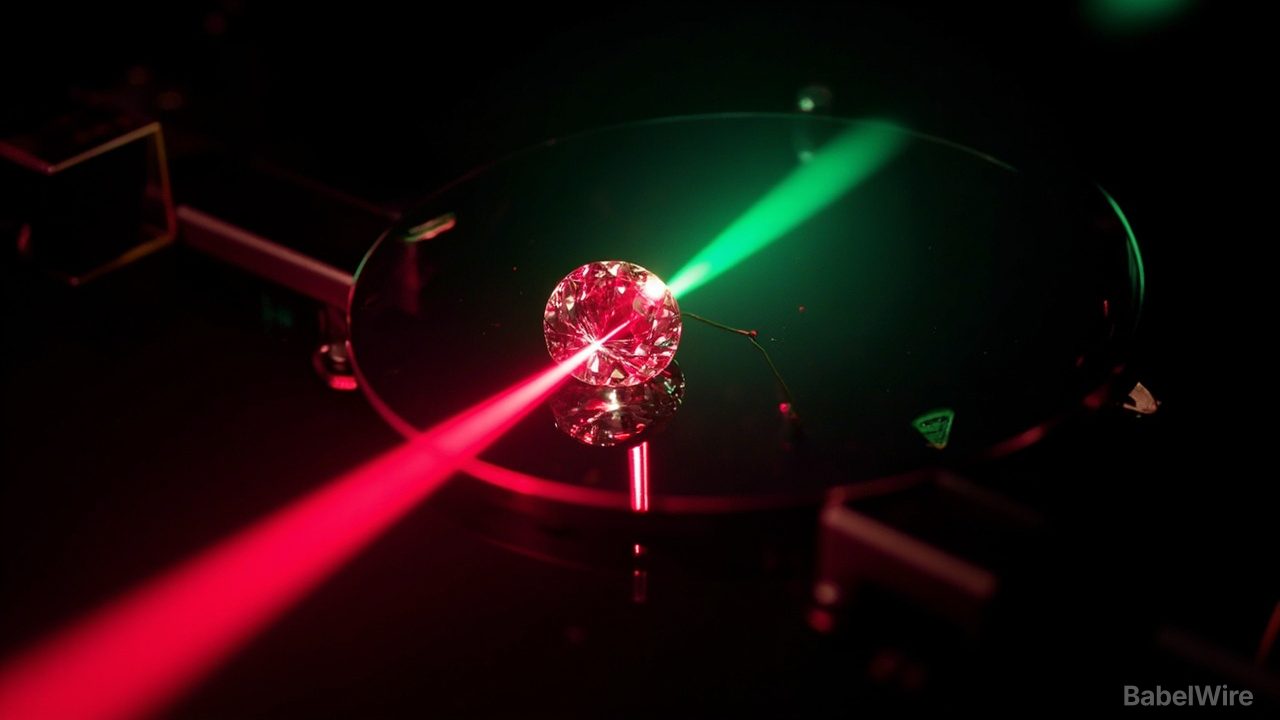
A nitrogen-vacancy centre is a defect in diamond's lattice: a nitrogen atom next to an empty site. The unpaired electron there has spin states the lattice keeps stable, which is why they respond to magnetic fields, temperature and strain — and why they have been the most versatile solid-state quantum sensor for over a decade. Reading them out has almost always meant fluorescence: a green laser excites, microwaves flip the spin, and the brightness of the red glow tells you where resonance sits. The limit was never the physics. It was the contrast. Fluorescence signals are weak, and the optical contrast lands in the low single digits.
The group led by Florian Schall at Fraunhofer IAF in Freiburg replaced the readout step entirely. The NV-doped diamond no longer sits in front of a detector; it sits inside a laser cavity, next to the semiconductor gain medium of a near-infrared laser at 1042 nanometres. The microwave frequency is held fixed. Change the magnetic field and the population of centres in the singlet state shifts — and those centres absorb the laser light. Because the laser runs just above threshold, a tiny extra absorption produces a large drop in output. At spin resonance it switches off completely.
The result is 100 percent optical contrast instead of a few percent, with output swinging from more than 50 milliwatts to zero. According to the results published in Nature Communications, that range yields roughly a 500-fold improvement in the ratio between the fundamental sensitivity limit and the dynamic range, compared with the best fluorescence-based sensors. And because absorption depends on the projection of the field onto the NV axis, all three components of the field vector can be extracted without a separate coil set.
Why it matters: NV magnetometers have always been the most portable quantum sensor and the least competitive on dynamic range. A device that works at room temperature, needs no cooling, and can now resolve faint fields while also spanning strong ones without saturating is interesting for magnetoencephalography and cardiac imaging, for navigation where GNSS is denied, and for mineral exploration — every case where today's instruments force a choice between sensitivity and measuring range.
The caveats deserve stating. This is a bench setup with a bulk diamond and a cavity that has to stay stable; sensitivity depends on holding the laser at threshold, and an absorption measurement is more exposed to thermal drift than a simple brightness reading. The paper describes a proof of principle, not an instrument. The route to a product runs through photonic integration — cavity and gain medium on one chip — and through diamond layers that can be grown reproducibly with a defined NV density.
Still, the direction is the interesting part. Quantum sensing has long been sold on sensitivity and has stumbled in the field on dynamic range: a sensor that resolves a nanotesla but goes blind at a millitesla is of limited use outdoors. Rebuilding the readout so that the sensor itself becomes the switch is the more pragmatic contribution, and it fits existing semiconductor fabrication better than any fluorescence optical train.