Zipline has raised $1.5 billion at a $21.5 billion post-money valuation — nearly triple the $7.6 billion it was worth in January, when it raised more than $600 million. Paradigm, WCM Investment Management and Layer Global led the round, with participation from Valor Equity Partners, Fidelity, Uber, Tiger Global, J.P. Morgan, ARK Invest and Salesforce Ventures.
The second half of the announcement is the more interesting one operationally. Walmart and Zipline have signed a new multi-year agreement adding 300 drone delivery sites across the United States. The two currently operate 21 active sites together. That is the jump that turns a delivery business from a demonstration into a surface — a factor of fifteen, in a retail channel that already exists.
Zipline was founded in 2014 and started in Rwanda flying blood, later Ghana and Nigeria; it now delivers in five African countries, several US cities, and Japan. US operations began in 2020 with medical supplies for Novant Health in North Carolina, and the first Walmart agreement followed in 2021. The real unlock, though, was regulatory: in 2022 the company received Part 135 air carrier certification from the FAA, which authorised long-range commercial drone deliveries. Partnerships have accumulated since, including one with Uber earlier this year.
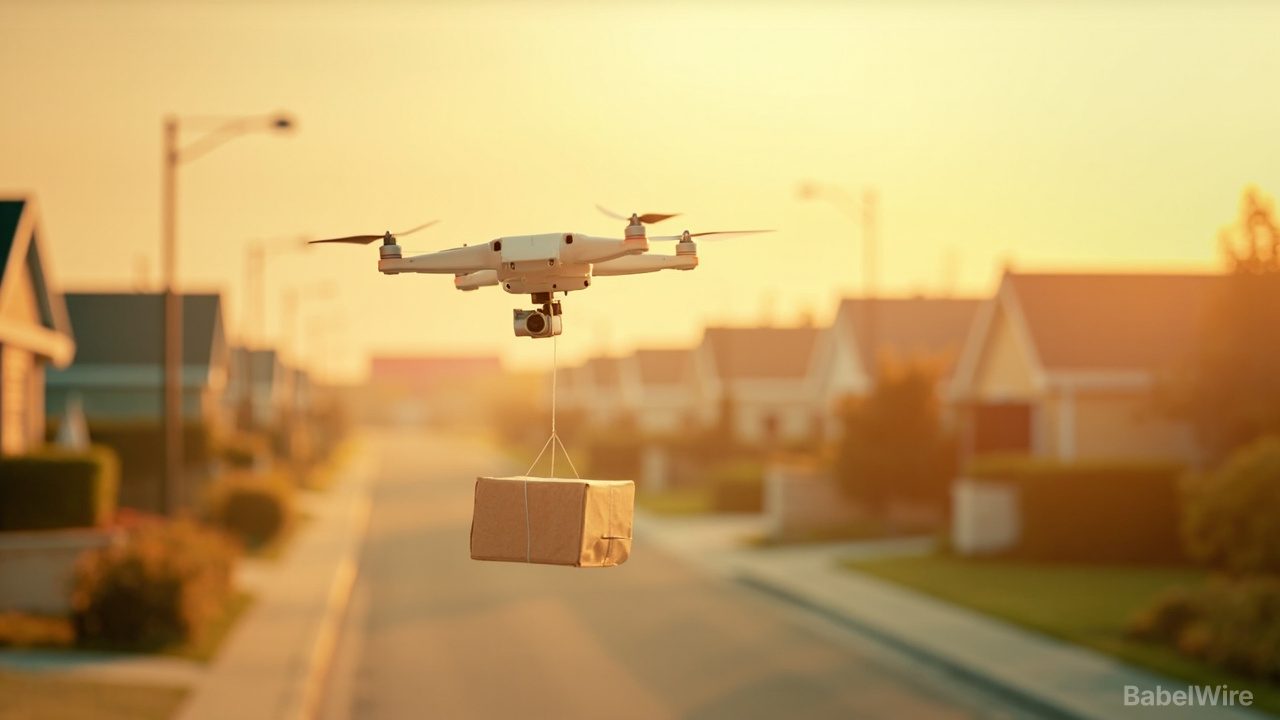
The fleet is deliberately split. Platform 2 handles doorstep delivery, carrying up to eight pounds within a ten-mile radius. Platform 1 flies longer routes for enterprise, business and government customers, covering 120 miles round trip. The new money is earmarked for US manufacturing capacity and hiring to build a national network.
The most telling sentence in the announcement is a number with no stated denominator. Zipline said its share of delivery revenue grew from 10.8% to 34.9% between March and October this year. The company did not specify the scope of that measure, whether it refers to the Walmart partnership, to US deliveries, or to something else. If it describes the partnership, it marks the point where customers start choosing the drone over the courier run. Without the denominator it remains a company figure.
The valuation is striking against its week. It lands days after the Nasdaq fell 5.5% on doubts about whether AI infrastructure spending can pay for itself. Zipline is the anti-data-centre: no three-digit-megawatt power contract, no chip supply agreement, just a physical service with visible unit costs. That investors added here while selling data-centre exposure is a bet that automation earns its money fastest where it can undercut a network someone else already paid to build.