Shield announced a definitive agreement on November 5 to acquire Echodyne Corp. for $5.3 billion — and what it is really buying is eyes. The company, which until recently branded itself Shield AI, gets compact solid-state radars built on Echodyne's metamaterial electronically scanned array (MESA) technology, hardware that sits inside hundreds of counter-drone and security systems used by defence, government and commercial customers in more than 40 countries.
The structure matters as much as the headline. Of the $5.3 billion, $4.8 billion is paid and issued at closing, with up to $500 million more contingent on Echodyne hitting agreed performance targets. Closing is expected in early 2027, subject to regulatory approval. The purchase is funded by $2.5 billion raised alongside it: a $1 billion Series H at a $28.8 billion post-money valuation, a $1 billion structured equity investment from funds managed by Blackstone, and $500 million in debt led by JPMorgan Chase as sole arranger. The Series H is co-led by Disruptive and Innovation X Capital, with participation from Advent, the Strategic Investment Group of JPMorganChase's Security and Resiliency Initiative, and Snowpoint Ventures.
For Shield, Echodyne is the third leg of a business that already spans software and aircraft. The company sells Hivemind autonomy software, the Aechelon simulation environment, and the V-BAT and X-BAT autonomous systems. Chief executive Gary Steele frames the goal as a "new-generation defense technology company" with three high-margin units — autonomy software, autonomous systems, mission systems — that reinforce each other. Echodyne founder and chief executive Eben Frankenberg stays on, reporting directly to Steele, and the MESA radars will remain available as standalone products.
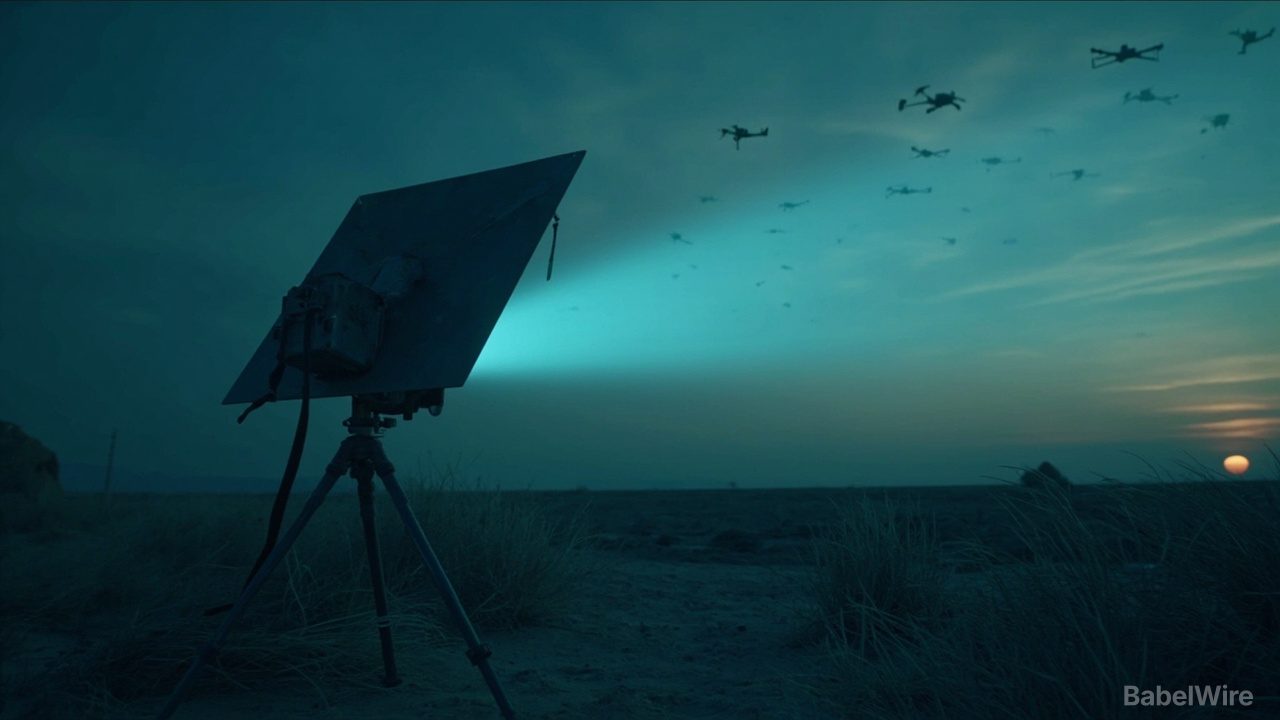
The timing is not incidental. In September, Echodyne won a contract with a $250 million ceiling from Joint Interagency Task Force 401 to supply counter-drone radar to US and allied forces. Its radars are integrated onto remote weapon stations, high-energy lasers and high-power microwave systems, and cue interceptors toward incoming drones. Civilian operators use the same hardware to keep stadiums and airports clear of unauthorised drones and to let police and fire departments fly safely in shared airspace. On the same day, NATO named 16 counter-drone systems from five companies as selected under its Drone Edge procurement framework.
The industrial base grows with the deal. Echodyne has just opened an 86,350-square-foot manufacturing facility in Kirkland, Washington — a $40 million investment able to produce roughly 30,000 radars a year. Shield had already named Washington as the production home for X-BAT in September. Both companies expect triple-digit revenue growth this fiscal year, a joint forecast rather than an audited result.
What is notable is the valuation logic. Shield is raising $2.5 billion to buy a company whose radars live inside other manufacturers' systems, and it is paying that much because sensing, not flying, is the current bottleneck in autonomy. Frankenberg's line in the announcement is the industry's thesis in one sentence: autonomous systems can only act on what they can sense, and superior sensors lead to superior systems. If you want to stop a drone, you first have to see it — and that particular chokepoint is now priced in the billions.
Sources
- shield.aiShield — Shield to acquire Echodyne in a transaction valued at $5.3 billion and raise $2.5 billion at a $28.8 billion valuation
- techstartups.comTech Startups — Top Tech News Roundup, November 5, 2026
- bizjournals.comPuget Sound Business Journal — Shield AI to buy Kirkland radar firm Echodyne for $5.3 billion