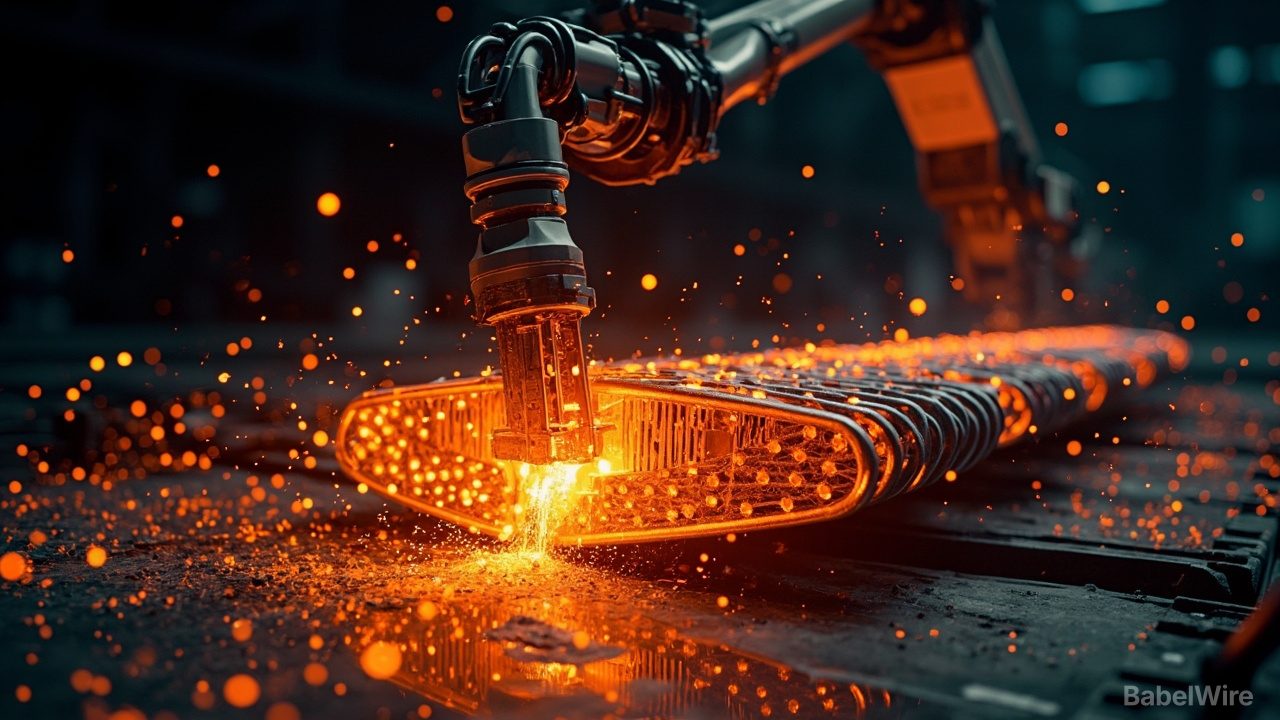
Metal additive manufacturing usually conjures images of a laser sintering fine powder inside a sealed chamber. A report from heise describes a different branch of the family that is drawing attention in aerospace: wire-arc additive manufacturing, or WAAM.
WAAM works more like welding than like printing. A robotic arm feeds a metal wire into an electric arc, melting it and depositing it bead by bead, layer by layer, until a near-net shape emerges. Because the feedstock is ordinary welding wire rather than specialised powder, the process is comparatively cheap to run, and because the arc can be moved over large areas, it suits big parts — brackets, ribs, structural sections and other components that are currently machined out of solid billets.
That last point is where the aviation interest lies. Subtractive machining removes most of a billet as chips, so a part that ends up weighing a few kilograms may start as tens of kilograms of expensive titanium or aluminium. Building the part up instead of cutting it down saves material, and it opens the door to geometries — hollow sections, integrated stiffeners, topology-optimised shapes — that are difficult or impossible to mill. Less material and freer geometry usually translate into less weight, and in aircraft every kilogram saved compounds across a lifetime of flying.
The catch is that none of this reaches a passenger cabin quickly. Additively built metal carries as-built surface roughness, internal porosity and residual stresses that must be removed by machining and heat treatment. Every process parameter — wire feed, arc current, travel speed, shielding gas, interpass temperature — influences the microstructure, so the material is only as good as the process window that produced it. Certification authorities require evidence that a printed part is at least as predictable and inspectable as the forged one it replaces.
The heise report frames WAAM as one of the reasons aircraft components are getting lighter, alongside the broader shift toward additive processes in the industry. Independent confirmation of specific parts, aircraft programmes or weight-savings figures is not available here, and WAAM's role is best read as part of a slow, qualification-bound transition rather than a sudden switch.
What is clear is the direction of travel: manufacturing is moving from carving metal away to putting it only where it is needed — and in an industry that pays for every gram, that is a structural change, not a cosmetic one.