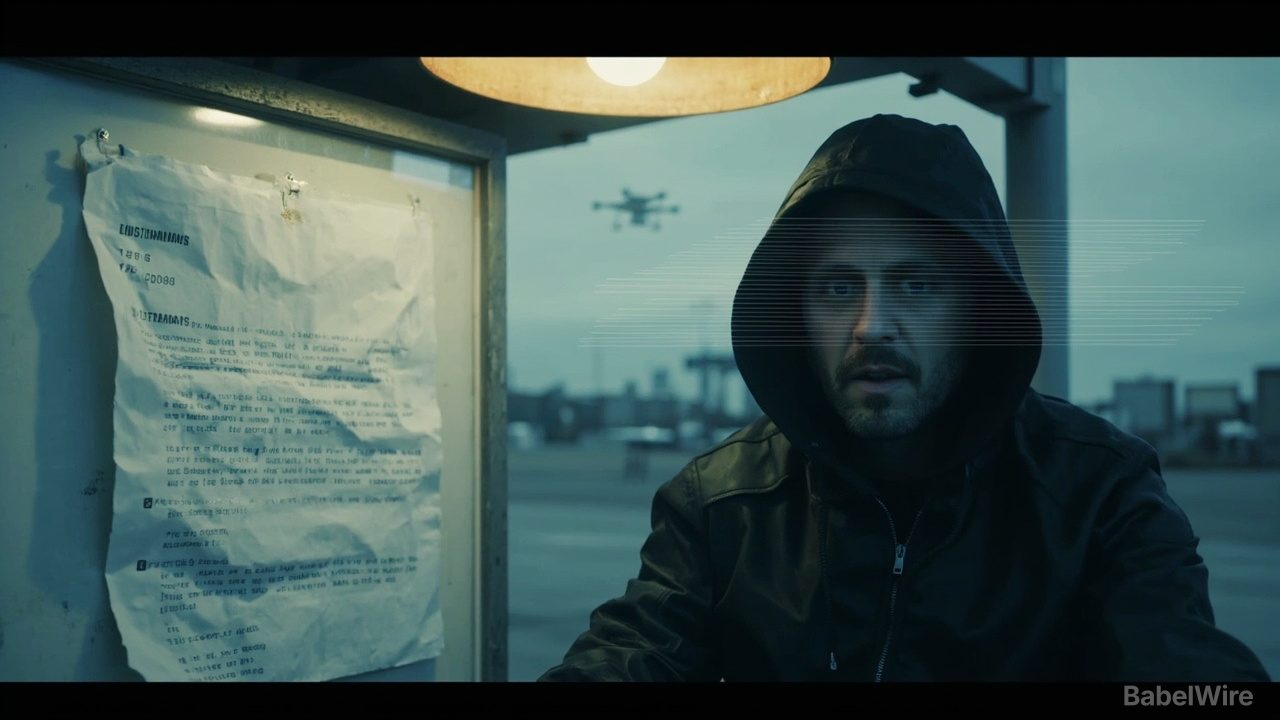
Germany's Federal Criminal Police Office has published a public manhunt notice for an unknown suspect in the attempted bombing of Leipzig/Halle airport — illustrated with images the office itself labels "KI-generiert", AI-generated.
The case is serious and unresolved. Late on the night of 4 August, an airport employee found a drone lying on the southern runway, immediately next to Ukrainian Antonov cargo aircraft. It was fitted with an explosive device and packed with explosives. A second drone and further explosives were found at the airport later in August during the investigation. The German government blamed Russia for the attempted attack in early September; Moscow rejects the accusation. Two suspects have been identified — according to research by NDR, WDR and Süddeutsche Zeitung, a Belarusian holding a Russian passport and a Russian-born man with a Latvian passport. The BKA believes a third, still unidentified person may also have been involved.
It is that third person the images are meant to find. According to the notice, the suspect is slim and notably over-dressed for high summer: a thick jacket, gloves, a hood, a baseball cap pulled low over the face, long dark trousers and a large black backpack — while riding an e-bike. Police place the person in the area of a connecting path between Rabutz and Beuditz, and near an industrial estate between Radefeld and Lützschena, between 31 July and 4 August. Investigators say a suspected drone launch site was located on the Rabutz–Beuditz path, and further suspected equipment was found near the industrial area. The manhunt is running on posters and leaflets as well as online.
The BKA's notice does not state what the renderings were based on. That is the gap worth noticing. A conventional composite sketch is already a negotiation between a witness's memory and an artist's interpretation; a generative image adds a model's learned priors about faces, skin and build on top of it, and renders the result in the uniform, confident texture of a photograph. Every published image of a suspect invites the public to match a face against strangers — and the more photographic the image looks, the stronger that pull is.
Labelling matters, and here the label is explicit and repeated in the captions. It is the minimum a police force owes the public when it puts a synthetic face on a poster: not "this is the person", but "this is a likeness produced by a model, from what we know". Whether the public reads a caption under a hooded figure at poster size is a different question, and one nobody has answered with evidence.
None of this makes the search illegitimate. The alternative — no image at all — leaves a description of a jacket and a backpack, which the notice also contains, and it is hard to argue the public is better served by that alone. What the Leipzig case shows is where European policing has arrived: a federal agency, in a case the government attributes to a state adversary, using generative imagery to ask millions of strangers whether they recognise someone.
The BKA is collecting tips through its online portal, by email, on +49 611 55 18777, and at any police station. Its questions are narrow and specific, which is the right shape for this kind of appeal: did you see this person, in these places, in these five days.