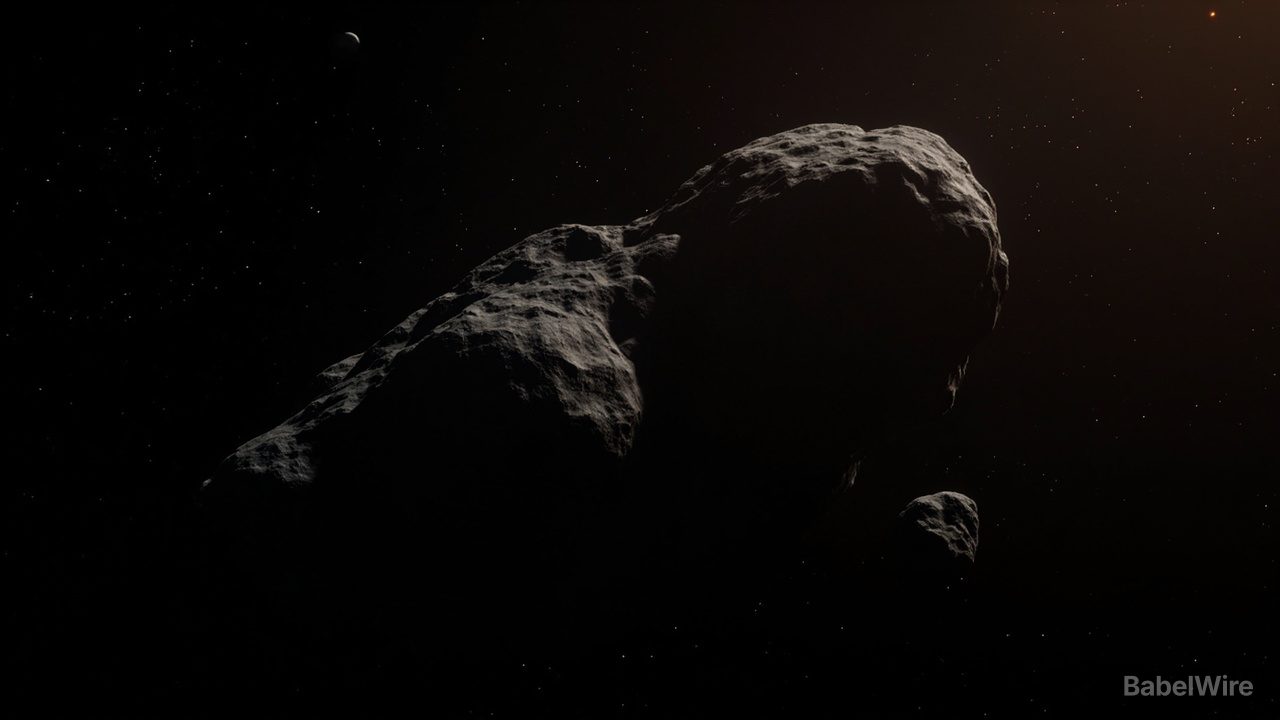
Astronomers have imaged what they believe is the first-known "trilobate" — or three-headed — asteroid in the solar system: (44) Nysa, a resident of the main asteroid belt between Mars and Jupiter. Though Nysa was first spotted in 1857, it took new observations with the Very Large Telescope in Chile and the Large Binocular Telescope in Arizona to resolve its bizarre shape.
The asteroid appears to be about 47 miles (75 kilometers) in circumference at its widest point, with two narrow "necks" connecting three rounded lobes — a shape unlike anything seen before among asteroids. Even more striking, the observations resolved a tiny moon, designated S/2026 (44) 1, roughly 0.6 miles (1 km) wide, orbiting Nysa at a distance of about 106 miles (170 km).
"The images reveal a remarkably unusual object," said Kate Minker of Arizona's Lowell Observatory, who led the work. "The most likely explanation is that Nysa is either a contact trinary, consisting of three connected components, or an extremely irregular coherent body unlike anything we've previously observed." Double-lobed "contact binary" asteroids are known — Japan's Hayabusa2 spacecraft photographed one during its mission — but a triple-lobed body would be a first.
Nysa belongs to a class of asteroids believed to have formed closer to the inner solar system, meaning its composition may resemble the building blocks that came together to form the inner planets. Studying odd objects like it helps scientists refine models of how the planets took shape more than 4.5 billion years ago.
For astronomers, the finding is also a reminder of how much of the solar system remains unseen: a world catalogued for 169 years still had a surprise in store once telescopes were pointed at it with enough resolution.