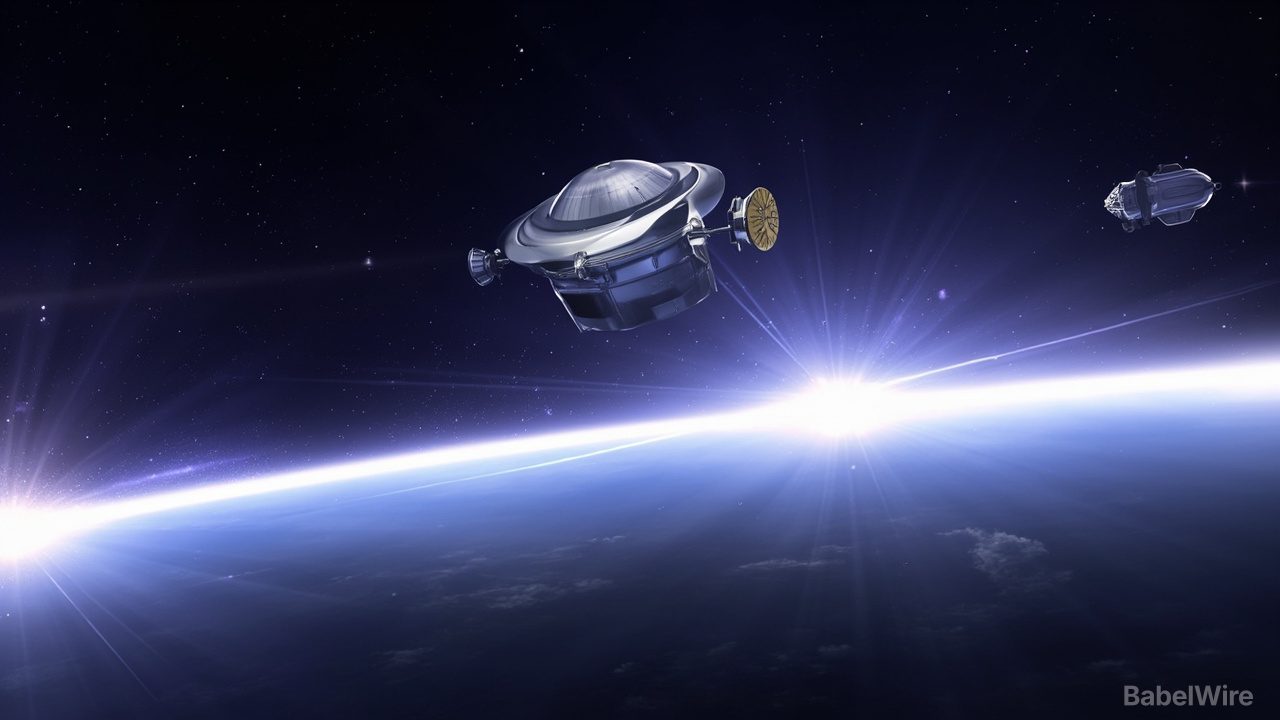
Three NASA-supported small spacecraft launched on Thursday aboard a SpaceX Falcon 9 from Space Launch Complex 4 East at Vandenberg Space Force Base, California, riding the company's Transporter-18 commercial rideshare mission. Each is doing something a shoebox-sized satellite was not expected to do a decade ago.
The first, the ASCENT Propulsion Dual Mode CubeSat, will demonstrate two forms of propulsion on one spacecraft. A single chemical thruster handles high-power manoeuvres; four electrospray thrusters handle low-power operations. Both run from a common supply of Advanced Spacecraft Energetic Non-Toxic (ASCENT) propellant — a low-toxicity fuel that is safer to handle during ground processing and has 50 percent higher specific impulse density than conventional propellants such as hydrazine. NASA's Marshall Space Flight Center leads the mission with MIT, Georgia Tech and Rubicon Space Systems.
The second is the one astronomers will watch. The Supernova Remnants and Proxies for ReIonization Testbed Experiment — SPRITE — is NASA's first astrophysics CubeSat able to detect a specific band of ultraviolet light that cannot be observed from the ground, because Earth's atmosphere blocks it. From orbit, SPRITE will examine how gas, dust and high-energy radiation move through galaxies and escape into the space between them. Its target is one of the biggest open questions in cosmology: what reionised the opaque, neutral fog of hydrogen that filled the early universe, clearing the way for light to travel as it does today. SPRITE measures 13.5 inches long by about 9 inches wide and high, yet uses highly sensitive detectors, specialised mirror coatings and an innovative telescope design that NASA says could match the performance of much larger instruments. It was built and will be operated by the University of Colorado Boulder's Laboratory for Atmospheric and Space Physics, and has a one-year mission observing star-forming regions and supernova remnants in and near the Milky Way.
The third, the Small Spacecraft Propulsion and Inspection Capability (SSPICY) mission, points at the growing problem of orbital debris. Starfish Space will operate its Otter 24C spacecraft to approach and inspect up to four inoperable US satellites in low Earth orbit, gathering data on surface condition, geometry and orbital characteristics. It will test new propulsion, autonomous guidance, navigation and control, an articulating robotic boom for directing thrust, and computer-vision navigation for safe proximity operations. The mission is expected to run about two years, with inspections beginning in 2027.
The three flew on a commercial rideshare, a model NASA uses to give selected CubeSat missions a cheap route to orbit: the agency's CubeSat Launch Initiative picked the ASCENT demonstration in 2024 and SPRITE in 2021, with the Launch Services Program managing the slots.
Why it matters: reionisation is a fundamental puzzle being attacked with hardware the size of a shoebox lid, and in-orbit inspection is a prerequisite for the servicing and debris-removal economy everyone talks about and almost nobody has demonstrated at scale.