M.C. Escher spent his career drawing pictures that look impossible and behave like theorems. A new Quanta Magazine feature examines how those images work, and why mathematicians keep returning to them.
The core of the work is the regular division of the plane. Escher studied the tilings of the Alhambra and set himself the harder version: not just geometric shapes, but lizards, birds and fish that interlock without gaps or overlaps. The result is a practical intuition for symmetry groups and orbital structure that he reached without ever taking a course in them.
He went further with hyperbolic geometry. In the Circle Limit prints he placed ever-shrinking figures along the curves of the Poincare disk, a model he learned about through correspondence with the mathematician H.S.M. Coxeter. The prints became a visual rendering of a non-Euclidean space that most readers of his work will never see written as an equation.
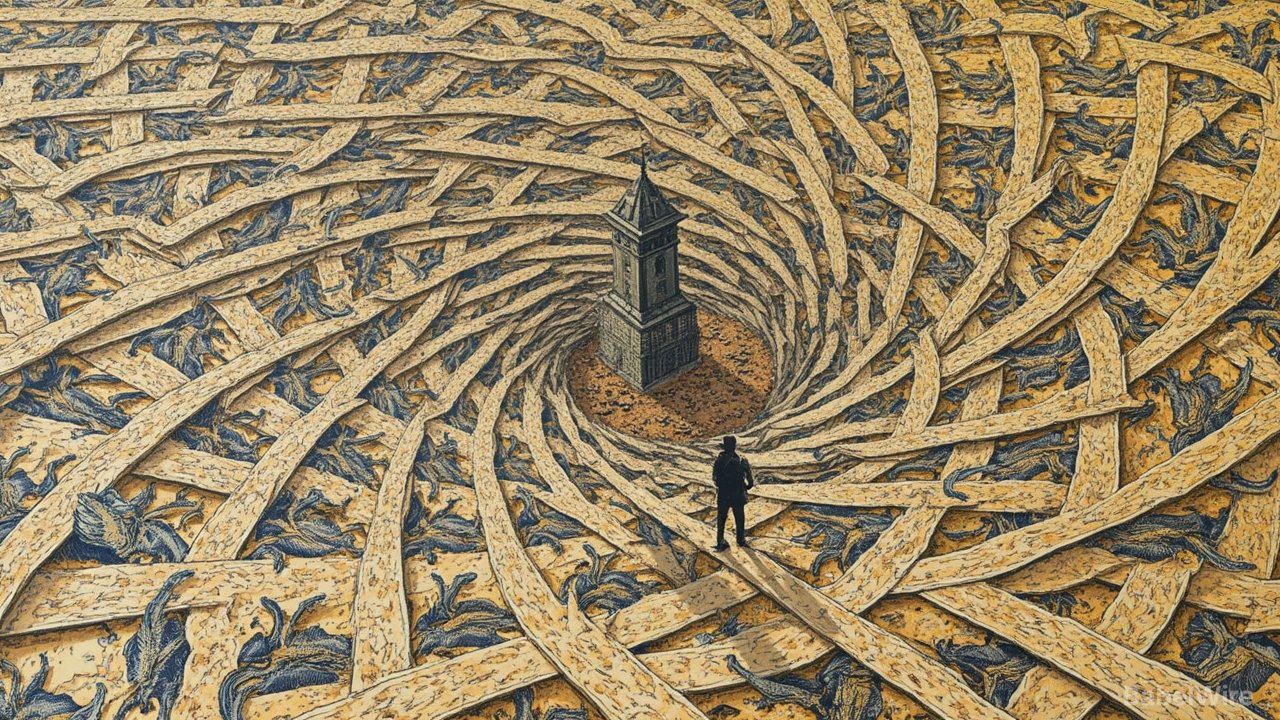
Other images invert that relationship: impossible objects such as tribars and impossible cubes, forms Escher drew before Roger Penrose's tribar became widely known, rely on local consistency and global contradiction. Prints like Drawing Hands and Print Gallery turn the drawing itself into its own subject, a recursion that later mathematicians and computer scientists would recognise as self-reference.
That is the through-line of the feature: Escher was not illustrating mathematics he had been taught; he was finding, by eye, structures that formalism arrived at later. The pictures endure because they do double duty, popular art on the wall and a diagram on the blackboard.