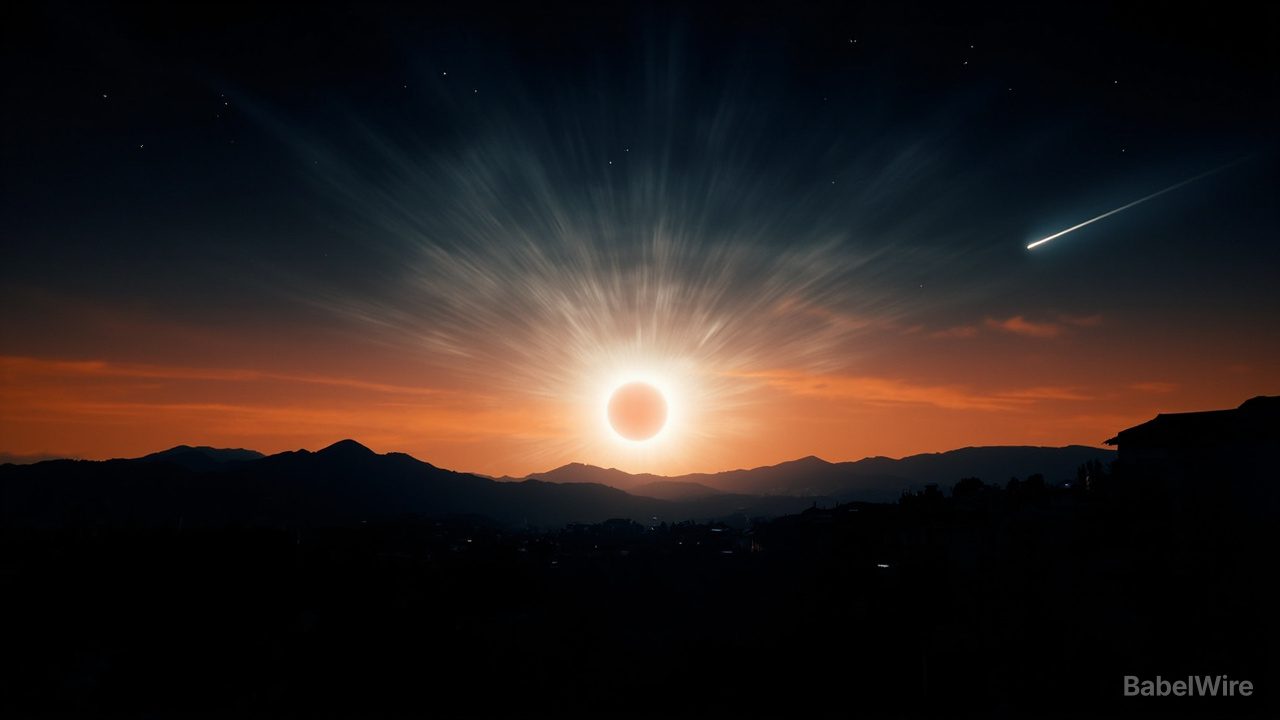
The countdown is on for one of the most anticipated celestial events of the decade. On August 12, a total solar eclipse will darken the sky along a path stretching from the Arctic to the Iberian Peninsula — and for the first time in more than a century, the Moon's shadow will cross mainland Spain.
Daytime darkness will descend close to sunset across northern Spain and slivers of Greenland and Iceland. The Moon's umbra will race along a 5,130-mile (8,260-km) course in about an hour and a half, most of it over the Atlantic. Totality peaks at two minutes and 18 seconds off Iceland's west coast, but by the time the shadow reaches Spain it will have dwindled to about a minute — a brief but dramatic curtain call as the Sun sinks toward the horizon.
Hundreds of millions more will see a partial eclipse. Coverage reaches 94 percent in Dublin, 83 percent in Oslo and 18 percent in Montreal, tapering to 9 percent in New York, with the spectacle visible from Alaska and Siberia across Canada, the northern United States, much of Europe and West Africa.
The eclipse shares its day with a crowded sky: six planets will line up in an arc before dawn, and the Perseid meteor shower peaks that night under a new moon — streaking meteors could even photobomb totality.
Scientists are treating the event as a flying laboratory. NASA will stream it live, and the European Space Agency will webcast from Spain's Javalambre observatory with a public celebration in León. U.S. college teams are launching more than 60 high-altitude balloons from Spain and Iceland to study how the Moon's shadow chills the atmosphere, while a NASA aircraft will chase totality at 460 mph (740 kph) to stretch viewing time to nearly three minutes.
For Spain, this is only the opening act. On August 2, 2027, an even longer total eclipse — up to six minutes and 23 seconds of totality — will sweep from southern Spain across North Africa to the Middle East, followed by a ring-of-fire eclipse on January 26, 2028. As ESA science director Carole Mundell put it, "It's also a very human moment."