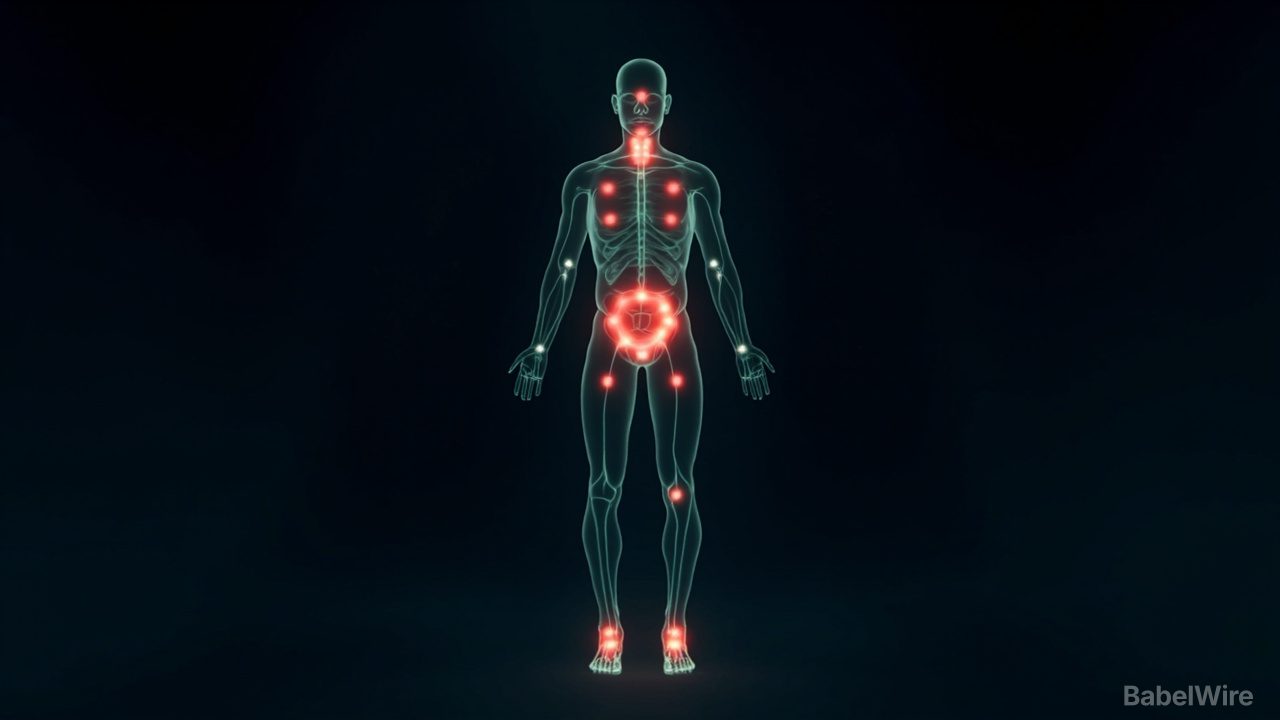
Ask people from Amsterdam, Athens or Shanghai where they're ticklish and you will get strikingly similar answers. Two neuroscientists at Radboud University in the Netherlands recruited 448 participants from Dutch, Greek and Chinese cultural backgrounds, asked them about their experiences of tickling, and had them colour in body maps of where they feel the sensation. The result: nearly everyone tickles, nearly everyone is ticklish, and the hotspots — neck, armpits, belly and soles of the feet — were highly consistent across cultures and individuals, according to the study published on 10 August in Nature Human Behaviour.
"Ticklishness seems to be its own class, physiologically and psychologically," said first author Ziliang Xiong. "It doesn't seem that it is only a by-product or the integration of other body sensations." When the researchers compared the tickle maps with maps of pain and pleasurable touch, the sensation came out as decidedly distinct — not a blend of the two. Ticklishness also proved stronger in areas that are rarely touched, hinting that the body may flag unexpected contact in vulnerable regions.
The study distinguishes between two types of tickling: gargalesis, the strong, repetitive, play-associated pressure that triggers laughter and squirming, and knismesis, a feather-light touch that doesn't produce laughter and is studied partly because of its similarity to itching. The authors say the work lays groundwork for standardized research into what Michael Brecht, a neuroscientist at Humboldt University in Berlin who studies ticklishness in rats and humans, calls "a really very poorly understood sensation."
The universality of the maps is all the more notable because how people interpret emotionally processed touch — a hug, for instance — can differ sharply across cultures. Tickling, by contrast, appears to be shared. That makes evolutionary sense: tickling and the laughter it provokes are found across species, from great apes that tickle each other to rats and meerkats that respond to human tickling, suggesting a very old, deeply wired role for the sensation in play, bonding and social signalling. The next question — why the body is wired this way at all — is one the researchers hope systematic, standardized studies will finally answer.
Sources
- nature.comWhere are you ticklish? Researchers map the sensation across cultures — Nature
- nature.comHuman ticklishness is a widespread, culturally shared sensation — Nature Human Behaviour
- phys.orgTicklish spots are shared across cultures, but why they are remains complex — Phys.org
- theconversation.comThe experience of tickling is the same across cultures — The Conversation