NASA's TESS mission was designed to find planets by watching stars dim as planets pass in front of them. Eight years into the mission, it has now found a planet in a completely different way: by watching a distant star's light bend.
The planet, named Gaia23bra b, is the first gravitationally bound microlensing planet discovered using TESS data. It is a super-Jupiter, about 1.63 times as massive as Jupiter, orbiting an orange dwarf star of roughly 80 percent the Sun's mass at a distance similar to Jupiter's orbit around the Sun. The system lies about 14,000 light-years away.
"When TESS launched, no one expected it to ever be capable of finding this kind of planet," says Diana Dragomir, professor at the University of New Mexico. "The discovery implies that there are probably other microlensing planets hiding in TESS's data that we hadn't previously thought to look for."
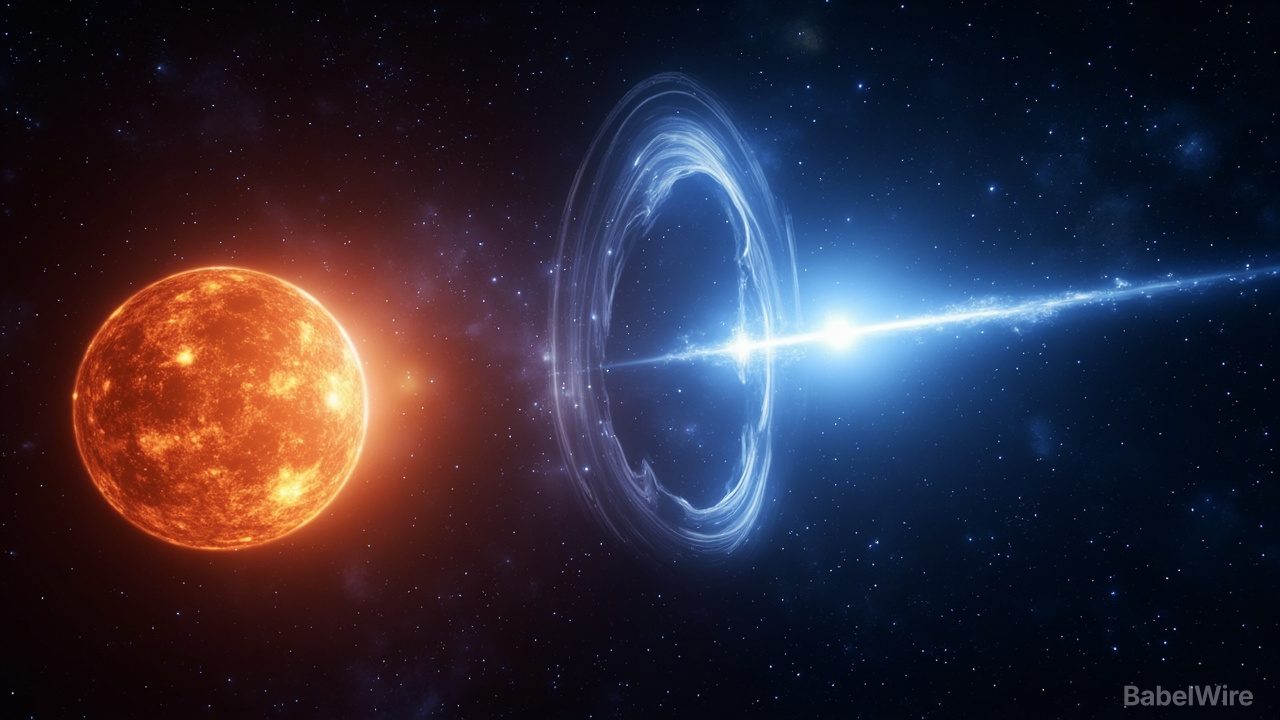
The story begins in 2023, when ESA's now-retired Gaia telescope spotted a microlensing event: the gravity of a foreground star and its planet bent and magnified the light of a more distant background star. Gaia's observations were too sparse to reveal a planet, but University of New Mexico PhD candidate Mallory Harris and colleagues realized TESS had been watching the same patch of sky every 200 seconds for nearly 60 days — and its denser light curve contained the planet's fingerprint.
"Despite this extensive coverage, Gaia23bra b represents the first definitive microlensing planet discovered using TESS data," Harris says.
The discovery matters beyond the trophy: microlensing is uniquely sensitive to planets on wide orbits — the kind of architecture found in our own solar system — and it is currently the only technique capable of routinely finding Earth-mass planets at Earth-like orbital distances. Only about 5 percent of the more than 6,000 known exoplanets were found this way, almost all from ground-based surveys.
Gaia23bra b also serves as a case study for NASA's Nancy Grace Roman Space Telescope, slated to launch in fall 2026. Roman will stare at the center of the galaxy and is expected to reveal roughly 1,000 microlensing planets — and, the team hopes, the first Earth analogs. "Microlensing events happen once and they're gone," Harris jokes. "We'll probably find the first Earth analog with microlensing, and then wave at it as it goes by because we'll never see it again."
Sources
- eurekalert.orgEurekAlert / NASA: NASA's TESS Mission finds planetary system in a new way
- iopscience.iop.orgThe Astrophysical Journal Letters: TESS's First Bound Microlensing Planet
- universetoday.comUniverse Today: Bending Spacetime Reveals New Planet Hidden in Archived TESS Data
- exoplanetarchive.ipac.caltech.eduNASA Exoplanet Archive: 2026 Exoplanet Archive News