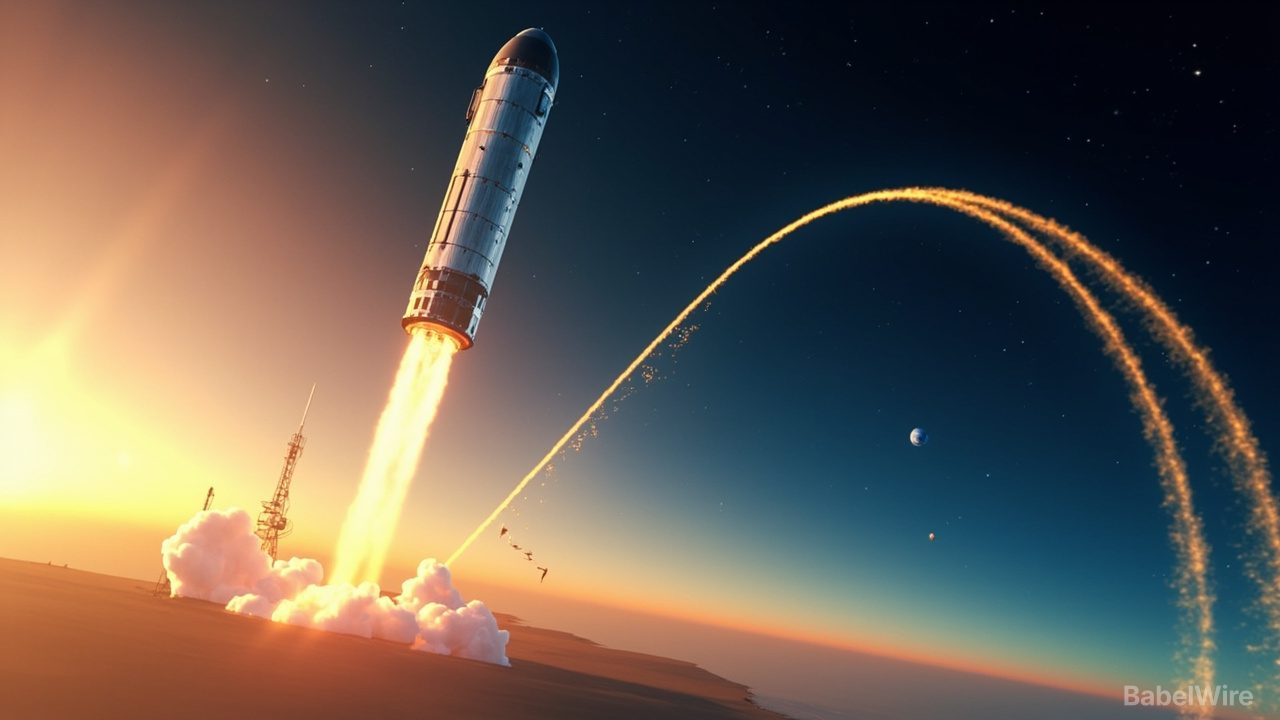
SpaceX spent more than three years proving Starship can get to space. On September 28 it set out to prove it can stay there.
Flight 14, the vehicle's 14th test, was targeted for liftoff from the company's Starbase pad in Texas as early as 8:15 a.m. ET, inside a 75-minute window closing at 9:30 a.m. The goal is qualitatively different from every flight before it: instead of a straight-up, straight-down suborbital arc - what SpaceX calls intentionally passively safe trajectories - the ship was to fly sideways fast enough, about 17,500 mph, to fall around the curve of the Earth and keep falling.
The plan calls for six laps of the planet, roughly a 10-hour mission, at an altitude of about 170 miles - below the International Space Station - and the first operational deployment of Starlink V3 satellites, 26 of them. Three will carry cameras to watch the ship and its heat shield. To come home, Starship must fire again to leave orbit, re-enter and splash down in the Pacific west of Chile. Flight controllers kept the option to skip the orbital burn and let the ship arc back down into the Indian Ocean if the vehicle looked unhealthy.
The 400-foot stack, powered by 33 Raptor engines and roughly 10 million pounds of thrust, is the centrepiece of NASA's Artemis lunar landing architecture and of Elon Musk's Mars ambitions. Going to orbit is also the precondition for rapid reuse: a ship that cannot stay up cannot come back to be refuelled and flown again.
The technical risk is concentrated in the long soak. Systems that survive a one-hour hop must now hold up across ten hours of thermal cycling, and the heat shield faces the same punishing reentry the programme has struggled with before. The company also has to manage 26 live satellites in the middle of a test flight, a first.
Whatever the outcome, the attempt marks the end of Starship's test-as-sideshow era. The next phase is payloads, satellites and contracts - and, for NASA, a lander that still has to be demonstrated.
Sources
- mashable.comMashable: Can SpaceX's Starship actually loop Earth six times? Watch it live
- tech.yahoo.comYahoo Tech: Can SpaceX's Starship actually loop Earth six times?
- archyde.comArchyde: Starship could make history on next launch. Watch SpaceX mission live
- nerranetwork.comNerra Network: Starship will attempt its first sustained orbit on Monday