Starlink's pitch is that it is hard to take down. The satellites are in low orbit, there are thousands of them, and a dish on a roof does not depend on a local mast. That pitch is true about the space segment and considerably less true about the ground segment, which is where this story lands.
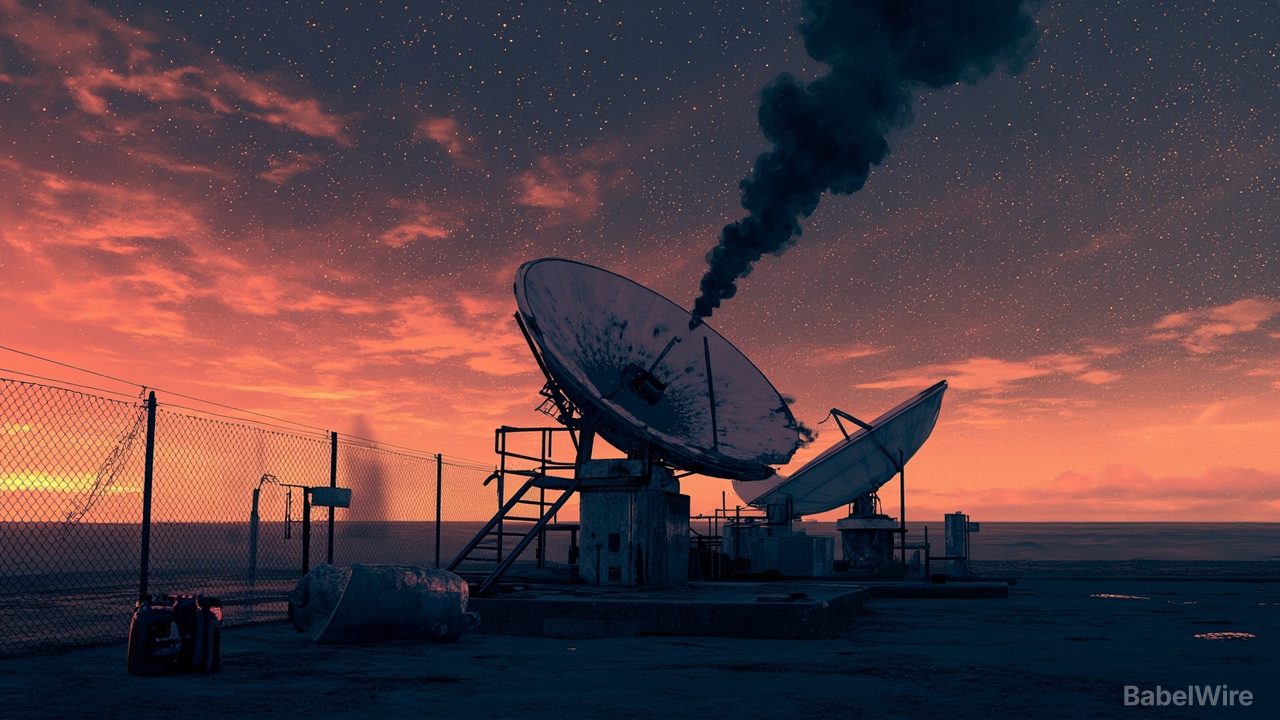
Golem reports arrests after a fire at a Starlink ground station, with investigators following a trail into criminal circles. The specifics are still thin — arrests are not convictions, and a motive has not been established in what has been reported. But the pattern the report points to deserves a precise name, because it is becoming a feature of infrastructure attacks in Europe.
A Starlink gateway is a modest piece of real estate with an outsized role. It is where the constellation meets the terrestrial internet: antennas, power, cooling and fibre backhaul. Take one out and you do not degrade service for one user; you remove a region's path to the network. A user terminal is one link. A gateway is a junction. Junctions are cheaper to attack than constellations, and they cannot be replaced by launching more satellites.
The "criminal circles" detail is the part worth attention. Infrastructure sabotage has been drifting toward a subcontracting model: rather than a state running an operation, someone pays people who do not need to know who is paying or why. Arson is cheap, deniable and available. That structure is harder to deter than a state actor with attributable assets, harder to attribute than a military unit and — crucially — harder to prevent, because the person lighting the fire may have no political motive at all. They may have been paid a few hundred euros.
The resilience lesson follows directly. Satellite constellations are designed for redundancy in orbit and are often surprisingly thin on the ground: a limited number of gateways, each a single point of failure for the traffic routed through it. Redundancy in space does not automatically produce redundancy on the ground, because the ground segment is where the economics are thinnest — nobody wants to build three gateways when one carries the traffic.
That is the question this case raises, and it is a design question rather than a policing one: how much physical redundancy does a network that markets itself on resilience actually have, and who is responsible for the parts that stand still?