Bluetooth's broadcast audio — Auracast — has spent three years being a demo and about eighteen months being a product. Heise's Missing Link column asks the question that matters for the accessibility case rather than the consumer one: how far has it actually got?
What it is
Auracast is the broadcast profile of Bluetooth LE Audio. One transmitter sends a single audio stream that an unlimited number of receivers can join — no pairing, no per-person handshake, no cap on how many people listen. A phone, a TV, or a venue's transmitter broadcasts; earbuds, hearing aids and phones listen. Discovery ranges from an "Auracast assistant" in a phone's Bluetooth settings to a QR code printed on a ticket.
For accessibility, that is the most interesting thing to happen to assistive listening since the telecoil.
Why the incumbent is creaking
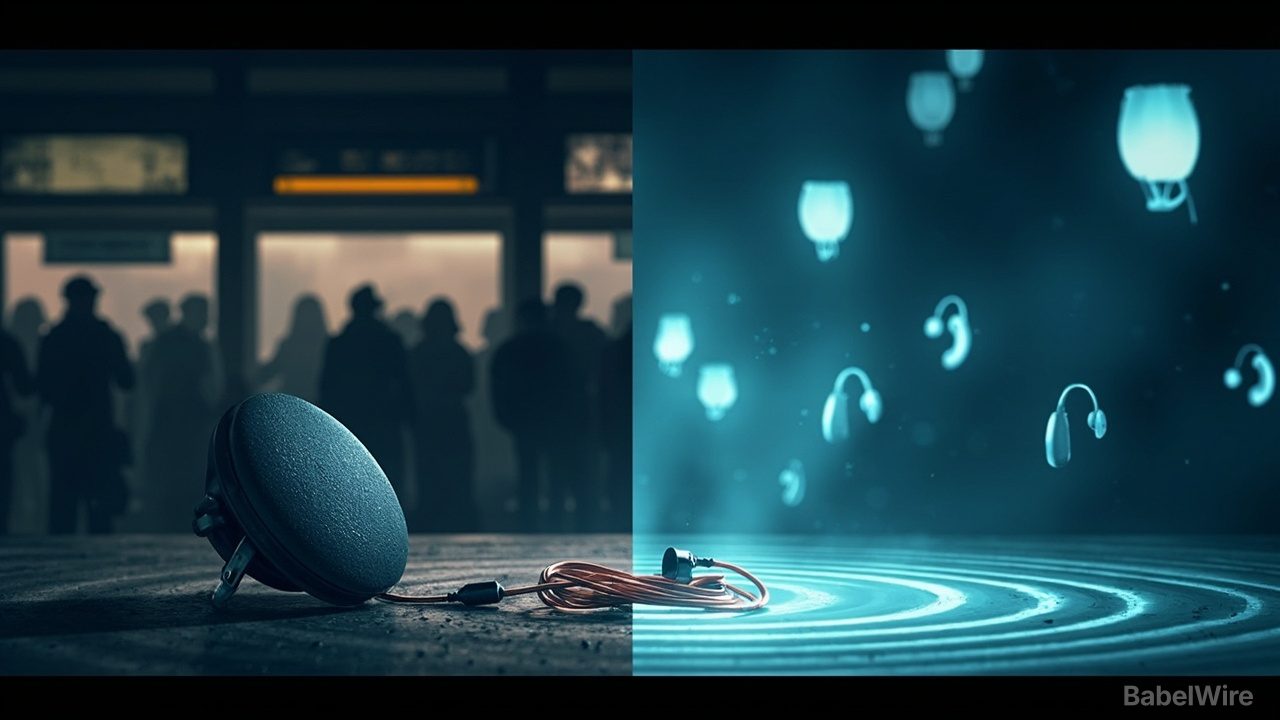
The hearing loop — the telecoil system in theatres, ticket counters, places of worship and taxis — is a remarkably good piece of engineering. It is cheap for the listener, because the receiver is a coil already inside the hearing aid, and it needs no battery, no app and no login. It works when the network is down. Its weakness sits on the other side of the counter: a loop costs a venue money to install, more money to fix when it silently degrades, and it fails invisibly. A broken loop is indistinguishable from a working one until someone with a hearing aid stands in the wrong spot and says nothing, because the alternative is making a scene.
Auracast attacks precisely that weakness. A transmitter is a small box, not a wiring project. Coverage is a radio problem rather than a copper problem. Failures are visible: if nothing shows up in the assistant, it is broken. And the receiver side is already in people's pockets — the earbuds they bought for the commute can double as an assistive listening device.
Where it actually stands
The receiver side arrived first, which is the normal order and the wrong one for accessibility. Earbuds, a growing set of hearing aids and flagship phones ship with Auracast support. Transmitters are the lag: airports, theatres, gyms, stations, lecture halls and places of worship have to buy something, install it, give the broadcast a name a human can recognise, and then tell people it exists.
Three bottlenecks, in order of stubbornness:
**Money and mandate.** Accessibility hardware spreads when a code requires it, not when it is nice. Building codes and accessibility regulations in many jurisdictions name the hearing loop specifically; a new radio standard is not grandfathered into a clause written in the 1990s. Until Auracast appears in procurement language and standards, a venue that has already met its obligation has no reason to spend again — even if the new thing is better and cheaper to run.
**The join experience.** A hearing loop is invisible in the best sense: you walk in, you switch your aid to T, it works. Auracast asks the user to find a broadcast, pick the right one out of those in range, and understand what the name means. That is three concepts standing between a person and the audio. Public deployments live or die on whether that has been solved with signage, a QR code at the door and sane naming — "Main Hall — English" rather than "AU_8823".
**Trust in the word "ready".** Marketing got ahead of certification. Devices and venues described as Auracast-capable may not interoperate with each other, and a user who has been burned once does not try twice.
The clock problem
There is a structural trap here worth stating plainly: consumer audio features and accessibility features ship on different schedules. Broadcast audio was launched as a sharing feature — listen to the same thing as the person next to you — because that is what sells earbuds. The accessibility use case is a compliance use case, and compliance moves at the speed of standards committees, procurement cycles and building codes, which is to say slowly, and in five-year blocks.
That is not a reason to be pessimistic. It is a reason to be precise about what "how far is Auracast?" means. Technically it is here and it works. Commercially, on the consumer side, it is arriving. Institutionally — the only side that matters for a person who cannot hear the announcement at gate B — it has barely started, and it will not finish on its own.
What to watch: whether Auracast gets named in accessibility procurement rules; whether hearing-aid makers ship it across the range rather than only in flagships; and whether any large venue operator publishes real deployment numbers instead of a pilot photo.