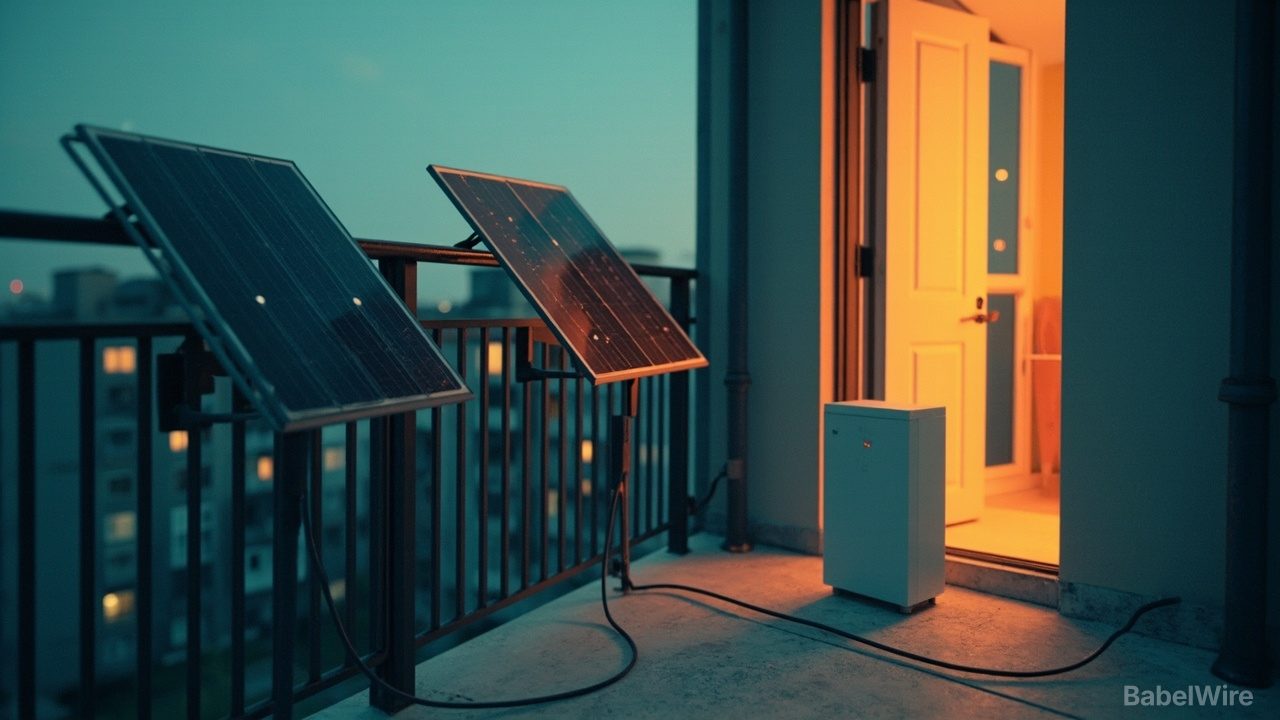
Bluetti's Balco 260, tested this week by heise online, belongs to a growing class of German balcony-solar accessories: a battery that sits between the panels and the wall socket. The detail worth noticing is not the capacity. It is that the unit can also be charged from the mains.
That single feature changes what the product is for. Germany's plug-in solar boom rested on a simple economic fact: with feed-in remuneration for balcony systems effectively at zero, every kilowatt-hour exported to the grid is a kilowatt-hour given away. The only return comes from consuming your own generation, and households are not home at midday. Storage exists to move solar noon into the evening.
Panel-only charging keeps that logic intact — a battery sized to the array, filled by the array, empty on a grey January week. Mains charging breaks it open in two directions. It lets the battery absorb cheap hours on a dynamic tariff and discharge them during expensive ones, and it keeps the unit useful in the months when a balcony produces almost nothing.
The economics then rest entirely on numbers a review can only partly supply. Round-trip efficiency on AC charging comes first: at typical lithium iron phosphate figures, roughly a tenth of the energy is lost in conversion — fine for arbitrage against a large tariff spread, hopeless against a small one. Standby draw is second. A permanently connected inverter idling at a few watts spends a meaningful share of a small battery's output doing nothing across a winter.
Two things capacity cannot fix: a battery does not raise the 800-watt feed-in limit that governs plug-in systems in Germany, and a grid-tied unit that also promises backup output needs proper transfer behaviour, not merely a socket. Neither is a reason to skip the category — only to read the measurements rather than the marketing.